 Justin
You don’t need a large budget to start sourcing from Yiwu. For many startups and small businesses, the real challenge is finding a way to test products and validate a niche without committing thousands of dollars upfront or being locked into high minimum order quantities.
This article breaks down practical strategies for sourcing with a budget between $1,000 and $5,000. We’ll cover how to work with a minimum viable budget of $500 to $1,500 for a lean test, the tactic of buying ‘spot goods’ to bypass MOQs, and how to use group buys and sample orders to access wholesale pricing with minimal capital. You’ll learn how to start with small batches, manage costs effectively, and build a supply chain that grows with your business.
The Minimum Viable Budget for Yiwu
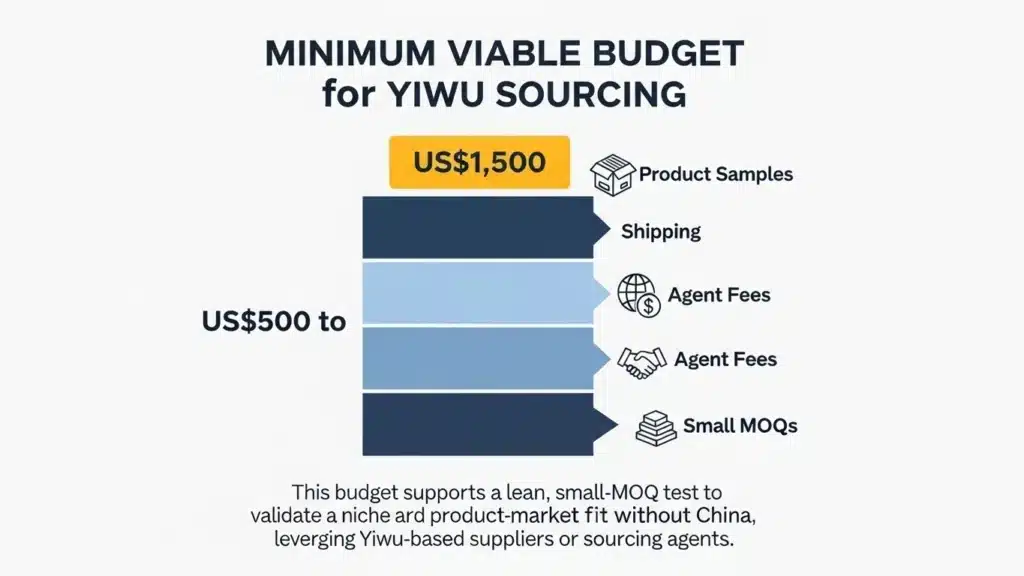
A minimum viable budget for Yiwu sourcing typically ranges from US$500 to US$1,500. This budget is designed for a lean, small-MOQ test to validate a new niche or product-market fit without visiting China, relying instead on Yiwu-based suppliers or sourcing agents that work with low minimums and minimal fees.
| Budget Tier | Typical Scope | Key Considerations |
|---|---|---|
| US$500 | 1-2 SKUs, very low price bands (e.g., sub-US$1 landed cost) | Relies heavily on free-to-start agents and the lowest MOQs; tight constraints on product cost and shipping. |
| US$1,000 – US$1,500 | More SKUs, better pricing negotiation, ability to absorb shipping variances | Offers practical flexibility for testing; keeps capital risk low while allowing for more robust small-batch tests. |
What a Minimum Viable Budget Means for Yiwu Sourcing
A minimum viable budget for Yiwu typically ranges from US$500 to US$1,500 for a lean, small-MOQ sourcing test, ideal for testing a new niche or starting as a novice.
This budget assumes you are not visiting China in person and instead rely on Yiwu-based suppliers or sourcing agents that accept low MOQs with no or very low setup fees.
It’s designed for cross-border e-commerce sellers, small wholesalers, and micro-brands to test product-market fit with minimal capital at risk.
How Small MOQs and Agent Services Shape Your Budget
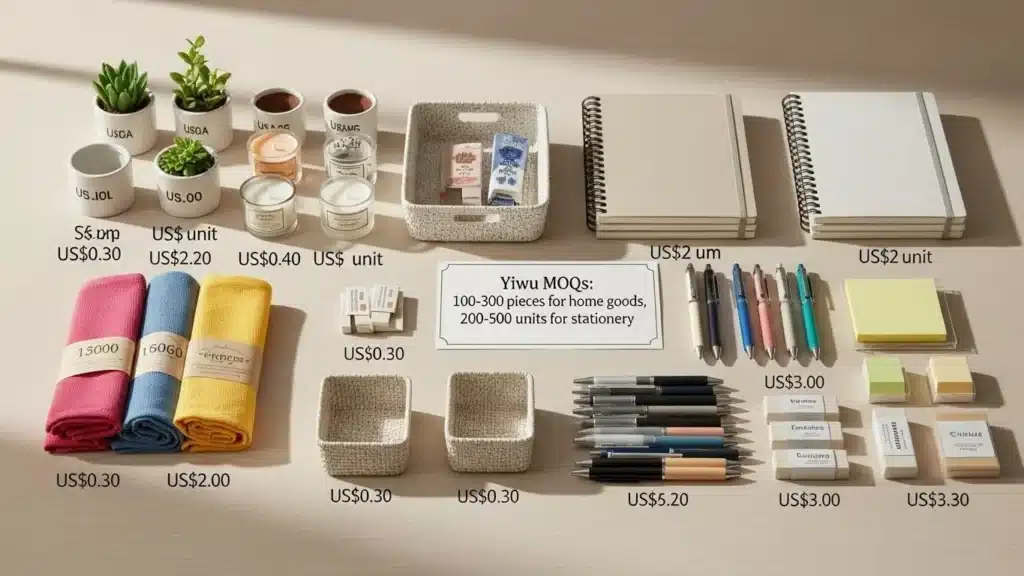
Yiwu’s common MOQs—such as 100–300 pieces for home goods or 200–500 units for stationery—keep initial product costs low, often between US$0.30–US$3 per unit.
Sourcing agents like JingSourcing and CJdropshipping are critical for small budgets, offering services with no setup fees, no monthly fees, and commission-based pricing to handle orders as low as a few hundred dollars.
Using an agent allows you to access supplier search, quality control, consolidation, and logistics management without the high upfront costs of factory-direct sourcing.
A Practical Budget Breakdown and Spending Thresholds
A lean test budget of US$500–US$1,000 typically allocates 60–75% to product cost, 15–30% to international shipping and handling, and 5–15% to agent commissions, QC, and incidentals.
At around US$500, you are typically limited to 1–2 SKUs in very low price bands and must rely on the most accessible agent models.
A budget of US$1,000 to US$1,500 provides more flexibility, allowing you to test more SKUs, negotiate better pricing, and absorb unexpected shipping costs while keeping capital risk low.
Buying “Spot Goods” (Inventory) to Bypass MOQ
Buying “spot goods” bypasses MOQ by purchasing from suppliers’ existing ready-to-ship stock rather than custom production runs requiring minimum quantities. This strategy allows low-budget startups to test niches with minimal capital risk, enabling orders as small as 1-100 units.
What Spot Goods Are and Why They Work for Startups
Spot goods are off-the-shelf inventory from suppliers’ existing stock, not custom production runs. This strategy bypasses typical 500-5000+ unit MOQs, allowing orders as small as 1-100 units.
It’s ideal for testing a niche with minimal capital risk, fitting a budget as low as $500 for 10-50 units. Key benefits include reduced upfront costs, faster fulfillment (1-7 days), and lower inventory risk.
How to Source Spot Goods and Negotiate Effectively
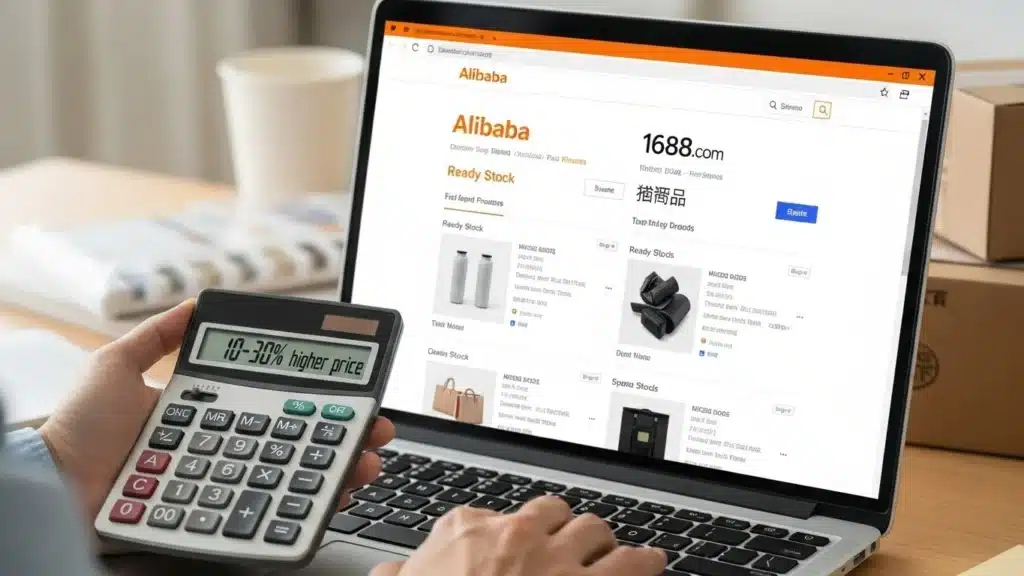
Use platforms like Alibaba or 1688.com with filters for “ready stock” or “现货” (spot goods). Be prepared to offer a 10-30% higher per-unit price to secure a below-MOQ lot and cover the supplier’s fixed costs.
Work with traders or intermediaries who aggregate small orders to meet MOQs and sell you a spot portion. Target factories after peak seasons to buy excess inventory at a discount. Always inspect samples and use verified supplier platforms to manage quality variability.
Comparing Spot Goods to Standard Orders and Mitigating Drawbacks
Spot goods offer faster lead times (days) and lower volume commitment but may have a slightly higher unit cost. Standard MOQ orders provide lower per-unit costs but require large commitments and have long lead times (4-12 weeks).
The main drawback is limited selection; mitigate this by monitoring multiple suppliers weekly. For novices, prioritize categories like apparel or accessories in Alibaba’s “ready to ship” section to start.
Avoiding Custom Molds (Use Stock Designs)
Using stock designs instead of custom molds is a core strategy for low-budget injection molding. Custom tooling costs from $2,000 to over $100,000, which is prohibitive for a startup with a $500 budget. Alternatives like 3D printed molds or on-demand services using shared stock tooling can produce initial batches for under $1,000, allowing you to validate your product with minimal upfront investment.
Why Custom Molds Break a Low-Budget Strategy
Custom tooling is the dominant cost in injection molding, with simple aluminum molds costing $2,000–$5,000 and complex steel molds reaching $20,000–$100,000.
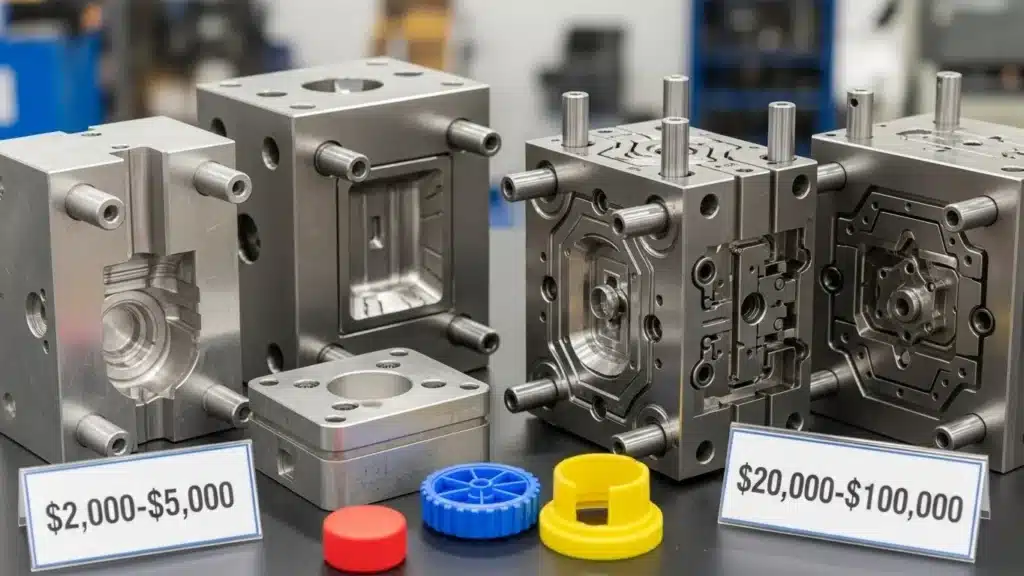
For a startup with a $500 budget, these upfront costs are prohibitive and come with long lead times of 3–8 weeks, delaying market testing.
The initial investment risk is high, as a custom mold locks you into a single design before validating product-market fit.
Practical Low-Cost Alternatives to Custom Tooling
3D printed polymer molds using stock resins cost around $100 and can produce about 100 parts in 1–3 days, fitting a $500 total budget.
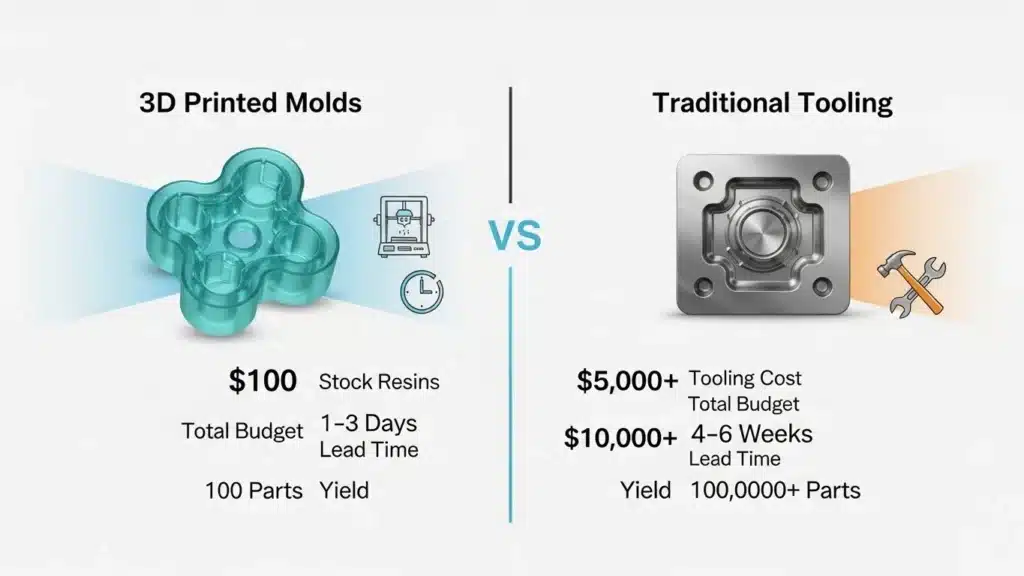
On-demand low-run injection services use shared stock tooling, with total costs of $1,000–$4,000 for 10–100 parts, offering better part durability than 3D printing.
For higher volumes, basic machined aluminum molds with stock profiles cost $2,000–$5,000 and are suitable for 1,000–5,000 unit runs, but exceed a minimal startup budget.
Using stock packaging components, like off-the-shelf cosmetic pumps, can avoid custom mold fees of $12,000 or more, becoming profitable after selling around 50,000 units.
Implementing a Stock-First Sourcing Approach
Start by prototyping with 3D printed stock molds and desktop injection machines, or outsource to platforms offering shared stock tooling services.
Validate your product with small batches of 10–100 units using low-run services before considering any investment in more durable aluminum tooling.
Understand the trade-off: stock designs limit uniqueness but reduce risk. Custom molds for intellectual property are only justified after sales validation, typically around 50,000–100,000 units.

Group Buys: Combining Orders with Other Sellers
Group buys let multiple sellers combine their orders to meet a supplier’s bulk requirements, unlocking wholesale pricing and discounts typically between 10% and 30%. This strategy is a cornerstone of low-budget sourcing, allowing startups with budgets as low as $500 to participate by pooling small orders through online platforms.
How Group Buys Work for Low-Budget Sourcing
Group buys let multiple sellers combine their orders to meet a supplier’s bulk requirements, unlocking wholesale pricing and discounts typically between 10% and 30%.
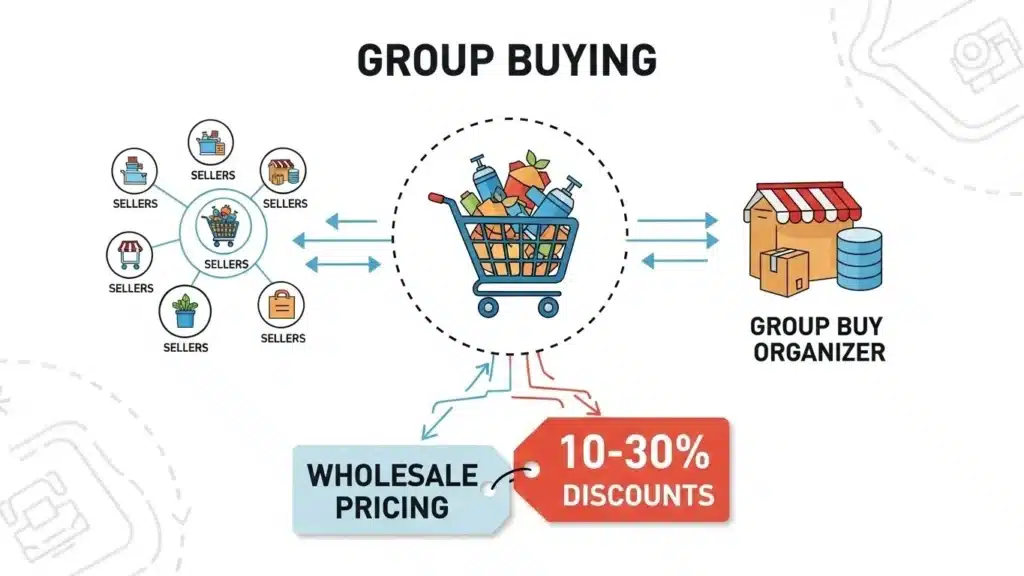
This strategy is a cornerstone of low-budget sourcing, allowing startups with budgets as low as $500 to participate by pooling small orders through online platforms.
For experienced sellers, it’s a low-risk method to test new product niches without committing to a large, individual minimum order quantity (MOQ).
Key Benefits and Market Growth
The primary benefit is direct cost reduction. For example, Group Purchasing Organizations (GPOs) in sectors like healthcare can achieve savings of up to 55% on medical supplies by consolidating demand.
Beyond savings, group buying streamlines procurement. Pre-negotiated contracts can cut sourcing time by 20% to 50%, removing the need for each buyer to negotiate individually.
The model is rapidly growing. The global group buying market was valued at $6.06 billion in 2023 and is projected to reach $20.22 billion by 2031, driven by e-commerce integration and demand for discounts.
Practical Steps to Start a Group Buy
Begin with online group buying platforms, which are ideal for individual sellers. These platforms, similar to Groupon, provide easy access to deals for household goods or travel without managing logistics.
To scale or test B2B niches, connect with community group buying (CGB) networks or formal GPOs. These are effective for categories like fresh food or fast-moving consumer goods (FMCG), where collective purchasing power is strong.
A key challenge is coordinating logistics and ensuring retailer participation. For best results, focus on high-demand product categories and use established platforms in North America or Europe as entry points.
The “Sample Order” Loophole
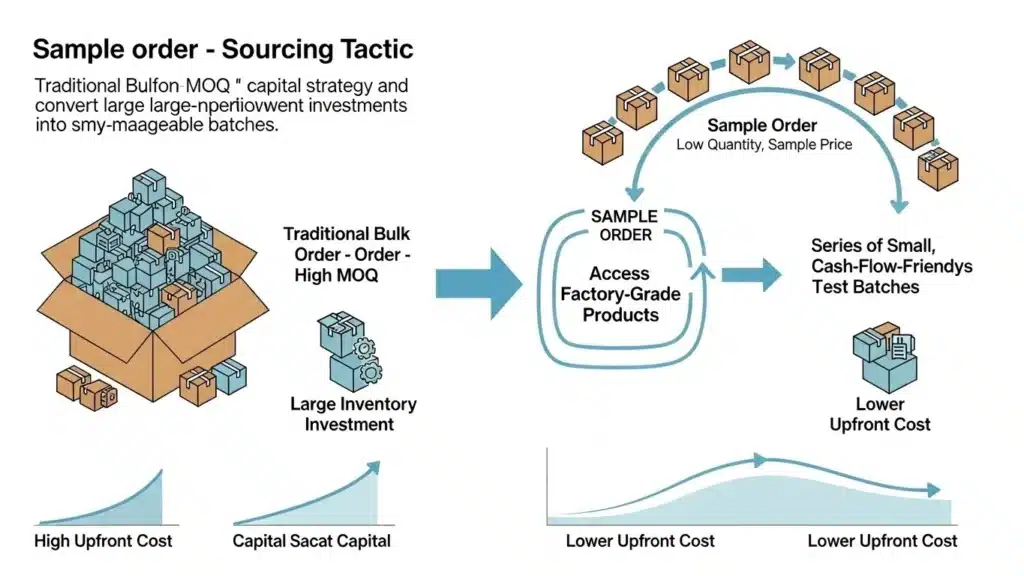
The “sample order” loophole is a sourcing tactic where you repeatedly place low-quantity, sample-priced orders with a supplier instead of committing to a traditional bulk MOQ. This allows you to access factory-grade products with far less upfront capital, converting a large inventory investment into a series of small, cash-flow-friendly test batches.
What the Sample Order Loophole Is and How It Works
This tactic involves placing repeated, low-quantity orders priced as ‘samples’ instead of committing to a traditional bulk MOQ.
It allows access to factory-grade products with far less upfront capital, converting a large inventory investment into a series of small, cash-flow-friendly batches.
In practice, you might order 1–20 units multiple times, selling them at retail to fund the next micro-order, creating a pay-as-you-go inventory model.
Why It’s a Game-Changer for Lean Budgets and Testing
For businesses starting with $2,000–$5,000, this method reallocates the typical 32% product-cost budget into iterative, sub-$500 test batches.
It shifts inventory from a large fixed cost to a variable expense, reducing the risk of dead stock and aligning spending with actual sales.
Quantitatively, it enables validating a single SKU with roughly $300–$800 in total product, packaging, and shipping costs, well below average startup figures.
Practical Applications and Key Limitations
Commonly used on platforms like Alibaba, with domestic wholesalers, and in print-on-demand for rapid product iteration in e-commerce and Amazon FBA.
Suppliers may cap sample orders or expect a move to standard MOQs, and repeated tiny orders can strain relationships if not handled transparently.
Operational limits include higher per-unit costs, shipping fees, and packaging overhead (10–40% of retail price), making it a bridge to negotiated low MOQs rather than a permanent solution.
Frequently Asked Questions
What is the minimum investment for Yiwu?
There is no fixed minimum investment required to start sourcing or doing business in Yiwu, China, as it depends on the business type, such as trading, company registration, or exhibitions. For company registration (e.g., Wholly Foreign Owned Enterprise or Foreign Invested Partnership Enterprise), sources indicate no minimum registered capital requirement, allowing setups with minimal costs like agent fees of $300–500 USD or total initial costs around $2,000 USD. For sourcing and low-budget startups (e.g., micro e-commerce or wholesale from Yiwu markets), you can begin with under $10,000 USD, including product sampling ($2,500–4,000), often validating ideas for $5,200–9,600 using platforms like 1688. Novices can test with $500 via small batches without formal registration, leveraging Yiwu’s wholesale markets. Exhibition participation (e.g., Yiwu fairs) starts at several thousand USD for basic stands.
Can I buy 1 carton of each item?
In most low-budget sourcing scenarios you *can* buy only 1 carton per SKU, but only from suppliers that support low or no minimum order quantities (MOQs). Many traditional wholesalers and factories set MOQs around 5–50 cartons per item or 500–1,000+ units per SKU, which means they will refuse single-carton orders or quote you a much higher unit price. For a $500 test budget, you typically need to work with: (1) online wholesalers or distributors that openly list low MOQs (sometimes even 1 carton or mixed-carton packs), (2) manufacturers that offer “startup” or “sample” runs, or (3) fulfillment/packaging services that let you mix several SKUs into one consolidated carton. When a supplier does allow 1 carton per SKU, expect unit costs to be significantly higher than bulk prices (commonly $0.50–$1.50 per unit on small runs versus $0.20–$0.80 at higher volumes) because you lose economies of scale.
Is LCL shipping expensive?
No, LCL (Less than Container Load) shipping is not expensive; it is typically cost-effective for small shipments under 15 CBM, with 2026 rates ranging from $25–$180 per CBM depending on route, often 30-50% cheaper than FCL for low volumes. LCL rates are charged per cubic meter (CBM) or per ton (whichever is greater), plus fees like consolidation ($100–$300), fuel surcharges (+10-15%), and origin/destination charges. For startups with a $500 budget, LCL suits testing niches if volume is minimal (e.g., 2–5 CBM).
How to start importing with little money?
Yes, but only if you choose very low-capital models like sample-based testing, micro‑batches, or dropshipping/print‑on‑demand instead of a full traditional import business. A conventional import–export operation with licenses, inventory, logistics, and marketing typically requires several thousand dollars; estimates for lean but real inventory-based setups often fall in the $2,000–$6,000+ range. With $500, your realistic goal is to validate products and suppliers, not to build a full import operation. Use $500 to: order 3–10 samples from 1–3 suppliers; test micro‑batches via air freight; pay for basic listings on marketplaces; or run small paid tests on demand (preorders, crowdfunding, or dropshipping). Avoid committing to MOQs that lock most of your capital in one SKU and focus on fast feedback loops instead.
Do I need a warehouse for small orders?
No, you do not need a dedicated warehouse for small orders. Small businesses and startups can effectively handle low-volume fulfillment through in-house methods or third-party logistics (3PL) services without their own warehouse space. For very few orders, manage storage, processing, and shipping using your home, office, or minimal facilities as a low-cost option. Start by sending a small inventory amount to a 3PL fulfillment warehouse to test systems without committing to your own space. For low-budget startups (e.g., under $500), begin with self-fulfillment or minimal 3PL inventory to minimize capital risk.
Final Thoughts
Sourcing from Yiwu with a budget between $1,000 and $5,000 is not only possible but a practical entry point for many startups. The strategies outlined—from leveraging small MOQs and spot goods to using group buys and the sample order loophole—are proven methods to test products and validate your market without a large financial commitment. Your budget isn’t a barrier; it’s a tool for focused, low-risk experimentation.
The key takeaway is to start with a clear, lean goal. Use your initial capital to gather real-world data on what sells, not to build a large inventory. Each small, successful test batch builds your confidence, refines your product selection, and creates a foundation for scaling. By adopting these cost-effective sourcing tactics, you turn a limited budget into a strategic advantage for learning and growth in the competitive world of e-commerce.