 Justin
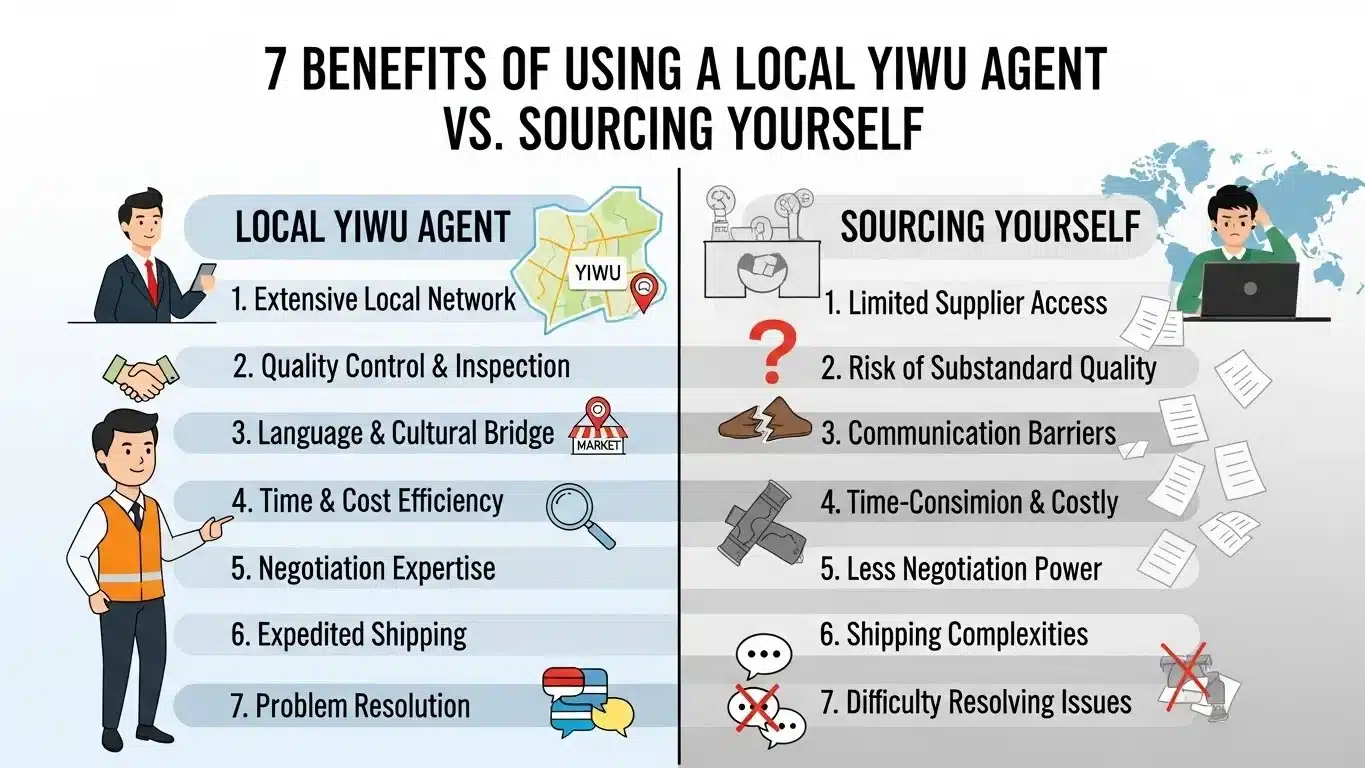
Sourcing directly from Yiwu’s vast marketplace can seem like a straightforward way to cut costs, but the reality for many importers is a maze of hidden risks, logistical headaches, and missed opportunities. The upfront savings of going solo are often erased by quality failures, shipping inefficiencies, and cultural missteps that disrupt your supply chain.

This article breaks down the seven key advantages of partnering with a local Yiwu agent. We’ll compare the direct approach against a professional service, detailing how agents provide access to unlisted factories, secure freight savings of 18-30% through consolidation, and offer real-time quality control on the production floor. You’ll see how these tangible benefits—like leveraging a network of over 5,000 verified factories—translate into lower total costs and a more reliable, scalable sourcing operation.
Industry Manufacturers List
Quick Comparison: Top Picks
| Manufacturer | Location | Core Strength | Verdict |
|---|---|---|---|
| Secure Escrow & Milestone-Based Payments | Industry Wide | Milestone schedules (e.g., 30% deposit / 70% after QC), escrow holding accounts, linked release to third‑party inspection and forwarder confirmations | Reduces risk by structuring payments to align with verified production and shipping milestones. |
| Banking, Currency, and Compliance Risk Management | Global Standard | Clean SWIFT data, correct beneficiary details, LC wording review, compliant invoices and contracts aligned with KYC/AML and sanctions screening | Ensures smooth international payments and avoids fund blockages through expert compliance handling. |
| Chargeback, Dispute, and Fraud Protection | Industry Wide | Factory background checks, blacklists/whitelists, dispute files with stamped contracts, inspection reports, and police/commerce‑bureau records where needed | Pre‑vetts suppliers and provides critical evidence to protect against fraud and win disputes. |
| Cash‑Flow Optimization and Supplier Credit Leverage | Industry Wide | Reduced deposits (e.g., 10–20% instead of 30–50%), open‑account days after shipment, rolling credit limits tied to performance and on‑time payment history | Leverages collective volume to negotiate better payment terms, improving buyer cash flow. |
| On‑the‑Ground Intervention for Urgent Payment Issues | Industry Wide | In‑person verification of production and loading, real‑time renegotiation of balances and discounts, rapid documentation fixes to release goods | Provides local, physical intervention to resolve urgent payment or shipment deadlocks. |
Secure Escrow & Milestone-Based Payments

This approach allows a sourcing agent to structure deals so that buyer funds are held in a controlled escrow or only released in stages against passed inspections and shipping proofs.
This system sharply reduces the risk of paying 100% upfront to a factory that later ships late, ships defective goods, or fails to ship at all.
At a Glance:
- 📍 Location: Industry Wide
- 🏭 Core Strength: Milestone schedules (e.g., 30% deposit / 70% after QC), escrow holding accounts, linked release to third‑party inspection and forwarder confirmations
- 🌍 Key Markets: International trade, import purchasing, cross‑border manufacturing orders
Why We Picked Them:
| ✅ The Wins | ⚠️ Trade-offs |
|---|---|
|
|
Banking, Currency, and Compliance Risk Management

This service focuses on managing the risks associated with cross-border financial transactions. Its agents are experts in handling international wires, letters of credit, and multi-currency payments. They possess critical knowledge about which local banks and payment channels are less susceptible to freezes, delays, or rejections due to compliance issues, helping to ensure smoother fund flows.
The core offering involves structuring payments and preparing documentation to meet stringent anti-money laundering checks, sanctions filters, and local capital-control regulations. This proactive approach is designed to prevent funds from being blocked or stranded in transit, providing a crucial layer of security for transactions in challenging environments.
At a Glance:
- 📍 Location: Global Standard
- 🏭 Core Strength: Clean SWIFT data, correct beneficiary details, LC wording review, compliant invoices and contracts aligned with KYC/AML and sanctions screening
- 🌍 Key Markets: High‑risk countries, emerging markets, large‑value industrial orders
Why We Picked Them:
| ✅ The Wins | ⚠️ Trade-offs |
|---|---|
|
|
Chargeback, Dispute, and Fraud Protection

This service focuses on protecting buyers from supplier fraud and transactional disputes. Reputable sourcing agents, whose own business licenses and reputation are on the line, perform the initial vetting. They screen out factories with patterns of fraud, inconsistent business registration, or a history of unresolved disputes.
When issues do arise, the agent provides critical local support. They gather and supply official documentation, correspondence records, and other evidence. This material directly strengthens a buyer’s position when filing card chargebacks, initiating bank disputes, or pursuing legal claims against a supplier.
At a Glance:
- 📍 Location: Industry Wide
- 🏭 Core Strength: Factory background checks, blacklists/whitelists, dispute files with stamped contracts, inspection reports, and police/commerce‑bureau records where needed
- 🌍 Key Markets: Online B2B marketplaces, unknown or first‑time suppliers, new regions
Why We Picked Them:
| ✅ The Wins | ⚠️ Trade-offs |
|---|---|
|
|
Cash‑Flow Optimization and Supplier Credit Leverage

This model centers on an established agent who aggregates purchasing volume from multiple buyers. By pooling this demand, the agent gains significant negotiating power with factories, securing far more favorable payment terms than any single overseas buyer could typically achieve alone.
The core benefit is financial. The agent’s leverage directly reduces the buyer’s upfront capital commitment. This frees up the buyer’s working capital, allowing them to finance more production or invest elsewhere. Essentially, production runs are funded more by the factory’s or agent’s own credit lines and relationships, rather than draining the buyer’s cash reserves.
At a Glance:
- 📍 Location: Industry Wide
- 🏭 Core Strength: Reduced deposits (e.g., 10–20% instead of 30–50%), open‑account days after shipment, rolling credit limits tied to performance and on‑time payment history
- 🌍 Key Markets: Repeat production runs, seasonal buying, high‑ticket equipment purchases
Why We Picked Them:
| ✅ The Wins | ⚠️ Trade-offs |
|---|---|
|
|
On‑the‑Ground Intervention for Urgent Payment Issues

This service provides direct, in-person intervention when shipments are held at the factory or port due to payment disputes, quality claims, or unexpected extra charges. A local agent physically visits the site to negotiate in the local language and verify what has actually been produced or loaded.
This hands-on approach breaks deadlocks that remote communication often cannot, preventing total loss of deposit, mounting storage fees, and missed critical delivery deadlines. It is a specialized form of crisis management for international trade logistics.
At a Glance:
- 📍 Location: Industry Wide
- 🏭 Core Strength: In‑person verification of production and loading, real‑time renegotiation of balances and discounts, rapid documentation fixes to release goods
- 🌍 Key Markets: Time‑critical projects, just‑in‑time production, retail seasons and product launches
Why We Picked Them:
| ✅ The Wins | ⚠️ Trade-offs |
|---|---|
|
|
Benefit 1: Access to “Hidden” Suppliers (Stock/Factory)
Working with a local partner in Yiwu provides direct access to thousands of factories and wholesalers not listed on major B2B platforms. This direct connection removes middlemen, reduces costs, and gives you control over quality and production, while mitigating risks like “bait and switch” tactics.

What Are “Hidden” Suppliers and Why They Matter
“Hidden” suppliers are factories and wholesalers not listed on major B2B directories like Alibaba, often operating through local networks and trade shows like those in Yiwu.
Accessing these suppliers removes middlemen, reduces costs from hidden commissions, and provides direct control over quality and production timelines.
This direct access mitigates the risk of “bait and switch” tactics, where sample quality differs from bulk orders, by enabling on-site verification and relationship building.
How a Local Partner Unlocks This Network
A partner physically based in Yiwu, like Chineseyiwu.com, provides guides to navigate over 75,000 supplier booths in the Yiwu Trade City, consolidating goods from multiple shops into a single shipment.
They extend beyond the market to a verified network of over 5,000 factories for specialized products, conducting on-site factory checks that online directories cannot provide.
This model offers real-time supply chain visibility, from raw materials to final quality checks, which is critical for proactive management and reducing disruption risks.
The Tangible Business Impact
Multi-tier supplier collaboration, which includes mapping these hidden sub-tier partners, can generate significant annual savings through improved efficiency and lower inventory costs. McKinsey research indicates such collaboration can generate €40-65 billion in annual savings.
Working with a local partner ensures faster response times, leaner inventory through just-in-time practices, and protection of intellectual property during custom manufacturing.
The premium paid for this reliable, consistent access and oversight often results in lower total costs by avoiding delays, material shortages, and complex international shipping issues. Paying for reliable local suppliers ensures stability over low-cost distant options.
Benefit 2: The Power of Consolidation (Save 30% Freight)
Freight consolidation saves 18-30% on shipping costs by combining multiple smaller shipments into larger, more efficient loads. This leverages economies of scale to secure lower per-unit rates from carriers, turning logistical complexity into direct savings.

How Consolidation Turns Small Shipments into Major Savings
Freight consolidation saves 18-30% on shipping costs by combining multiple smaller shipments into larger, more efficient loads.
This leverages economies of scale to secure lower per-unit freight rates from carriers.
For example, consolidating ten weekly LTL shipments into three full truckloads can yield over $72,000 in annual savings.
Beyond Cost: The Additional Advantages of Consolidated Shipping
Consolidation reduces handling, which lowers the risk of product damage and associated claims.
It often results in faster, more reliable transit times; one 3PL case study showed a 1.2-day speedup alongside 12.4% freight savings.
The model is more environmentally friendly, cutting CO₂ emissions by up to 35% per shipment through optimized load efficiency.
Making Consolidation Work for Your Sourcing Strategy
Savings vary by product and volume: international bulky items can see up to 40% savings, while strategic LTL programs typically save 15-20%.
The service acts as a logistical ‘fixer,’ where efficiencies like shared container costs can offset a standard agent service premium.
It’s best suited for compatible shipments with flexible timelines; evaluating your shipment volume and destination is the first step.

Benefit 3: Boots on the Ground QC
Having a local quality control agent physically present on the production floor transforms quality management from a reactive, post-shipment audit into a proactive, real-time process. This boots-on-the-ground approach catches defects as they happen, verifies compliance on-site, and generates reliable data, directly preventing costly rework, reducing risk, and improving your bottom line.

Real-Time Problem Solving on the Production Floor
Our local inspectors are present during production, catching defects, labeling errors, and specification deviations as they happen. This immediate feedback prevents entire batches from being compromised, reducing costly rework and scrap that often goes unnoticed until goods arrive at your warehouse.
We move beyond delayed email reports. Issues are logged instantly from the shop floor with photos and notes, shortening the time between a defect occurring and a corrective action being taken, which is critical for mitigating major quality risks.
Verified Compliance and Process Audits
We conduct on-site verification to ensure factories follow your required processes, maintain hygiene standards, and keep accurate, auditable records. This bridges the gap between paperwork and practice, reducing your regulatory and contractual exposure.
Our team provides localized technical expertise, spotting operational risks and recommending specific, prioritized improvements while production is running. This hands-on assistance translates your quality standards into actionable changes on specific production lines.
Data-Driven Insights and Measurable Outcomes
Our boots-on-the-ground program generates standardized, verified field data. This reliable information feeds into performance models, yielding more accurate insights than remote data collection or factory self-reporting alone.
This validated approach directly links on-site observations to strategic improvements. Coordinated field interventions have demonstrated measurable profit and yield gains by identifying and correcting key management gaps, providing a clear return on your quality investment.
Benefit 4: Native Negotiation (Face Saving)
Native Negotiation refers to a local agent’s ability to conduct talks in a culturally sensitive way that preserves the dignity and social standing of all parties. This is critical in high-context cultures like China, Japan, and across Asia, where direct confrontation or blunt refusal can kill a deal by causing loss of trust.

What Face-Saving Means for Your Business
Native Negotiation refers to a local agent’s ability to conduct talks in a culturally sensitive way that preserves the dignity and social standing of all parties.
This is critical in high-context cultures like China, Japan, and across Asia, where direct confrontation or blunt refusal can kill a deal by causing loss of trust.
For a buyer, it means your local partner handles delicate issues—like price disputes or quality complaints—without embarrassing the factory, which keeps the relationship and your supply chain intact.
How Our Local Team Secures Better Deals
Our agents use subtle language, build rapport through small talk, and understand local etiquette to navigate negotiations where a Western approach might fail.
This cultural adaptation leads to fewer misunderstandings, reduces conflicts, and builds the long-term trust necessary for reliable partnerships.
For urgent issues, our team acts as a local ‘fixer,’ leveraging native fluency and established relationships to resolve problems rapidly, often outpacing an outsider’s efforts.
The Tangible Impact on Novice and Veteran Buyers
For a novice, this service justifies a modest fee by preventing costly cultural missteps that could lead to lost contracts or offended suppliers.
For a veteran importer, it provides a critical on-the-ground resource to handle sensitive renegotiations or production crises, saving significant time and preserving key supplier relationships.
Investing in native negotiation capabilities is a strategic move to de-risk international sourcing, mirroring the benefits of formal cultural intelligence (CQ) training for durable business success.
Frequently Asked Questions
Is it worth hiring a sourcing agent?
Yes, hiring a sourcing agent is worth it for most businesses. They deliver net cost savings, time efficiency, quality control, and risk reduction that often exceed their fee. For novices, agents leverage networks to secure lower supplier quotes and eliminate distributor markups, turning their commission into profit gains. Veterans benefit from having a local ‘fixer’ for real-time oversight and rapid problem-solving. Research indicates procurement costs can drop by up to 15% through an agent’s competitive pricing and total cost analysis.
Can I buy from Yiwu without an agent?
Yes, it’s technically possible, but for most foreign buyers, it’s highly impractical and risky. Without an agent, you face major hurdles: no local warehouse to consolidate goods from multiple suppliers, no export license to arrange compliant shipping, and no one on-site to inspect quality or resolve problems. Language and cultural barriers often lead to overpaying, defects, and logistical nightmares. While experienced importers with fluent Mandarin and local staff can buy directly, even they often use an agent for efficiency, especially when scaling orders or needing multi-supplier consolidation from Yiwu’s 70,000+ booths.
What does a sourcing agent do?
A sourcing agent manages the end-to-end procurement process in international markets like China. Their core responsibilities include finding and vetting reliable suppliers, negotiating prices and contracts, collecting and tracking samples, monitoring production timelines, conducting quality control inspections (e.g., to AQL standards), and arranging all logistics and shipping. They act as your local representative, bridging language and cultural gaps to ensure specifications are met and problems are solved quickly, providing a consistent and reliable buying experience.
How much do sourcing agents charge?
Sourcing agent fees typically range from 3% to 10% of the total purchase value, with some services advertised as low as ~1% for bundled offerings. For most small to mid-size importers, this commission is often offset or exceeded by the better prices, reduced defects, and logistical efficiencies the agent secures. The fee structure is usually transparent and negotiated based on order complexity and volume, contrasting with models that rely on hidden kickbacks from suppliers.
Do agents get better shipping rates?
Agents and freight brokers do not typically secure lower base rates for shippers than booking directly with a carrier. They operate on a commission model, earning a margin (often 10-35%) on the total shipping cost. However, they provide significant value by leveraging carrier relationships and logistics expertise to negotiate favorable rates and handle complex consolidation, documentation, and customs clearance efficiently. For importers, especially those consolidating goods from multiple Yiwu suppliers, an agent’s managed shipping service prevents costly errors and delays, making the total landed cost more predictable and often more effective.
Final Thoughts
Choosing between sourcing from Yiwu yourself or using a local agent isn’t just about cost—it’s about control and risk. While going direct might seem cheaper upfront, the hidden costs of mistakes, delays, and quality failures can quickly add up. A local agent provides a direct line to suppliers you can’t find online, turns logistical headaches into savings, and puts a professional eye on your production line. This oversight protects your investment and your brand’s reputation.
The real value of a local partner lies in turning complexity into a competitive edge. They handle the day-to-day challenges of international trade—negotiating with cultural nuance, consolidating shipments for better rates, and solving problems on the factory floor—so you can focus on growing your business. For most importers, the agent’s fee is an investment that pays for itself through lower total costs, fewer headaches, and a more reliable, scalable supply chain.