 Justin
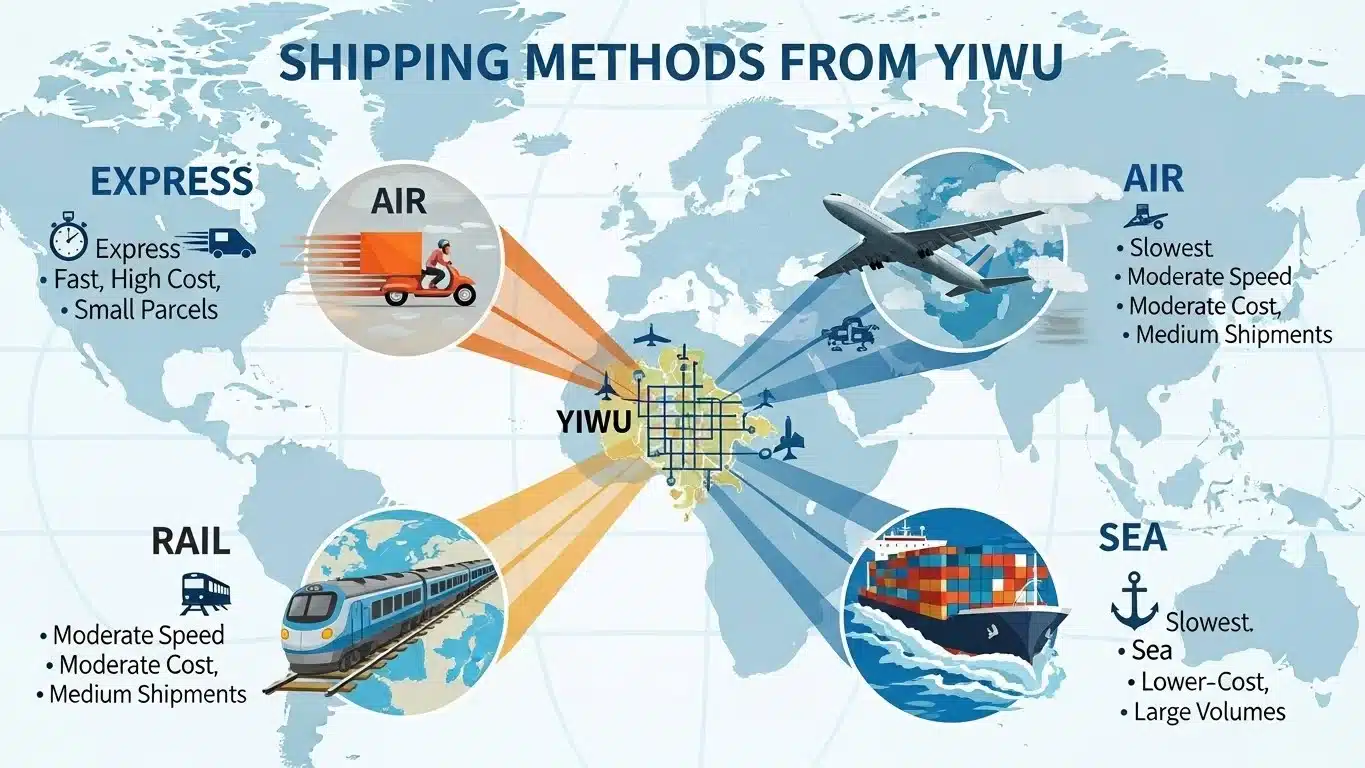
Choosing the wrong shipping method from Yiwu can lock up capital in slow-moving inventory or inflate your landed costs. With options ranging from express courier to sea freight, the decision hinges on your shipment’s weight, value, and urgency.

This guide breaks down the core logistics from Yiwu, comparing express, air, rail, and sea freight. You’ll get specific data, like the 20-day transit and one-fifth-the-air-cost pricing of the Yiwu-Madrid rail route, and learn the critical 70-100 kg weight breakpoint where air freight becomes more economical than express.
Industry Manufacturers List
Quick Comparison: Top Picks
| Manufacturer | Location | Core Strength | Verdict |
|---|---|---|---|
| USPS First-Class Package International | Global (180+ countries) | Lightweight parcels up to 4 lbs | Most affordable for lightweight international parcels under 4 lbs. Ideal for non-urgent, low-value items. |
| USPS Priority Mail International | Global | Parcels up to 70 lbs | Balanced economy service for heavier non-urgent shipments where cost is a priority. |
| UPS Worldwide Expedited | Global (strong in Americas/Europe) | 2-5 lb packages | Reliable mid-tier express service. Best for faster-than-sea but cost-effective needs. |
| FedEx International Priority | Global | Up to 70 lbs packages | Premium express air service for time-critical shipments where speed outweighs cost. |
USPS First-Class Package International

USPS First-Class Package International is the go-to service for sending lightweight packages overseas without breaking the bank. It’s designed for parcels under 4 lbs, making it perfect for e-commerce sellers or individuals shipping small items like books, clothing, or accessories. The service reaches over 180 countries, offering broad global coverage.
This service is built for volume and affordability rather than speed. It handles a massive number of small parcels daily, providing a reliable pipeline for cost-sensitive international shipping. Its capacity is optimized for lightweight goods valued under $400, which aligns with the needs of small businesses and online sellers managing frequent, low-value shipments.
At a Glance:
- 📍 Location: Global (180+ countries)
- 🏭 Core Strength: Lightweight parcels up to 4 lbs
- 🌍 Key Markets: Cost-sensitive e-commerce and small packages
Why We Picked Them:
| ✅ The Wins | ⚠️ Trade-offs |
|---|---|
|
|
USPS Priority Mail International

USPS Priority Mail International is a balanced economy shipping service designed for sending packages worldwide. It provides a practical middle ground for businesses and individuals who need to ship items internationally without the premium cost of express services. The service includes tracking and basic insurance, offering a layer of security and visibility for shipments.
The service handles a significant range of package weights, accommodating parcels up to 70 pounds. This makes it a strong option for shipping heavier items like bulk merchandise, books, or equipment internationally. Its pricing structure is tiered, with costs for typical 1-3 pound packages starting around $42.95 to $85 for most destinations, positioning it as an economical choice for regular shipments.
At a Glance:
- 📍 Location: Global
- 🏭 Core Strength: Parcels up to 70 lbs
- 🌍 Key Markets: Regular international business shipments
Why We Picked Them:
| ✅ The Wins | ⚠️ Trade-offs |
|---|---|
|
|
UPS Worldwide Expedited

UPS Worldwide Expedited is a dependable express shipping option designed for businesses that need a balance of speed and cost. It offers guaranteed delivery within 2 to 5 business days, making it significantly faster than ocean freight but more affordable than premium air services. This service is backed by comprehensive tracking, providing clear visibility from pickup to delivery.
The service is optimized for shipments in the 2 to 5 lb range, with costs typically between $75 and $130. Its operational strength is concentrated in the Americas and Europe, offering extensive coverage and reliable transit times in these key trade corridors. This makes it a practical choice for companies shipping to and from these regions.
At a Glance:
- 📍 Location: Global (strong in Americas/Europe)
- 🏭 Core Strength: 2-5 lb packages
- 🌍 Key Markets: Less-urgent international e-commerce
Why We Picked Them:
| ✅ The Wins | ⚠️ Trade-offs |
|---|---|
|
|
FedEx International Priority

FedEx International Priority is a premium express air freight service designed for time-sensitive international shipments. It guarantees delivery within 1 to 3 business days for packages like a 5 lb shipment, with pricing typically ranging from $120 to $155. A key feature is the included customs clearance assistance, which helps streamline the process of moving goods across borders.
The service can handle packages up to 70 lbs, making it suitable for a wide range of urgent business shipments, documents, and smaller parcels. Its operational strength lies in its extensive global network and dedicated air fleet, which provide the consistent speed and reliability it’s known for in major markets worldwide.
At a Glance:
- 📍 Location: Global
- 🏭 Core Strength: Up to 70 lbs packages
- 🌍 Key Markets: Time-critical express delivery
Why We Picked Them:
| ✅ The Wins | ⚠️ Trade-offs |
|---|---|
|
|
Yixinou Railway: The “Silk Road” to Europe
The Yixinou railway is a flagship China-Europe freight corridor connecting Yiwu to Madrid. It offers a transit time of under 20 days—about one-third that of sea freight—at a cost roughly one-fifth of equivalent air freight, making it a strategic middle-ground option for time-sensitive cargo.

The Core Route and Its Strategic Scale
The Yixinou railway connects Yiwu, China, to Madrid, Spain, spanning approximately 13,052 km across eight countries.
It serves as the main axis for the China-Europe rail network, with 18 branch lines linking over 160 cities in more than 50 countries across Eurasia.
By 2023, Yiwu Customs had processed over 6,000 trains on this corridor, moving nearly 98,000 TEUs in a single recent year.
Transit Time and Cost Positioning
Transit from Yiwu to Madrid typically takes under 20 days, which is about one-third the door-to-door time of sea freight on the same route.
Rail freight costs on this lane are roughly one-fifth the price of equivalent air freight, offering a middle ground for time-sensitive cargo.
This balance makes it ideal for goods like electronics, automotive parts, and fashion items that need faster delivery than sea but at a lower cost than air.
Evolving Cargo and Operational Efficiency
The product mix has shifted from Yiwu’s traditional small commodities to higher-value goods like smart devices, solar panels, automobiles, and medical equipment.
Imports from Europe now include wine, ham, dairy, mechanical equipment, and high-end furniture, creating a balanced two-way trade flow.
Operational efficiency is driven by Yiwu Customs’ 24/7 clearance and automated X-ray scanning, reducing processing time to about 10 minutes per train.
Express (Courier) vs. Air Freight: The Weight Break Point
The choice between express courier and air freight often comes down to shipment weight. Express is typically more cost-effective for urgent shipments under 30 kg, while air freight becomes the economical choice for heavier consignments, usually at or above 70-100 kg, where its lower per-kg rate outweighs the cost of separate logistics handling.

The Typical Weight Break Point
Express courier is generally more cost-effective for small, urgent shipments in the 0–30 kg range.
Between 30–70 kg is an evaluation zone where shippers should compare quotes for both modes.
Air freight typically becomes the more economical choice for shipments at or above 70–100 kg, as the per-kg rate drops significantly with higher weight breaks.
Why the Cost Structure Creates a Break Point
Express courier uses a bundled, door-to-door rate that includes customs clearance, tracking, and final delivery, resulting in a higher base transport cost per kilogram.
Air freight offers a lower per-kg transport rate but requires separate handling for terminal fees, customs brokerage, and local delivery, which adds to the total cost.
The dimensional weight calculation also differs: couriers often use a 5000 divisor, while air freight typically uses 6000, affecting the chargeable weight for bulky items.
Operational Use Cases for Each Mode
Express courier is ideal for time-critical parcels, samples, documents, and small, high-value parts under approximately 70 kg where speed and simplicity are priorities.
Air freight is preferred for heavier shipments (100 kg+), bulkier or palletized cargo like production parts or consolidated orders, where managing separate logistics is worthwhile for significant cost savings.
For shippers like Chineseyiwu.com, this analysis helps determine the most cost-effective shipping channel for client consignments, whether they are urgent samples or bulk production runs.

Transit Times & Cost Comparison Table
Choosing the right shipping method from Yiwu depends on balancing cost, speed, and cargo type. Sea freight is the most economical for bulk, non-urgent goods. Rail freight offers a middle ground with faster transit times than sea at a higher cost. Air freight is the fastest but most expensive option, best for high-value, time-sensitive shipments.

| Shipping Method | Typical Transit Time | Cost Benchmark |
|---|---|---|
| Sea Freight | 23-45 days | $8,000–$10,000 per 40HQ (approx. 2 EUR/kg) |
| Rail Freight (Yiwu-Madrid) | 15-25 days (typically 18-22) | $10,500–$13,000 per 40HQ (130-160 USD/CBM, ~1.5 EUR/kg) |
| Air Freight | 3-10 days | $5–$8 per kg (approx. 3-5 EUR/kg) |
Sea Freight: The Economical Bulk Solution
Sea freight is the most cost-effective option for large shipments, with costs around $8,000–$10,000 per 40HQ container. A typical cost benchmark for planning is approximately 2 EUR per kilogram.
Transit times average 23 to 45 days, making it suitable for non-urgent, high-volume goods. It is commonly used for bulk cargo and lower-value items, but schedules can be affected by port congestion and delays.
For Yiwu-based exports, the choice of port impacts cost and speed. Ningbo-Zhoushan Port is typically more economical and faster for landside processing than Shanghai, offering about 31% savings on annual port-related costs in some scenarios and quicker customs clearance.
Rail Freight (Yiwu-Madrid): The Balanced Middle Ground
The Yiwu-Madrid rail route offers a balance of speed and cost, with transit times typically between 15 and 25 days. This is roughly one-third of the door-to-door time of sea freight on the same lane, positioning it as a faster-than-sea, slower-than-air option.
Costs range from $10,500 to $13,000 per 40HQ container, or about 130-160 USD per cubic meter. This is roughly one-fifth the cost of equivalent air freight, making it attractive for higher-value or time-sensitive cargo that cannot justify air rates.
The direct Yixinou (YXE) route travels about 13,052 km through Kazakhstan, Russia, Belarus, Poland, and Germany to Madrid, Spain. It is ideal for mid-value cargo like electronics, fashion, and machinery from the Yiwu wholesale market. The corridor supports high frequency, with three to four trains departing daily, and benefits from efficient 24/7 customs clearance at the Yiwu rail port.
Air Freight: Speed for Urgent and High-Value Goods
Air freight is the fastest shipping method, with delivery in 3 to 10 days for time-sensitive shipments. Schedules are reliable, making it critical during peak seasons or for urgent supply chain needs.
It is the most expensive option, with costs typically between $5 and $8 per kilogram. This cost structure makes it best suited for high-value, low-weight goods, though shipments are subject to strict weight and volume restrictions.
For smaller urgent parcels, express courier services (e.g., DHL, UPS) are often more cost-effective for shipments under roughly 70 kg, as they bundle door-to-door service and customs. Air freight becomes more economical for heavier, palletized cargo where shippers can manage separate logistics for a lower per-kilogram rate.
Frequently Asked Questions
How long does shipping take from Yiwu?
Shipping times from Yiwu depend on the method and destination. Express shipping for small parcels typically takes 2-5 business days door-to-door to major markets like the US. Air freight takes 5-12 days door-to-door. Sea freight is slower, with Full Container Load (FCL) taking 25-35 days and Less than Container Load (LCL) taking 30-45 days door-to-door. Key routes include 28-35 days to the US West Coast and 38-45 days to the US East Coast by sea. The Yiwu-Madrid rail offers a 14-20 day alternative to Europe. Times are estimates and can be affected by port congestion, customs, and holidays.
What is the Yiwu-Madrid railway?
The Yiwu-Madrid railway is a major China–Europe freight rail route, also known as the Yixinou (YXE) China Railway Express. It spans approximately 13,052 km across eight countries, connecting Yiwu in China to Madrid, Spain. The service typically takes around 21 days, providing a transport option that is faster than sea freight and more cost-effective than air freight for containerized goods. It primarily carries daily necessities, machinery, car parts, and electronics, serving the trade corridor between China and the European Union.
Is rail shipping cheaper than sea?
For most high-volume international shipments, sea freight is cheaper than rail. In 2025, sea freight costs approximately $0.10–$0.30 per kg, while rail freight costs about $0.60–$1.00 per kg, making ocean shipping 2–6 times cheaper per kilogram. On specific routes like China to Europe, a full container by rail can cost 25–75% more than by sea. Rail is generally not a cheaper alternative to ocean shipping but competes as a faster, mid-priced option between sea and air, suitable for time-sensitive or higher-value goods where the faster transit (saving roughly 15–20 days) can offset the higher freight cost through reduced inventory expenses.
Which port does Yiwu use?
Yiwu primarily uses the Ningbo-Zhoushan Port for its maritime exports. This port is located about 220 km from Yiwu, which is closer than Shanghai Port (~300 km away). The shorter distance results in lower trucking costs (around $400 for a 40HQ container), less congestion, and faster customs clearance, making it the standard and preferred choice for most Yiwu exporters. While Shanghai Port is also used for its extensive route network, Ningbo-Zhoushan Port offers better efficiency and cost savings for shipments from the Yiwu market.
How do I track a shipment from Yiwu?
To track a shipment from Yiwu, especially via the Yiwu-Madrid rail, use the tracking portal provided by your freight forwarder or the rail operator. You will need a tracking identifier such as the rail waybill number, container number, or the forwarder’s internal booking reference. Typical status updates include gate-in at the Yiwu rail terminal, departure, key border crossings (e.g., China-Kazakhstan, Belarus/Poland), arrival at the Madrid terminal, and final delivery if a door-to-door service was booked.
What is the cheapest way to ship from Yiwu?
The cheapest way to ship bulk cargo from Yiwu is by sea freight. For example, in late 2025, shipping a 20-foot container (20GP) from China to Spain cost approximately $2,050–$2,115, with transit times of 20–30 days port-to-port. For smaller volumes, Less than Container Load (LCL) sea freight is cost-effective, priced per cubic meter. Sea freight remains the most economical option for large, non-urgent shipments where lowest freight cost is the priority over transit speed.
Final Thoughts
The best shipping method from Yiwu isn’t a one-size-fits-all answer. It’s a strategic choice based on your cargo’s value, urgency, and volume. Sea freight offers unbeatable cost for large, non-urgent shipments. Rail freight provides a valuable middle ground, balancing speed and cost for time-sensitive goods that don’t require air freight’s premium. For urgent or high-value items, air freight or express courier is the clear choice, with the decision between them often hinging on shipment weight.
Understanding these trade-offs allows you to optimize your supply chain from Yiwu. For many businesses, a multi-modal strategy is most effective—using sea for bulk inventory, rail for replenishment cycles, and air for critical components or samples. The key is to match the method to your specific needs for cost, speed, and reliability.