 Justin
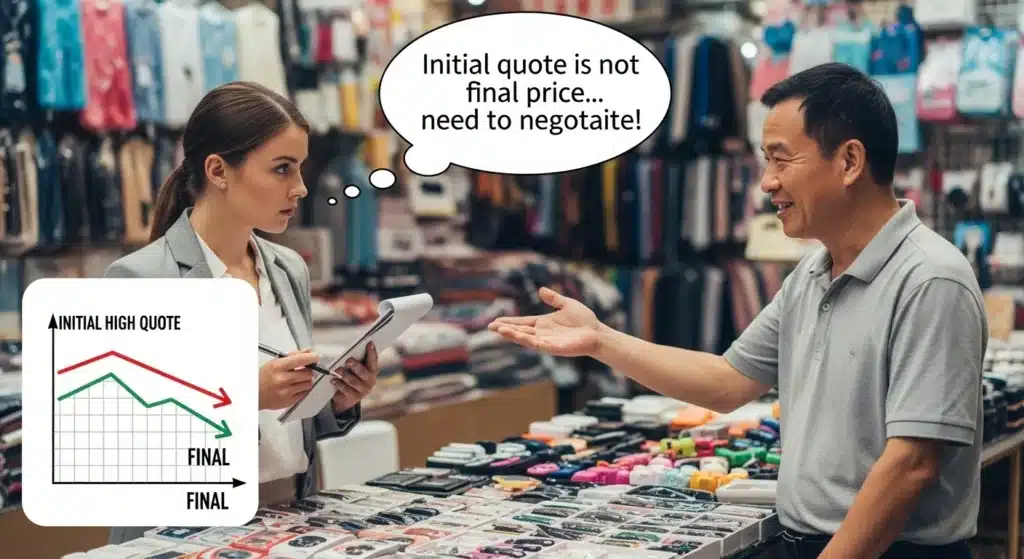
Your first quote in Yiwu isn’t a final price—it’s a calculated risk premium. Suppliers systematically inflate initial prices by 15–40% for new buyers, creating a built-in buffer for the negotiation they fully expect. If you don’t push back, you’re leaving money on the table and missing a key step in establishing a credible long-term partnership.
This guide moves beyond generic advice to give you the specific language and tactics used by successful buyers. You’ll learn the 10 essential Mandarin phrases that manage ‘face’ and unlock better terms, how to structure a ‘trial order’ to bypass high MOQs, and the negotiation playbook for samples and volume discounts. We’ll detail how to secure an average 20% reduction by understanding the supplier’s risk model, where margins of 5–10% make every concession count.
The “Laoban” Mindset: How They Price New Buyers
Chinese suppliers treat new buyers as a risk premium problem. Without a payment history or guarantee of repeat business, they systematically inflate first-order prices by 15–40% and demand strict prepayment terms. This creates a ‘negotiation buffer’ and protects their thin 5–20% margins until trust is established.

The Risk Premium Model: Why Your First Quote is High
When a Chinese factory owner, or “laoban,” receives an inquiry from a new international buyer, they don’t see a simple sales opportunity. They see a risk assessment problem. The initial quote is a calculated output from a structured risk model, not a standard list price.
New buyers are immediately categorized into internal “risk bands.” This classification is often automated within ERP or CRM systems and is based on factors like the buyer’s country risk (using scales like the OECD Country Risk Classification), the age of the buying company, and the size of the initial order. Each risk band maps directly to a standard surcharge tier, typically adding 5% to 20% or more to the supplier’s base cost-plus-margin price.
On top of this risk surcharge, the first quote includes a deliberate “negotiation buffer” or “anchoring premium.” Suppliers intentionally start 10–25% above their internal target price. This creates a “concession bank” for the expected haggling, ensuring they can give ground during negotiations while still landing above their minimum acceptable margin.
The core purpose of this model is to compensate for two critical unknowns: the default risk of an unproven buyer and the uncertainty of whether this will become a long-term, reliable partnership. With net margins for many small manufacturers operating in the 5–10% range, absorbing the potential costs of a failed first transaction—like non-payment or excessive support—is not feasible without this upfront risk premium.
From First Quote to Repeat Buyer: The Normalization Process
The high first quote is not a permanent condition. It is the starting point of a deliberate, data-driven normalization process. As a buyer demonstrates reliability, the supplier systematically revises their internal risk score, which triggers adjustments in both price and payment terms.
Empirical research shows price reductions of 5–15% are typical over the first 3 to 5 repeat orders, provided the buyer shows consistent, on-time payment and stable demand. Each successful transaction chips away at the initial risk premium.
The shift in payment terms is even more dramatic. A new “unknown” buyer will typically face strict terms like 30/70 (30% deposit, 70% before shipment), 50/50, or even 100% prepayment. In contrast, a proven buyer can negotiate terms like Net 30, Net 60, or even Net 90, where payment is due long after the goods are received.
This stepwise normalization is the supplier’s method of de-risking the relationship. It transforms a high-risk, high-premium transaction into a lower-risk, volume-based partnership. The supplier’s ultimate preference is for reliable, long-term partners, and this process filters for them. For the buyer, understanding this structured process is key: it means negotiating hard on the first quote is not only expected but is part of the script for establishing a credible, cost-effective long-term relationship.
MOQ Bargaining: “Trial Order” Strategy
A trial order is a negotiation tactic where a buyer proposes a smaller initial purchase quantity than the supplier’s standard MOQ. This allows the buyer to test product quality and market demand with less risk, while demonstrating reliability to the supplier to build a long-term relationship and secure better future terms.

What a Trial Order Is and Why It Works
A trial order is a smaller initial purchase, like 100-200 units, proposed to a supplier whose standard MOQ might be 500 units or more.
Suppliers set high MOQs to cover fixed costs like machine setup and raw material purchases, achieving economies of scale. For example, a typical MOQ might be 500 units to amortize these setup costs effectively.
A supplier may accept a lower trial MOQ to secure a new, promising long-term client, valuing future volume over the initial unit cost. This strategy reduces buyer risk by preventing large investments in untested products and avoids costly unsold inventory.
How to Structure and Negotiate Your Trial
Propose concrete terms: a 30% deposit with 70% balance upon approving the final QC inspection report, instead of standard Net 30 terms. This payment split demonstrates commitment and reduces financial risk for both parties.
Share a 12-month forecast with the supplier to demonstrate your potential for recurring volume, which can justify flexibility on the first order. Showing a plan for future orders, like moving from 550 units every six months to larger batches, makes a compelling case.
Consolidate product variations (SKUs) into a single trial order to meet a higher total unit count while testing the market. This approach helps you reach a more acceptable quantity for the supplier without overcommitting to any one style.
Use the trial to build a track record. Reliable payment and clear communication on the first order are leverage for negotiating better prices on subsequent, larger orders. Success with a trial order can lead to negotiations for discounts, installment plans, or adjustments to standard MOQs for future purchases.
5 Chinese Phrases Every Buyer Must Know
Using specific Mandarin phrases shows respect, manages ‘face’, and signals you understand local business norms. This guide covers five essential phrases, from the formal opening ‘Nín hǎo’ to the closing ‘Xièxiè hézuò’, that help you negotiate price, request discounts, and frame discussions around long-term cooperation more effectively than English alone.
| Phrase (Pinyin) | English Meaning | Purpose & Cultural Context |
|---|---|---|
| 您好 (Nín hǎo) | Formal “hello” | Shows respect, preserves face (面子), and initiates relationship building (关系). Essential for setting a formal, respectful tone. |
| 我们谈一下 (Wǒmen tán yīxià) | “Let’s talk a bit” | A soft, non-confrontational opener that signals a willingness to discuss terms. It avoids putting the supplier on the defensive. |
| 价格怎么样? (Jiàgé zěnmeyàng?) | “How about the price?” | A neutral probe to anchor the pricing discussion. It’s less aggressive than a direct counteroffer and invites a response. |
| 可以再优惠吗? (Kěyǐ zài yōuhuì ma?) | “Can we get a further discount?” | A polite, explicit request for a discount. It fits the expectation of hard bargaining while giving the supplier a way to save face. |
| 谢谢合作 (Xièxiè hézuò) | “Thank you for the cooperation” | Closes discussions by signaling appreciation and intent for long-term cooperation, protecting the relationship for future business. |

您好 (Nín hǎo)
This formal greeting is your first tool for building 关系 guānxì (relationship). Using “您” (nín) instead of the informal “你” (nǐ) immediately shows respect and acknowledges the supplier’s status. This act of giving 面子 miànzi (face) from the outset creates a positive foundation for negotiation, making the other party more receptive to your requests later on.
我们谈一下 (Wǒmen tán yīxià)
Transitioning from greetings to business requires finesse. This phrase, meaning “Let’s talk a bit,” is a gentle invitation. It frames the upcoming negotiation as a collaborative discussion rather than a demand. This indirect approach is culturally preferred, as it avoids putting the supplier in a corner and maintains a harmonious atmosphere, which is crucial for productive talks.
价格怎么样? (Jiàgé zěnmeyàng?)
When it’s time to discuss numbers, this question serves as a neutral anchor. Directly stating “your price is too high” can cause loss of face. Instead, “How about the price?” opens the floor for the supplier to state their position first. This gives you information and time to formulate your response, whether it’s using a face-saving complaint or moving to a direct discount request.
可以再优惠吗? (Kěyǐ zài yōuhuì ma?)
Hard bargaining is expected, but it must be done politely. This phrase translates to “Can we get a further discount?” The word “再” (zài) implies there has already been some discussion of price or terms, making the request feel like a natural next step in the conversation rather than an abrupt challenge. It allows the supplier to offer a concession while maintaining their dignity.
谢谢合作 (Xièxiè hézuò)
How you end a discussion is as important as how you begin. “Thank you for the cooperation” does more than express thanks; it implicitly frames the interaction as part of an ongoing partnership. This aligns with the Chinese business emphasis on long-term gains over short-term wins. Using this phrase reinforces your role as a serious buyer interested in a future relationship, not just a one-time transaction.
For more complex negotiations, experienced buyers use additional “insider” phrases. To signal a price is unacceptable without causing offense, you might say, “按这个价格,我们太吃亏了” (Àn zhège jiàgé, wǒmen tài chīkuī le) – “At this price, we’re really at a loss.” This presents you as being in a vulnerable position, which appeals to the supplier’s sense of fairness and allows them to offer a better price while saving face.
When discussions need to move to concrete terms like payment schedules (e.g., 30% deposit vs. 70% balance), use “我们来讨论一下协议的条款” (Wǒmen lái tǎolùn yīxià xiéyì de tiáokuǎn) – “Let’s discuss the terms of our agreement.” This depersonalizes the request, framing it as a standard contractual item. Pair this with “我们重视长期合作” (Wǒmen zhòngshì chángqī hézuò) – “We value long-term cooperation” – to justify requests for better terms based on the promise of future business.
Once terms are verbally agreed, a phrase like “一言为定” (Yī yán wéi dìng) – “It’s a deal / you have my word” – can be powerful. It carries a weight of moral commitment in Chinese culture, helping to “lock in” the agreement before the formal contract is signed. For buyers new to this environment, mastering this small set of phrases reduces the risk of miscommunication and demonstrates an understanding of the relationship-first, yet strategically firm, approach needed for successful negotiations in China.

The “Sample Trap”: Don’t Pay Retail for Samples
Paying retail for samples is a common trap where suppliers charge inflated prices for small quantities. Savvy buyers negotiate sample costs as part of the overall deal, often getting them for free or at cost, especially when committing to a future trial order. This section breaks down the supplier’s perspective and your negotiation tactics.

Why Suppliers Charge for Samples (And When You Should Pay)
Suppliers incur real costs for materials, specialized labor, and setup time, especially for custom or low-MOQ items where sample production disrupts regular lines.
High sample fees can act as a filter for serious buyers, deterring time-wasters who aren’t ready for a commercial relationship or bulk order.
Paying a reasonable fee is standard for highly customized products, but it should be credited back against your first official purchase order.
Your Sample Negotiation Playbook: From Cost to Free
Frame the sample as a ‘pre-qualification step’ for a potential trial order, making the cost a shared investment in the business relationship.
Offer to pay for express shipping yourself; this goodwill gesture often convinces suppliers to waive the sample fee entirely.
Use technical specifications (like the need for AQL Level II inspection or specific materials akin to 0.53 mm ID fused silica tubing) to justify the sample’s necessity for your quality process.
Volume Discounts: When do they kick in?
Volume discounts kick in at specific, pre-defined quantity tiers, not through vague negotiation. In sourcing, this often means crossing a threshold like 5,001 units to unlock a 5-10% discount. The key for buyers is to identify the first non-zero discount band and negotiate to lower that trigger point or increase the discount percentage.

The Tiered Discount Ladder: How Suppliers Structure Pricing
Volume discounts are triggered by crossing predefined quantity thresholds, such as 0–5,000 units at full price, then 5,001–10,000 units with a 5–10% discount.
This tiered logic is automated in systems like Salesforce CPQ, which uses ‘Volume Discount Entries’ with specific lower and upper bounds (e.g., 100+ units unlocking a 25% discount).
For physical goods sourcing, the first discount often starts at a modest volume, like a 5% discount for orders of 10–20 units.
Negotiating the Breakpoints: From Enterprise Software to Your Sourcing Deal
In enterprise software, thresholds are expressed in user seats. Microsoft’s historical EA program offered a ~10-12% discount at Level D for customers with 15,000+ seats.
SAP deals demonstrate the potential for deeper cuts, with high-volume negotiations yielding 30–50% per-license price reductions.
The practical strategy for any buyer is to first surface the supplier’s full discount ladder, then negotiate to tie future growth to pre-agreed, favorable tiers, aiming for the first band where the supplier can sustainably offer a ≥5% discount.
Red Flags: When a Price is Too Low
A price that seems too good to be true often signals deeper issues like a client’s financial instability, a commodity mindset that ignores value, or a contract full of hidden traps. These risks include vague payment terms, one-sided clauses allowing price hikes, and partners who avoid budget talks or demand extended payment terms before starting work.

The Client Red Flags in Negotiation
Some clients approach negotiations with a primary goal of reducing cost, regardless of the value or scope being offered. They may immediately ask for a discount or compare your price to a completely different type of service provider, ignoring the specific details of what you’re delivering.
Financial concerns can manifest indirectly. A client who is hesitant to discuss their budget, asks for payment terms significantly longer than the industry standard (like Net 60 or Net 90), or pressures you to begin work before a formal agreement is in place may be signaling cash flow problems. This creates risk for you as the supplier.
Treating your service as a simple commodity is another major warning sign. When a buyer focuses exclusively on the unit cost and dismisses discussions about quality, expertise, or project scope, it sets the stage for conflict. This mindset often leads to requests for mid-project renegotiations or scope creep, which erodes your planned margin.
The Contractual Traps and Vague Language
The contract itself can contain red flags that make a low initial price unsustainable. Agreements with unclear payment terms are a common issue. If the document doesn’t specify exact amounts, due dates, late payment penalties, or a deposit schedule, it increases the likelihood of payment disputes and delays.
Be wary of one-sided terms that heavily favor the other party. Clauses that allow them to unilaterally amend pricing or terminate the agreement without penalty shift all the financial risk to you. These terms are often buried in standard vendor agreements.
Vague language around deliverables creates ambiguity that can be used against you. Phrases like “completed in a reasonable time,” “as needed,” or “subject to approval” lack measurable specifics. Without clear definitions for timelines, performance standards, or acceptance criteria, your obligations can be reinterpreted, leading to disputes about whether the work is truly complete.
Final Thoughts
Bargaining in Yiwu isn’t a random haggling match; it’s a structured process. Suppliers have a clear system for pricing new buyers, building in a risk premium and a negotiation buffer. Your goal isn’t to eliminate their margin but to work within this system to reduce that initial premium. Using the right phrases, proposing a trial order, and negotiating samples and volume discounts are all moves within an established framework. Success comes from understanding the rules of the game, not fighting against them.
The most effective negotiation strategy combines cultural respect with commercial firmness. Start with the formal greeting “Nín hǎo” to build rapport, use the trial order tactic to demonstrate serious intent with lower risk, and always negotiate sample costs as part of the larger deal. Remember, a price that seems suspiciously low is often a red flag for future problems. By approaching the process with this dual focus—respecting the relationship while clearly pursuing better terms—you position yourself not as a one-time bargain hunter, but as a credible partner worthy of the supplier’s best long-term pricing.
Frequently Asked Questions
Is it rude to bargain in China?
In mainland China, bargaining is a standard part of B2B and commercial negotiations. It’s not considered rude; in fact, it’s expected. The key is your approach. Using aggressive or confrontational tactics that damage the supplier’s sense of respect and harmony is what’s seen as inappropriate. The effective method is to negotiate firmly but politely, showing patience and a willingness for both sides to make concessions.
How much discount can I ask for?
For B2B vendor negotiations, a practical starting point is to ask for a small, incremental discount. Industry benchmarks suggest an initial request in the 2-4% range is reasonable, especially when paired with a commitment like a multi-year contract, which might justify an additional 2% concession. The strategy is to focus on small, stacked concessions rather than making one large, aggressive demand.
What does ‘Tai Gui Le’ mean and when should I use it?
‘Tai Gui Le’ (太贵了) translates to ‘too expensive’ in Mandarin. It’s a common and direct phrase used in Chinese business negotiations to signal that the current price is unacceptable and to prompt the seller to offer a better deal. It’s typically invoked when the quoted price is perceived to be significantly above market rate or the buyer’s target, often serving as the opening move in a price discussion.
Can I pay with US dollars in cash?
For high-value B2B transactions, paying in physical US cash is highly unusual and often impractical. In the US, there’s no federal law requiring businesses to accept cash for such deals, and banks are required to file special reports for any single-day cash transaction over $10,000. In China, large international payments are almost exclusively handled via bank transfer (TT), letter of credit (LC), or other digital methods. Cash is not a standard or recommended payment method for sourcing orders.
Can I negotiate the Minimum Order Quantity (MOQ)?
Yes, MOQ is frequently negotiable. While a supplier might state an MOQ—commonly ranging from 75 to 500 units per SKU, or a minimum order value between $700 and $10,000—this is often a starting point for discussion. You can negotiate for a lower initial ‘trial order’ by offering a higher per-unit price, agreeing to bundle multiple products, or committing to a larger annual purchase volume. Many suppliers are open to flexibility to secure a new, reliable business relationship.