 Justin
Navigating the world’s largest wholesale market can be overwhelming, especially when you need to find the right suppliers, understand minimum order quantities, and avoid common pitfalls. With over 75,000 booths across five massive districts, a successful sourcing trip to Yiwu requires a clear, actionable plan.

This guide provides that plan. We break down the 6.4 million square meter Yiwu International Trade City, detailing what to buy in each of the five specialized districts, from toys in District 1 to textiles in District 4. You’ll get practical advice on travel logistics, from high-speed rail options to on-the-ground navigation, along with a 3-day itinerary to maximize your time. We also cover critical operational details, including how to verify suppliers to mitigate risk and the reality of MOQs, which can range from a single carton for spot goods to thousands of units for custom orders.
What is the Yiwu International Trade City?
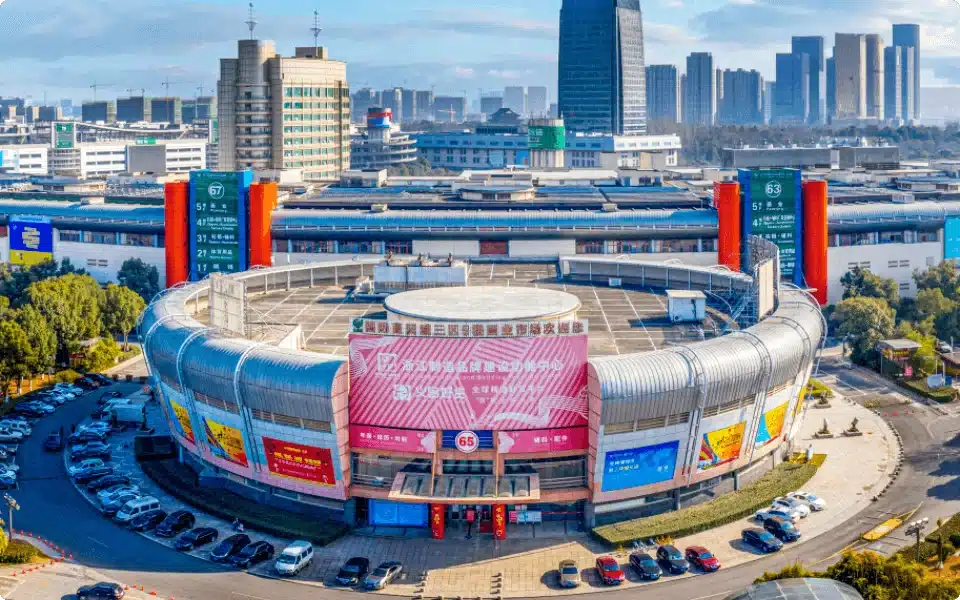
The Yiwu International Trade City is the world’s largest wholesale market for small commodities. It’s a massive, multi-district complex spanning over 6.4 million square meters, housing more than 75,000 booths and 100,000 suppliers across five main districts, each specializing in different product categories.

A Planned Mega-Complex for Global Trade
The Yiwu International Trade City is not a single building but a multi-phase campus of interconnected wholesale malls. It was engineered specifically for high-volume B2B trade, functioning as a standardized wholesale infrastructure platform.
Its core positioning is as the world’s largest wholesale hub for small commodities. The market organizes its vast offerings into 26 major product categories, encompassing over 2.1 million individual SKUs. This design integrates logistics, exhibition, and transaction systems into a single, cohesive location for global buyers.
Technical Specifications and Operational Scale
The total operational wholesale space across all districts is approximately 6.4 to 6.5 million square meters. The layout is highly standardized: most districts feature five above-ground trading floors. The lower levels (floors 1-3) are densely packed with 14-square-meter booths for small-lot transactions, while the upper floors (4 and 5) host larger, 80-100 square meter factory-direct showrooms and production-sales centers.
The infrastructure is industrial-grade. District-wide central air-conditioning, intelligent security and firefighting systems, and comprehensive broadband networks with data centers are standard. Large electronic information screens support on-site commerce and order processing.
Traffic engineering is a key feature, with elevated roads and vehicle-accessible floors allowing cars to reach all trading levels. The complex provides over 4,000 parking spaces across interconnected roofs, surface lots, and basements to facilitate smooth circulation. The market holds ISO 9001 and ISO 14001 management certifications and is also rated as a national AAAA tourist attraction.
District 1-5 Breakdown: What to Buy Where
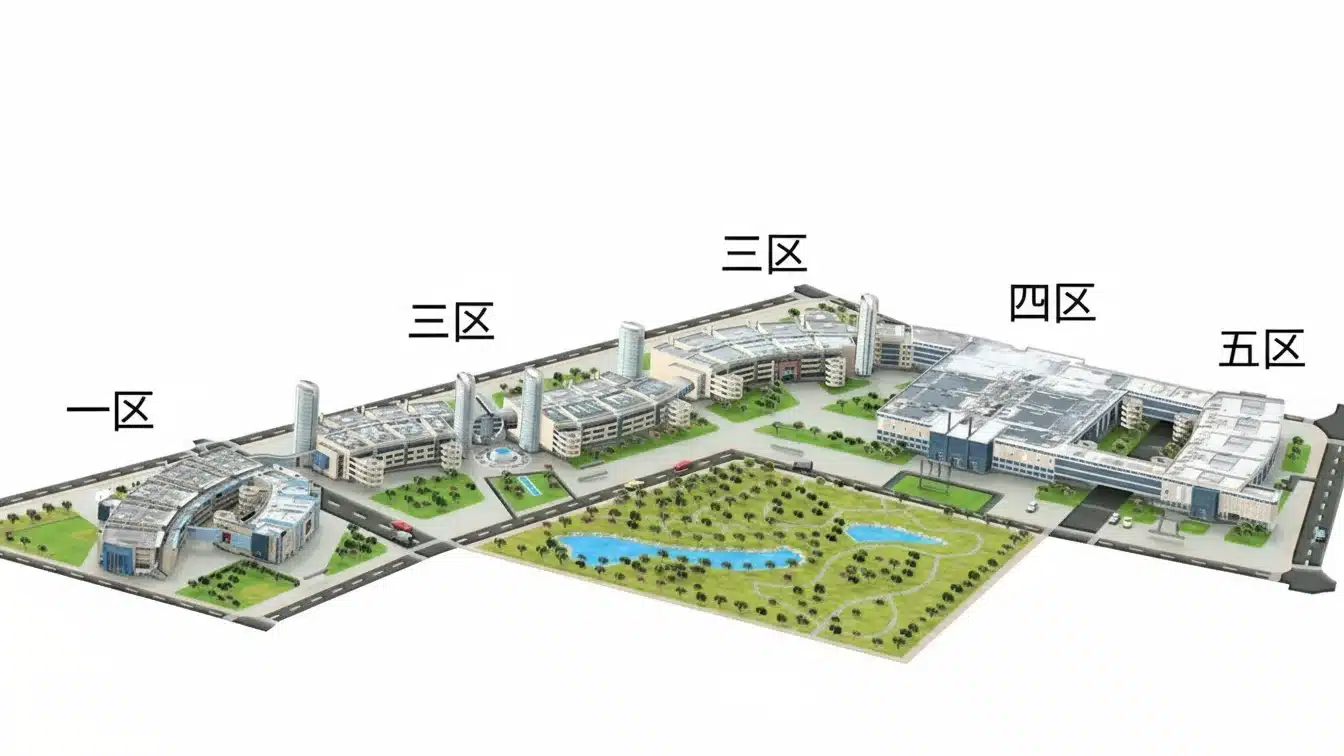
Yiwu’s five districts are functionally zoned. District 1 focuses on toys, artificial flowers, and jewelry. District 2 is for hardware, tools, and electronics. District 3 houses stationery and cosmetics. District 4 is the core for socks and textiles. District 5 features home textiles, knitwear, and imported goods. Each district organizes products by floor, with upper levels often dedicated to factory-direct outlets.

| District | Key Product Categories | Strategic Sourcing Notes |
|---|---|---|
| District 1 ~340,000 m² | Toys, Artificial Flowers, Fashion Jewelry, Festival Crafts, Ceramics | F4 is the dedicated Manufacturers Direct Sales Center for factory-direct sourcing. |
| District 2 >600,000 m² | Hardware, Tools, Electronics, Home Appliances, Bags, Umbrellas | Upper floors (F4-F5) host larger factory booths and export service agencies. |
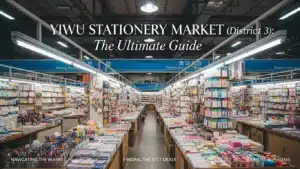
| District 3 460,000 m² | Stationery, Cosmetics, Office Supplies, Sports Products | F4 is a factory outlet zone; F5 houses the Imported Commodities Mall. |
| District 4 Modern Multi-floor | Socks, Hosiery, Daily-Use Garments, Belts, Underwear, Scarves | Floors 4-5 are heavy with factory outlets and brand showrooms. |
| District 5 640,000 m² | Home Textiles, Knitwear, Imported Goods, Auto Accessories | Newest district with many direct manufacturers; F5 is the E‑commerce Shopping Center. |
The Functional Zoning Logic of Yiwu’s Five Districts
Yiwu International Trade City is engineered as a functional zoning system. Each of the five districts is a discrete building complex, ranging from 340,000 m² to 640,000 m² in size.
The core logic is to cluster substitutable products—like all toys or all socks—into dense corridors of standard 14 m² booths on the lower floors. This creates an environment for efficient comparison shopping. Larger 80–100 m² booths and dedicated factory outlet zones are strategically placed on upper floors, such as District 1’s fourth floor and District 3’s fourth floor, to house manufacturers and brands directly.
This grid-like arrangement means that once a buyer is on the correct floor of the correct district, walking just one or two corridors exposes most major suppliers for that specific product line. Districts 1 through 3 are optimized for traditional small commodities, while Districts 4 and 5 concentrate on textiles, garments, and higher-value or imported products.
Floor-by-Floor Product Matrix and Key Sourcing Zones
For strategic sourcing, knowing the exact floor layout is critical. District 1 (340,000 m²) places toys and artificial flowers on the first floor, fashion jewelry on the second, festival crafts and ceramics on the third, and its crucial Manufacturers Direct Sales Center on the fourth.
District 2, the largest at over 600,000 m², organizes bags and rainwear on F1, hardware and tools on F2, home appliances and electronics on F3 and F4, with export services on F5. District 3 (460,000 m²) dedicates its first two floors to stationery and office supplies, the third floor to cosmetics and clothing accessories, the fourth to factory outlets, and the fifth to the Imported Commodities Mall.
District 4 is the core cluster for socks, leggings, and hosiery. Its upper floors (F4-F5) focus on factory outlets for belts, underwear, and scarves. The newest district, District 5 (640,000 m²), features imported goods on F1, bedding and wedding textiles on F2, knitwear and fabrics on F3, car accessories on F4, and the Yiwu E‑commerce Shopping Center on F5.
How to Get to Yiwu (Train vs. Flight)
High-speed trains offer direct, punctual service to Yiwu Railway Station from major cities like Shanghai (1.5 hours) and Beijing (6.5–10 hours), with easy downtown access. Flights to Yiwu Airport are faster for long distances but involve airport transfers and are more prone to delays. For most business travel from nearby hubs, the train is the more reliable and often more convenient choice.

The Case for High-Speed Rail: Efficiency and Reliability
Trains on the Shanghai-Kunming High-Speed Railway arrive at Yiwu Railway Station, located downtown for quick market access. This central location means you can be at your hotel or the Yiwu International Trade Market within half an hour of arrival.
With a top speed of 300 km/h and minimal delays, bullet trains offer predictable travel times, unlike flights affected by weather. This reliability is crucial for business schedules. Check-in takes about 5 minutes, and passengers enjoy spacious seating with legroom often exceeding economy class on planes, allowing for comfortable work or rest.
For routes under 5 hours, like Shanghai (1.5 hours) or Hangzhou (40 minutes), trains are typically faster door-to-door than flying. You avoid lengthy airport security, boarding procedures, and the transfer from a suburban airport into the city center.
Flight Logistics and When to Choose Air Travel
Yiwu Airport (YIW) handles domestic flights from Beijing, Shanghai, Guangzhou, and Shenzhen, with a flight from Beijing taking roughly 2.5 hours. A taxi from the airport to the city center takes about 20 minutes and costs around CNY 50.
Discounted economy fares can drop to approximately CNY 450, making flights competitively priced for time-sensitive travel on longer routes. For journeys over 1,000 km where time is critical, a 2.5-hour flight may outweigh the 6.5+ hour train ride, despite the extra transfer time.
Air travel is best considered for long-distance trips where the total flight time, including transfers, is significantly less than the train journey. However, you must account for potential flight delays, earlier arrival times for security, and the final leg of travel from the airport.
Stop Overpaying. Start Sourcing Smarter in Yiwu.
Yiwu’s new Global Digital Trade Center is built on a 10‑Gbps optical network designed for real‑time video and data exchange. This reliable, high‑bandwidth connectivity supports seamless use of cloud‑based translation apps and remote communication, making digital tools a core part of the trade workflow rather than an afterthought.

The Digital Backbone: High‑Speed Connectivity in the Market
The Yiwu Global Digital Trade Center operates on a 10‑gigabit optical network with dedicated cross‑border data channels for stable, high‑bandwidth access.
This infrastructure spans 1.25 million m² and is engineered to support thousands of concurrent HD live streams and real‑time negotiations between vendors and global buyers.
The network enables practical workflows like using cloud translation apps, video calls with remote translators, and instant data exchange via platforms like Chinagoods.
Practical Tools: From AI Translation to Hardware Upgrades
The market’s digital ecosystem, powered by partnerships with Alibaba Cloud and Tencent, integrates AI‑driven trade tools and spatial‑intelligence solutions for streamlined operations.
Smartphone‑based translation and remote interpreting are viable, supported by the high‑throughput WiFi and cloud platforms like Chinagoods for end‑to‑end trade management.
Clients can purchase hardware like USB 360 WiFi receivers from in‑market suppliers to upgrade legacy devices and fully leverage the available network bandwidth.
MOQ & Spot Goods: The Truth
MOQ is the minimum quantity a supplier needs to make an order profitable, based on covering their fixed and variable costs. Spot goods are ready-made items in stock, which often have lower MOQs. In Yiwu, factory-linked stalls require hundreds or thousands of units, while traders selling spot goods can offer much smaller quantities.

What MOQ Really Means in Yiwu
MOQ is not an arbitrary number; it’s calculated to cover a supplier’s fixed setup costs (like machinery and tooling) and variable costs, ensuring a profit margin.
Suppliers use a breakeven formula: MOQ = (Fixed Costs + Variable Costs) ÷ Profit per Unit. This is why ultra-low MOQs are rare for custom products.
There are three common MOQ structures: unit-based (e.g., 500 pieces), value-based (e.g., a $2,000 minimum order), and assortment-based (mixing SKUs to reach a total quantity).
Factory-direct booths in Yiwu, especially for apparel, bags, or electronics, operate like small production units and need high MOQs—often 500 to 3,000+ units per style—to run efficiently.
Spot Goods vs. Custom Orders: The MOQ Reality
Spot goods are finished products already in a booth or warehouse. Since production costs are already covered, MOQs are lower, often tied to carton sizes like 24, 48, or 72 pieces.
For generic accessories, toys, and homeware, spot-goods traders can offer MOQs as low as 10–50 pieces per SKU.
For custom or private-label orders (OEM/ODM), MOQs are significantly higher. Examples include 500 pieces per style & color for garments or 3,000 units per SKU for private-label cosmetics.
Export agents who consolidate orders often impose a value-based MOQ, typically requiring a total order value of $2,000 to $10,000 to justify the logistics and fill a container.
Avoiding Scams in Futian Market
Scams in Yiwu’s Futian Market are a material risk, with historical losses estimated at ¥400 million. Effective avoidance relies on a formal verification workflow: cross-checking business licenses against official registries, validating booth tenancy, rejecting prices 20-40% below market, and only paying deposits to verified corporate bank accounts.

The Core Verification Framework: Documents, Data, and Due Diligence
The first line of defense is a systematic document check. Demand the Business Licence (营业执照) with its unified social credit code, the Tax Registration Certificate, and an Export Licence if the supplier claims to export directly. These are non-negotiable.
Verification is not complete until you cross-reference these documents. Use the National Enterprise Credit Information Publicity System and local bureaus like the Zhejiang Business Registration Bureau to confirm the company’s registration status, legal representative, and that it is not listed for violations.
Financial verification is critical. The supplier’s company bank account (公户) name must match the business licence exactly. Payment to personal accounts is a major red flag and significantly increases fraud risk. This is a primary control point.
Within the market, use the official Futian directory and navigation apps to verify the physical booth. Confirm the booth number, the tenant name listed, and how long they have operated from that location. A supplier who frequently changes booths may be avoiding scrutiny.
Budget for this process. Allocating ¥2,000–¥5,000 per supplier for thorough on-site or third-party verification is a standard sourcing cost, not an extra. This investment covers document checks, potential factory visits, and reputation inquiries with market management.
Operational Red Flags and Risk Mitigation Strategies
Pricing is a key indicator. Treat quotes that are 20-40% below the prevailing market level as a high-risk indicator, not a bargain. This pricing is statistically linked to scams, often leading to non-delivery or substandard goods.
Be skeptical of “factory-direct” claims without proof. Request the factory’s physical address, recent utility bills, or live production photos. Many booths in Futian are traders, not manufacturers. Validating the production source is essential for quality and reliability.
Structure your orders to minimize risk. Start with a small trial order to test quality and reliability. Use a formal, written Purchase Order that details specifications, packaging, and delivery terms. Avoid finalizing significant deals based solely on informal chat app conversations.
Manage payments cautiously. Sending a 30% deposit to an unverified entity is a high-risk scenario. After verification, structure payments so the final balance is only released after you approve a quality control report for the shipment. This aligns payment with performance.
Be wary of unsustainable agent structures. Reject offers from agents promising “1% commission with free services and a car.” This model is commonly flagged as non-viable and is often a precursor to hidden fees or a scam, as legitimate agents operate on sustainable margins.
3-Day Itinerary for Buyers
This itinerary is designed for buyers with 72 hours on the ground. It strategically allocates time across Yiwu’s five main districts, focusing on product clusters by floor to enable efficient price comparison and supplier discovery. The schedule balances sourcing, quality checks, and logistics planning, leveraging the market’s low MOQs and the official Yiwugo platform for pre-trip planning.

| Day | Primary Focus | Key Districts & Product Clusters |
|---|---|---|
| Day 1 | Initial assortment building and supplier discovery | District 1 (Toys, Artificial Flowers, Crafts, Jewelry) |
| Day 2 | Benchmarking across industrial and electronic goods | Districts 2 & 3 (Hardware, Tools, Electronics) |
| Day 3 | Final sourcing and logistics consolidation | Districts 4 & 5 (Apparel, Textiles, Imported Goods) |
Day-by-Day Sourcing Strategy
This plan breaks down the market’s 4 million m² into manageable, product-specific blocks to maximize efficiency.
Day 1 focuses on District 1 (340,000 m²), covering toys, artificial flowers, and crafts/jewelry on separate floors for initial assortment building.
Day 2 shifts to Districts 2 and 3 for hardware, tools, and electronics, allowing for benchmarking across similar product clusters.
Day 3 targets Districts 4 and 5 for apparel, textiles, and imported goods, concluding with logistics consolidation and forwarder meetings.
Operational Workflow and Logistics
These on-site processes for order management and shipment preparation run parallel to the sourcing schedule.
Utilize the official Yiwugo platform’s 360° shop views before arrival to shortlist 10-15 target suppliers per product category, reducing scouting time.
Leverage the market’s typical MOQ of 50 pieces or less to place multiple trial orders across different suppliers within the three-day window.
Schedule daily end-of-day sessions for sample review, QC report analysis, and coordination with freight forwarders familiar with Yiwu’s commodity logistics system.
Final Thoughts
Yiwu International Trade City is a highly specialized ecosystem built for global wholesale. Its scale and organization are its greatest assets. The functional zoning across five districts and the floor-by-floor product clustering turn a massive 6.4 million square meter complex into a navigable sourcing grid. This design allows buyers to efficiently compare hundreds of suppliers for a single product line within a few corridors. The infrastructure, from high-speed digital networks to vehicle-accessible trading floors, is engineered to support high-volume B2B transactions.
Success in Yiwu depends on understanding its operational logic. This means knowing where to go for specific products, how to verify suppliers to mitigate risk, and the reality of MOQs for spot goods versus custom orders. It’s a market where preparation—using platforms like Yiwugo to pre-select suppliers and planning a focused itinerary—directly translates to efficiency and better deals. While the sheer size can be daunting, its systematic layout and the availability of small-lot purchases make it a uniquely accessible gateway to China’s manufacturing base for businesses of all sizes.
Frequently Asked Questions
Do I need a visa to visit Yiwu?
Yes, most visitors need a visa to visit Yiwu, China, as it is in mainland China requiring visas for tourism, business, or trade unless eligible for visa-free transit (up to 10 days/240 hours with confirmed onward ticket to a third country) or from visa-exempt nationalities (e.g., 30-90 days for select countries). Your passport must have at least 6 months of validity remaining to apply.
Can I buy small quantities (1 carton) at the market?
Yes. In Yiwu Market you can generally buy small quantities starting from about 1 carton per item, especially for household goods and many small commodities. The exact minimum order quantity still depends on the product category and whether it is stock or made-to-order.
Is Yiwu market open on weekends?
Yes, Yiwu International Trade City is open on weekends. Standard business hours are from about 8:30–9:00 a.m. to 5:00–5:30 p.m., Monday through Sunday. The market only fully closes during the Chinese Spring Festival period (about 15–20 days). During other public holidays, some vendors may be absent, but the buildings remain open.
How much does a translator cost per day?
A professional translator for business in Yiwu typically charges a day rate of about $200 to $600 for an 8-hour day. This rate is based on standard output and per-word pricing for common language pairs.
Is Yiwu safe for foreigners?
Yes, Yiwu is generally safe for foreigners. China, including Yiwu, is rated as a ‘Low’ travel security risk by organizations like International SOS, indicating a low level of violent crime. The main risks for visitors are petty theft, scams, and navigating local regulations, rather than serious crime.
What is the best hotel near District 1?
The closest business-class hotel within walking distance (roughly 300–500 meters) of District 1 is the Byland Star Hotel. For an international brand with full facilities, the International Trade City, Yiwu – Marriott Executive Apartments is the top option in the Trade City area, offering extensive meeting space and services.