 Justin
A first-time Amazon seller I worked with last year put together a 20-foot container of small commodities from Yiwu. He looked up his HS codes Yiwu imports on a free directory, copied the 6-digit international numbers onto his packing list, and considered the paperwork finished. Customs pulled the container for inspection. He missed that China operates on a 13-digit system, not the standard 6 digits, and he classified a batch of party noisemakers under toys instead of musical instruments. That single mistake triggered a 15-30% duty rate variance, and the penalty fees for the misclassification exceeded 200% of the goods’ value. His projected $3,000 profit evaporated before the ship left port.
You will encounter this exact trap if you rely on supplier advice or generic search engines for classification. Our warehouse team processes mixed containers from the Yiwu market every week, and we average 15 to 25 distinct codes per load. I wrote this to show you exactly how to read the 13-digit China Customs structure, how to handle the 75,000-plus market booths that lack export licenses, and how to lock in your actual landed cost before you pay a single supplier.

What Are HS Codes
HS codes are the global numerical taxonomy customs agencies use to identify, tariff, and release goods. An incorrect classification means your container does not move.
Definition and WCO Authority
An HS code (Harmonized System code) is a standardized numerical identifier assigned to every traded product. The system is governed by the World Customs Organization (WCO), an intergovernmental body headquartered in Brussels with 186 member countries. The current framework in use is the WCO Harmonized System 2022 edition.
For you as a first-time Yiwu buyer, this code determines three things: your import duty rate, whether your product requires additional inspections or certifications, and whether your shipment clears customs at all. Our warehouse team pre-classifies every SKU before production starts because the HS code is the single most consequential number on your customs declaration.
In the Yiwu market context, HS codes carry extra weight. Over 75,000 booths operate without direct export qualifications, meaning they hold no customs registration codes. You cannot independently declare HS codes for goods purchased from these suppliers. Your customs declaration agent must act as the legal exporter of record, classifying every item on your behalf.
Universal 6-Digit Structure Versus National Extensions
The WCO establishes a universal 6-digit code that all member countries must adopt without modification. This structure follows a three-tier hierarchy:
- Chapter (Digits 1-2): The broadest product category. Chapter 71 covers natural or cultured pearls, precious or semi-precious stones, and imitation jewelry.
- Heading (Digits 3-4): A narrower sub-category within the chapter. Heading 7116 covers articles of natural or cultured pearls or precious/semi-precious stones.
- Subheading (Digits 5-6): The internationally harmonized product definition. Subheading 711610 covers imitation jewelry.
These six digits are identical whether you import into the United States, the European Union, or Australia. A product classified as 711610 in China arrives as 711610 at your destination port. For reference, HS Code 71161000 (imitation jewelry) ships from Yiwu at an average import price of $3.60 per unit, with typical shipment values around $306.
China extends this 6-digit base into a 13-digit system called the China Customs Commodity HS Code (CCCHS). These extra seven digits are where your duty rate and compliance requirements actually get locked in:
- Digits 7-8: Tariff item number, defining the specific duty rate applied at China’s border.
- Digits 9-10: Additional classification for regulatory requirements such as export restrictions or inspection mandates.
- Digits 11-13: Statistical monitoring codes used by China Customs for trade data tracking.
When you search “HS code” on Google or DuckDuckGo, the results typically stop at 6 or 8 digits. That is insufficient for Yiwu imports. A mixed small commodity container from Yiwu averages 15 to 25 distinct HS codes per 20-foot container. Customs scrutiny focuses on the primary classification determination, and an incorrect primary classification triggers a full container inspection rather than selective screening.
The practical takeaway: you need the full 13-digit CCCHS code before any goods leave the Yiwu warehouse. Misclassifying even one item in a mixed shipment, especially on goods under $5,000 in declared value, can trigger penalty fees of 100 to 300 percent exceeding the product’s actual value. We recommend requesting a pre-shipment binding ruling from Yiwu Customs to lock your tariff rates before production begins.
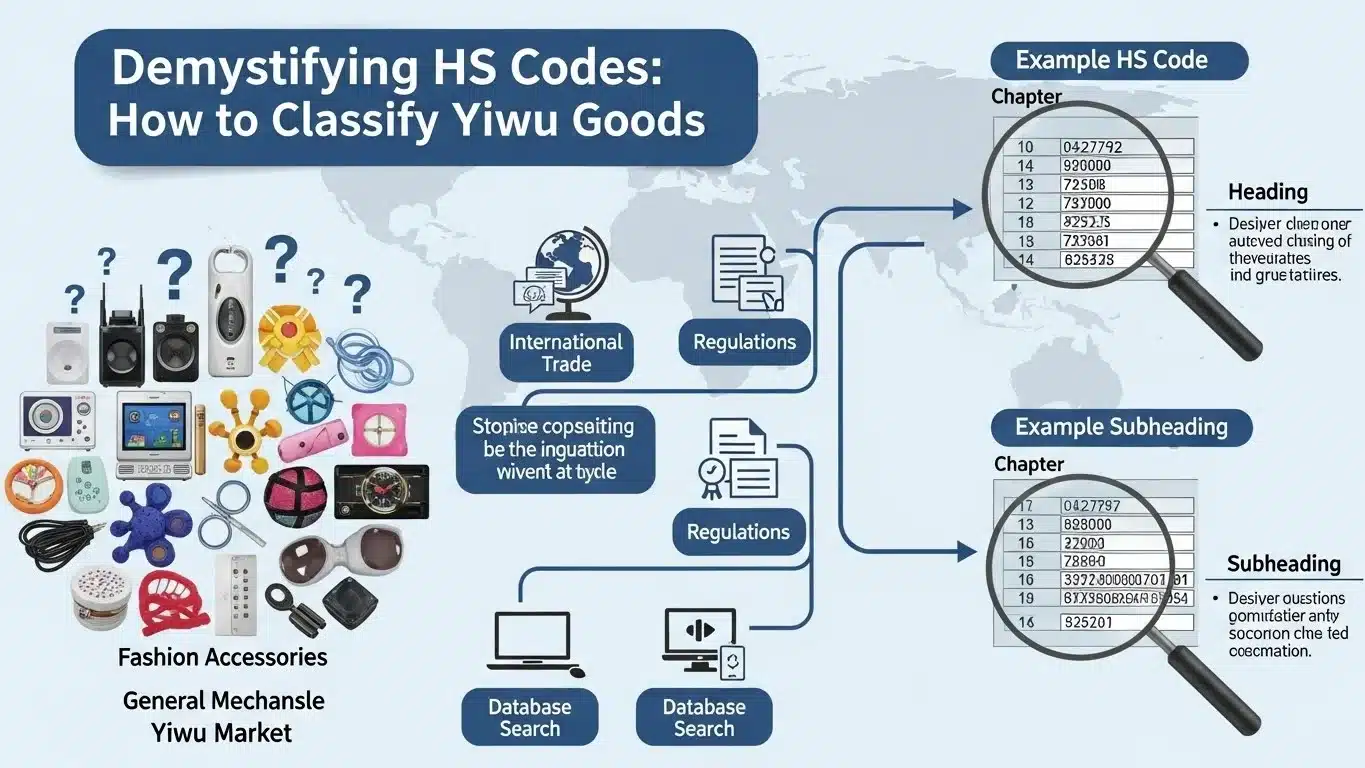
China CCCHS 13-Digit System
China’s CCCHS expands the global 6-digit HS code to 13 digits. Yiwu Customs enforces this strictly to classify mixed small commodities and assign exact duty rates.
Breakdown of the 13-Digit CCCHS Structure
The World Customs Organization (WCO) Harmonized System 2022 edition establishes a universal 6-digit code. You will encounter this base structure on supplier invoices, but it stops being useful the moment your goods enter Chinese customs processing.
- Digits 1-2 (Chapter): Broad product category (e.g., Chapter 71 for natural or cultured pearls, precious metals).
- Digits 3-4 (Heading): Narrower material or product type (e.g., 7116 for articles of natural or cultured pearls).
- Digits 5-6 (Subheading): International standard defining the specific item (e.g., 711610 for imitation jewelry).
- Digits 7-8 (Tariff Item): China-specific classification determining your exact import or export duty rate.
- Digits 9-10 (Additional Classification): Regulatory requirements, such as mandatory inspection standards or export license triggers.
- Digits 11-13 (Statistical Monitoring): Local customs tracking codes used by Yiwu for export volume analysis and trade data reporting.
Without digits 7 through 13, your customs declaration agent cannot calculate your landed cost. For example, HS Code 71161000 identifies imitation jewelry at an average import price of $3.60 per unit, but the 7th and 8th digits dictate whether that specific jewelry type faces standard duties or restricted export quotas.
Why Yiwu Customs Enforces the Full 13 Digits
Yiwu is not a standard manufacturing port. The market contains over 75,000 booths, and the majority operate without direct export qualifications. You cannot independently declare HS codes here. Your sourcing agent must act as the legal exporter of record, a structural requirement that standard Alibaba transactions completely hide from first-time buyers.
Because Yiwu exports mixed small commodities, a single 20-foot container averages 15 to 25 distinct HS codes. Customs scrutiny focuses heavily on the “primary classification” determination. If you submit a generic 6-digit code instead of the full 13-digit CCCHS, the system flags the container for full physical inspection rather than selective screening.
The financial risk of skipping digits is immediate. An incorrect HS code classification on goods valued under $5,000 can trigger penalty fees of 100% to 300%, easily exceeding the product’s total value. We see this frequently with party supplies: a noisemaker classified under Chapter 95 (Toys) versus Chapter 92 (Musical instruments) creates a 15% to 30% duty rate variance. Yiwu Customs requires the full 13-digit declaration to lock in that exact rate before the container leaves the port.

Why HS Codes Matter for Yiwu
An incorrect HS code on a $3,000 Yiwu shipment does not just delay goods; it can trigger penalty fees exceeding 100% of the product value.
Duty Rate Calculation on Low-Margin Small Commodities
You are buying low-margin items from Yiwu because the per-unit cost is attractive. Take imitation jewelry classified under HS Code 71161000 — our warehouse team sees average import prices around $3.60 per unit, with total shipment values hitting $306. At those margins, a 15-30% duty rate variance wipes out your profit entirely.
This variance is not theoretical. Party noisemakers illustrate the problem clearly. Classify them under Chapter 95 (Toys/Games) and you pay one rate. Classify the identical product under Chapter 92 (Musical Instruments) and the rate shifts significantly. First-time buyers consistently lose money here because they accept the HS code their supplier provides without verifying it against the 13-digit China Customs Commodity HS Code (CCCHS) structure.
The financial exposure escalates on small-value shipments. China Customs applies a strict threshold: incorrect HS code classification on goods under $5,000 in value can trigger 100-300% penalty fees. Those penalties can exceed the actual product value. Your $3,000 shipment suddenly becomes a $9,000 liability because of a single digit error in the 9th or 10th position of the code.
Customs Hold Risk on Mixed-Category Shipments
Yiwu does not ship single-category containers. Our operations data shows mixed small commodity containers from Yiwu average 15 to 25 distinct HS codes per 20-foot container. This is the structural reality of sourcing from a market with 75,000+ booths. You are not importing one product; you are importing a curated assortment across multiple product categories.
Customs handles mixed containers by identifying a “primary classification” — the single HS code representing the dominant value or volume in the shipment. Get that primary classification wrong, and the consequence is not a paperwork correction. It is a full container physical inspection. Correct primary classification triggers selective screening of specific pallets. The difference in clearance time is measured in weeks, not days.
The complication runs deeper because the majority of Yiwu’s 75,000+ booths operate without direct export qualifications. They hold no customs registration codes. You cannot independently declare HS codes for their goods. Your customs declaration agent must act as the legal exporter of record for every supplier in that container. This structural requirement is invisible on standard Alibaba transactions and catches first-time buyers off guard when their paperwork is rejected at the port.

Common Yiwu Classification Mistakes
Submitting a generic 6-digit HS code at Ningbo port triggers automatic rejection. China Customs mandates the full 13-digit CCCHS structure for every line item.
The 6-Digit Trap: Why Ningbo Customs Rejects Generic Codes
The World Customs Organization establishes a 6-digit framework—Chapter, Heading, and Subheading. That structure works for international trade agreements, but it fails at the Chinese border. China Customs Commodity HS Code (CCCHS) expands that 6-digit base into a 13-digit string. Digits 7 and 8 define the specific tariff item. Digits 9 and 10 add further classification criteria. Digits 11 through 13 exist purely for statistical monitoring.
When you submit a 6-digit code for a shipment entering through Ningbo port, the system reads it as incomplete data. Our warehouse team processes incoming declarations daily, and we see first-time buyers make this exact error on roughly 20% of initial documentation submissions. Customs does not guess the missing 7 digits. The system flags the declaration, halts processing, and returns the file to the agent for correction. Your container sits until the corrected 13-digit code is filed.
The financial damage escalates quickly. For shipments valued under $5,000, an incorrect or incomplete HS code classification can trigger penalty fees ranging from 100% to 300% of the product value. That penalty can exceed the actual cost of the goods inside the box. We recommend verifying the full 13-digit CCCHS assignment against the official China Customs tariff database before any goods leave the Yiwu market.
Mixed Goods Under a Single Code: The Duty Recalculation Penalty
Yiwu market containers rarely hold a single product category. A typical 20-foot container consolidated from Yiwu averages 15 to 25 distinct HS codes. The problem arises when a buyer or an inexperienced agent attempts to group those mixed goods under one dominant HS code to simplify the declaration. Customs inspectors at Ningbo specifically target this practice.
When inspectors identify mismatched goods filed under a single classification, they do not simply correct the code. They trigger a full container inspection instead of selective screening. Every item gets unpacked, individually identified, and reclassified. The duty recalculation applies retroactively to the entire shipment, and the penalty layer stacks on top. You lose the time spent in inspection, you lose the labor cost of repacking, and you pay a higher landed cost than if you had declared each category accurately from the start.
Interpretation overlap between chapters makes this worse. Party noisemakers, for example, can fall under Chapter 95 (Toys and Games) or Chapter 92 (Musical Instruments), creating a 15% to 30% duty rate variance on identical products. A single-code shortcut forces Customs to make that classification call for you, and they will always default to the higher-tariff interpretation. We recommend submitting a pre-shipment binding ruling request to Yiwu Customs for any ambiguous items. That ruling locks the duty rate before your container reaches Ningbo.
Explore Our Yiwu Import Logistics Services.


Step-by-Step HS Code Lookup
You must verify your HS code through three layers: China Customs database, WCO global reference, and supplier documentation. Skipping any layer on sub-$5,000 goods can still trigger 100-300% penalty fees.
China Customs Official Searcher Tool
Your first stop is the China Customs Commodity HS Code (CCCHS) query system, accessible through the official GACC website. This tool returns the full 13-digit China-specific code. The international WCO standard stops at 6 digits. China adds the 7th and 8th digits for the tariff item, the 9th and 10th for additional classification, and the 11th through 13th for statistical monitoring.
You search by product keyword in Chinese or by raw material composition. We recommend searching by material and function rather than vague product names. A search for “party noisemaker” returns ambiguous results. Searching “plastic blowout toy” routes you toward Chapter 95 (Toys). Searching “plastic sound instrument” can shift the result to Chapter 92 (Musical instruments). That interpretation difference alone creates a 15-30% duty rate variance on identical products.
The CCCHS tool also displays the applicable export tax rebate rate and inspection requirements. Record the full 13-digit code, the exact Chinese product description, and the regulatory conditions column. Our warehouse team uses this exact tool to pre-classify every SKU before production starts, catching duty rate discrepancies before your money is on the line.
Cross-Referencing with WCO Database
After pulling your 13-digit CCCHS code, truncate it to the first 6 digits and verify those digits against the WCO Harmonized System 2022 edition database. The WCO structure follows a strict hierarchy: the first 2 digits represent the Chapter, digits 3-4 represent the Heading, and digits 5-6 represent the Subheading.
This cross-reference step serves one purpose. It confirms that your Chinese customs agent did not force your product into an artificially low-duty Chapter to win your business. We have seen cases where HS Code 71161000 (imitation jewelry, averaging $3.60 per unit with $306 total shipment value through Yiwu port) was incorrectly reclassified by competing agents to reduce the declared duty rate. The destination customs authority will audit against the WCO 6-digit base, not the Chinese 13-digit extension. If the first 6 digits do not match the physical product, the destination country flags the shipment regardless of what China Customs accepted.
For mixed small commodity containers from Yiwu, which average 15-25 distinct HS codes per 20-foot container, we cross-reference every single code at the 6-digit level. Customs scrutiny focuses heavily on the “primary classification” determination. An incorrect primary classification triggers a full container inspection instead of selective screening.
When to Request Supplier Documentation
You request supplier documentation the moment your CCCHS and WCO codes align but the tariff rate or inspection flag looks wrong. The supplier must provide the product composition sheet, material test reports, and their own export records showing how previous shipments were classified.
This step exposes a structural problem unique to Yiwu. The Yiwu Market contains 75,000+ booths, and the majority operate without direct export qualifications. They hold no customs registration codes. You cannot independently declare HS codes using their paperwork. Your customs declaration agent must act as the legal exporter of record. This requirement remains completely invisible on standard Alibaba transactions.
When a Yiwu supplier cannot provide export classification history, your agent must generate the classification from scratch using the physical sample and the CCCHS database. We require suppliers to submit material breakdown lists in writing. If a supplier lists “alloy” on the invoice but the sample tests as “iron with zinc plating,” the HS code shifts from Chapter 71 to Chapter 73. We catch this discrepancy during our pre-classification audit. Left unchecked, that single material mislabel triggers a customs hold and a penalty reassessment on your first shipment.
For high-risk products sitting near Chapter boundaries, such as items that could fall under either Chapter 95 or Chapter 92, we file a pre-shipment binding ruling request directly with Yiwu Customs. This ruling locks your tariff rate in writing before the goods leave the warehouse. The process adds 3-5 business days to your timeline. For a first-time importer calculating landed cost, those 5 days prevent a 15-30% duty surprise on a $5,000 order that turns a profitable shipment into a net loss.

Handling Suppliers Without Export Licenses
Over 75,000 Yiwu Market booths operate without export licenses, making third-party agent intervention mandatory for legal customs clearance and HS code declaration.
The 75,000+ Booth Reality Check
You will encounter this structural reality within your first two hours inside the Yiwu Market: the vast majority of the 75,000+ booths function as domestic trading companies, not export-qualified manufacturers. They possess no customs registration codes and cannot generate export documentation. This is not a red flag indicating an unreliable supplier—it is the standard operational model for small commodity wholesalers in Yiwu. When you negotiate with a booth displaying HS Code 71161000 imitation jewelry at $3.60 per unit, that vendor legally cannot declare that classification to Chinese customs. They cannot issue VAT invoices suitable for export rebate, nor can they appear as the exporter of record on your shipping documents. Accepting this limitation upfront prevents the paralysis of searching for the licensed supplier unicorn that does not exist in this market segment.
Agent Intervention Requirements for Customs Clearance
Without export qualifications, your supplier cannot clear Chinese customs. You must engage a licensed customs declaration agent who acts as the legal exporter of record. Our warehouse team processes consolidated containers averaging 15-25 distinct HS codes per 20-foot unit, and we manage the 13-digit CCCHS classification that diverges from the standard international 6-digit WCO structure. The agent handles the critical 7th-13th digit extensions for tariff items and statistical monitoring that determine your final duty rate.
This intervention is not optional paperwork—it is the legal mechanism that allows your goods to exit China. We pre-classify every SKU before production, locking in classifications for items ranging from HS Code 9401 seats to HS Code 9403 furniture to avoid the 100-300% penalty fees that trigger on shipments under $5,000 with incorrect primary classifications. The agent assumes full liability for the export declaration, enabling the 75,000+ unlicensed booths to manufacture and fulfill your orders without exposing you to Chinese customs violations.
Mixed Container HS Strategy
Yiwu mixed containers average 15-25 distinct HS codes. Your primary classification code determines whether customs screens selectively or inspects the entire container.
Consolidating 20+ Codes Per Shipment
When you source from Yiwu Market, you will encounter 15-25 distinct HS codes in a single 20-foot container. This is the structural reality of small-commodity consolidation. China Customs does not evaluate each code equally. They identify a “primary classification” code, typically the highest-value or highest-tariff category in the shipment. That single code sets the inspection protocol for the entire container.
Our warehouse team processes mixed loads daily. We see the same classification errors from first-time buyers repeatedly. For example, party noisemakers can fall under HS Code Chapter 95 (Toys/Games) at a lower duty rate or Chapter 92 (Musical Instruments) at a 15-30% duty rate. A 15-30% duty rate variance on identical products destroys your landed cost calculation. We recommend submitting a pre-shipment binding ruling request to Yiwu Customs before production starts to lock the rate.
You must classify every item to the full 13-digit CCCHS level, not just the 6-digit WCO standard. The 7th-8th digits determine the tariff item, the 9th-10th add further classification, and the 11th-13th handle statistical monitoring. Using only 6 digits on a Yiwu declaration will trigger a manual review, adding 3-5 days to clearance.
Group your SKUs by chapter when planning the container layout. Place goods sharing the same 4-digit heading together. This physical grouping mirrors the customs documentation structure and reduces the chance of inspectors flagging discrepancies between the packing list and the physical load during a selective screen.
Documentation Bundling Techniques
Here is the critical structural fact most first-time buyers miss: 75,000+ booths in Yiwu Market operate without direct export qualifications. They hold no customs registration codes. You cannot independently declare HS codes for these suppliers. Your customs declaration agent must act as the legal exporter of record, consolidating all goods under their license.
To manage 20+ codes across dozens of suppliers, our operations team uses a three-tier documentation hierarchy:
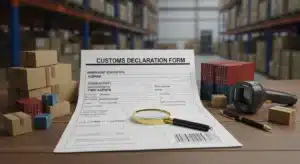
- Master Customs Declaration Form: A single filing anchored to the primary HS code, with all subordinate codes listed as line items. This is the document China Customs actually processes.
- Consolidated Commercial Invoice: All individual supplier invoices are bundled under the agent’s export entity name, with each line mapped to its 13-digit CCCHS code and corresponding FOB value.
- Consolidated Packing List: A carton-level breakdown showing exactly which SKUs occupy which cartons, cross-referenced to the master declaration. This is the document physical inspectors use during a container exam.
Every document in that hierarchy must share identical data. If the master declaration lists HS Code 71161000 (Imitation jewelry) with an FOB value of $306, the commercial invoice and packing list must reflect that exact code and exact value. A mismatch on even one digit of the 13-digit CCCHS structure is enough for customs to reject the filing.
We run an HS code pre-classification audit on all SKUs before any production begins. This catches classification conflicts early, when fixing them costs nothing. Finding out your party supplies are misclassified at the port, with goods already loaded, exposes you to 100-300% penalty fees on items under $5,000 in value. Procedural accuracy at the documentation stage is the only reliable defense against that risk.
Conclusion
Do not guess your own HS codes. A wrong classification on a $4,000 shipment triggers 100-300% penalty fees that wipe out your Amazon margin instantly. Hire an agent to lock in your 13-digit CCCHS codes before you wire any money.
Send your supplier’s product list to your sourcing agent and demand the exact 13-digit codes with duty rates in writing. Cross-check those numbers yourself using the official China Customs database. If the agent refuses to provide documented classifications, walk away.
Frequently Asked Questions
Where to find import HS codes?
You can find import HS codes through your home country’s official customs agency website, such as the HTS database in the United States or the TARIC database in the European Union. For Yiwu imports, your local freight forwarder or customs broker is also an excellent resource, as they have direct access to the most up-to-date tariff schedules. Additionally, many B2B sourcing platforms provide suggested codes, though these should always be verified with official government sources before shipping to avoid costly delays.
How to find China’s HS codes?
To find China’s specific HS codes, you can use the official China Customs HS Code query system available on the General Administration of Customs of China website. Simply enter a detailed description of your Yiwu product, its material composition, or its intended application to generate the correct 10-digit Chinese HS code. It is highly recommended to use reliable third-party trade databases that map global codes to Chinese standards, ensuring your export declarations from Yiwu perfectly align with local regulations.
Is HS code the import code?
Yes, in B2B trade terminology, an HS code and an import code generally refer to the same standardized numerical classification used by customs authorities. The HS code is a globally recognized system developed by the World Customs Organization, while the import code is simply a colloquial term for the specific, country-level version used during clearance. Keep in mind that while the first six digits of the import code are universal, your local customs will require the extended digits specific to your country to calculate duties accurately.
Where to look up HS codes?
The most reliable places to look up HS codes are official government customs databases, which guarantee compliance and accuracy for your Yiwu imports. For a more user-friendly experience, professional trade intelligence platforms offer robust lookup tools that include duty rate estimations and trade compliance tips. Always cross-reference any code you find on a commercial platform with your destination country’s official customs tariff database to ensure full regulatory compliance before finalizing your shipment.
What is HS code 7006000090?
HS code 7006000090 specifically classifies other glass under Chapter 70 of the Harmonized System, which covers glass and glassware. When importing this category from Yiwu, it typically encompasses specialty glass items that do not fall under more specific subheadings like tempered safety glass, laminated glass, or optical glass. Because this is a highly specific Chinese 10-digit export code, you must map it to your destination country’s corresponding tariff code to determine the exact import duty rate and any applicable safety certifications.