 Justin
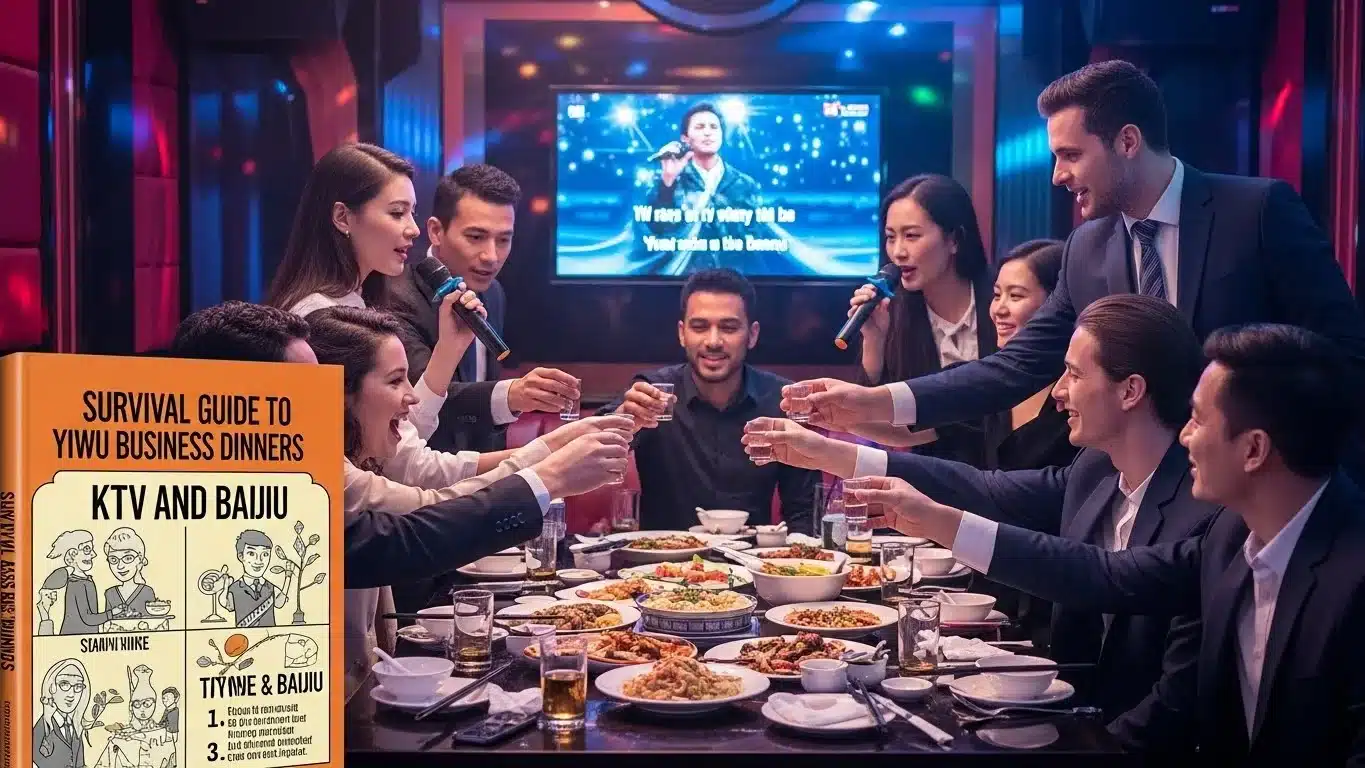
A business dinner in Yiwu is more than a meal; it’s a high-stakes ritual where deals are made or broken over baijiu and KTV. One misstep in etiquette can jeopardize a partnership before the main course arrives. This guide cuts through the complexity to give you the actionable rules you need to navigate these critical social events with confidence.

We’ll explain the unspoken rules that govern these dinners, from managing the social currency of ‘face’ (mianzi) to executing the ganbei drinking ritual. You’ll learn the logic behind seating arrangements, discover which conversation topics to avoid, and understand the protocols for after-dinner activities. We’ll cover practical details, such as how KTV rooms are soundproofed to handle noise levels up to 100 dB(A) and why you should pour tea only 70% full in a tea house.
The Importance of “Mianzi” (Face) at Dinner
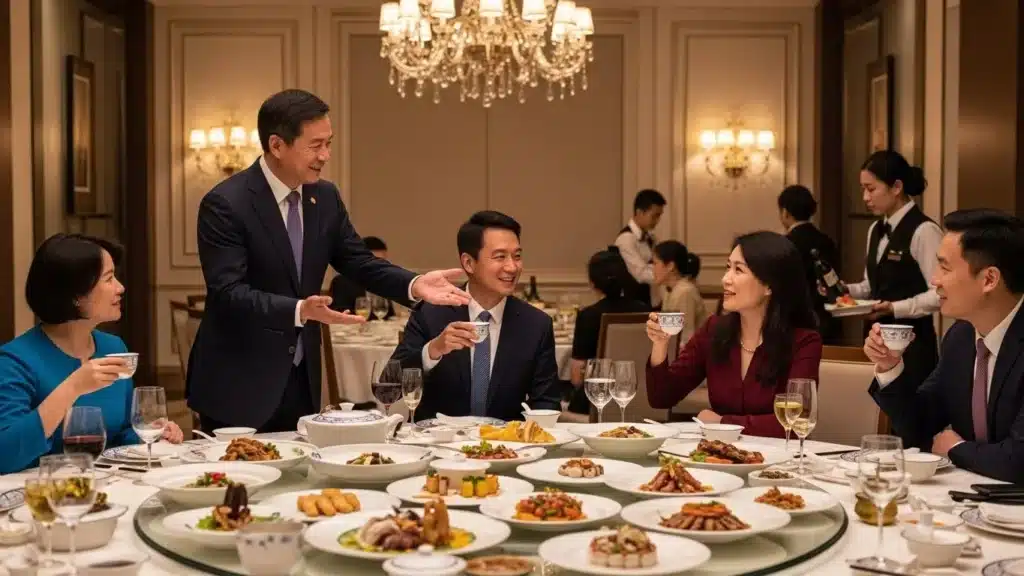
Mianzi is a person’s public reputation and social standing, treated as a form of currency exchanged at the dinner table. Hosts give face through lavish hospitality, while guests reciprocate with respect and participation. Public actions that honor or embarrass others directly affect trust and long-term business prospects.
What Mianzi Is and Why It’s a Social Currency
Mianzi (面子) refers to a person’s reputation, dignity, honor, and social standing within a group. It is the central concept in Chinese dining and business etiquette.
This concept functions as a social currency. During a banquet, mianzi is actively exchanged and managed. The event is more than a meal; it’s a structured ritual to display respect and confirm the social hierarchy among participants.
Successfully navigating this exchange is fundamental to building trust, credibility, and the long-term business relationships known as guanxi. How you handle face at the table signals your commitment to the relationship beyond the immediate deal.
How to Give Face and Avoid Causing Loss of Face
Giving face involves specific, public actions that honor your host or guests. Common methods include offering public compliments, proposing heartfelt toasts, and the ritual of “fighting” to pay the bill. Accepting at least a token sip of a offered drink is also a key gesture.
Show deference through the toasting hierarchy. Toast seniors or higher-status individuals first. When toasting them, it’s respectful to stand, hold your glass with two hands, and angle the rim of your glass slightly lower than theirs.
If you need to refuse alcohol, you can preserve face by citing health reasons, medication, or driving duties. The critical step is to then immediately participate with a soft drink, tea, or beer—maintaining the ritual of the toast while substituting the beverage.
Actions that cause a loss of face are often public and humiliating. They include contradicting someone in front of others, bluntly refusing a toast without a polite alternative, or criticizing the host’s choices (like the food or drink). Such acts can damage guanxi and jeopardize future business opportunities.
Seating Logic: Who Sits Where? (The Seat of Honor)
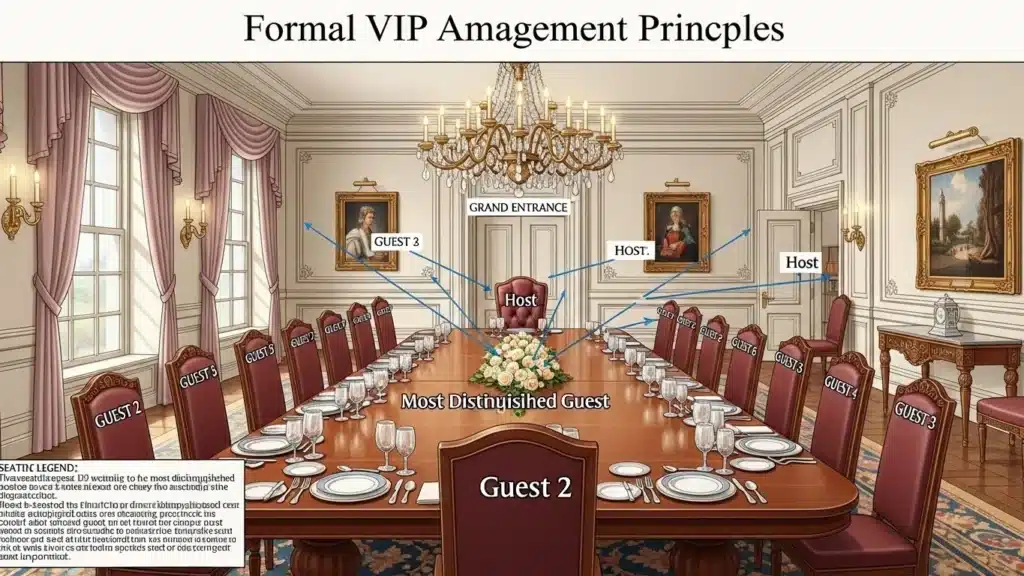
Seating follows a strict protocol based on seniority and status. The most honored guest sits in the central seat facing the entrance or east. Other guests are ranked by proximity to this seat, with the host typically sitting nearest the service door to show humility.
The Hierarchy of Seats: From the Seat of Honor to the Host
The seat of honor is the central position facing east or directly facing the main entrance. This placement symbolizes authority and visibility, placing the most respected person in a commanding view of the room.
In contrast, the host takes the least prominent seat, which is typically nearest to the kitchen or service door. This position demonstrates humility and casts the host in a role of service, prioritizing the guests’ comfort.
On a round table, guests of descending status are seated in an alternating pattern from the seat of honor. The left side (holding the 2nd, 4th, and 6th most important seats) traditionally outranks the corresponding right side (3rd, 5th, 7th). This arrangement maintains a clear hierarchy while allowing for easy conversation.
This protocol is rooted in cultural tradition rather than written rules. A key practice that reinforces this communal respect is for all other guests to wait for the senior person to be seated first.
Applying the Logic: Table Types and Multi-Table Banquets
For smaller gatherings, square or rectangular tables are common. The core principle remains: the seat of honor still faces the main entrance, establishing a clear focal point for the hierarchy.
Larger groups typically use round tables equipped with a Lazy Susan. This format is ideal for shared meals, as the rotating tray allows everyone access to dishes while the circular seating arrangement naturally maintains the established order of precedence.
At multi-table banquets, the logic scales up. The primary table of honor is positioned furthest from the entrance or facing east. The ranking of surrounding tables follows the same left-over-right principle, with tables to the left of the honor table considered more prestigious than those to the right.
In modern business contexts, official corporate rank may take precedence over age-based seniority when determining status. However, the core logic—where visibility and proximity to the seat of honor denote importance—remains the constant foundation for seating arrangements.
The “Ganbei” Ritual: How to Drink Without Passing Out
Ganbei is a Chinese drinking ritual where you empty your glass in one gulp to show respect. The shot size is often small, and you must clink glasses low to show deference. You can substitute baijiu with beer or wine, but refusing outright is considered rude.

| Key Rule | Practical Gesture | Moderation Strategy |
|---|---|---|
| Drink the entire small shot in one gulp. | Clink glasses low to show deference. | Substitute baijiu with beer or red wine. |
The Rules and Meaning of Ganbei
The ganbei ritual requires you to drink the entire contents of a small shot glass in one continuous gulp. This act is a fundamental sign of respect and a key method for building relationships in a social or business setting.
This tradition has deep roots, originating from historical practices where a subordinate would completely drink a reward offered by an emperor. The complete consumption demonstrated total acceptance and loyalty.
Refusing a ganbei toast or only taking a sip from your glass is a serious breach of etiquette. It creates an awkward atmosphere and is interpreted as a direct sign of disrespect, undermining the group’s desired harmony.
Practical Execution and Moderation Strategies
Hold your glass correctly to show respect. Use your right hand to hold the glass, while your left hand supports the bottom during the toast. This two-handed gesture signifies the importance you place on the moment.
The act of clinking glasses, or “cheers,” has a specific hierarchy. You should lower your glass to make contact with the top rim of the other person’s glass. The lower you position your own glass, the greater the deference you are showing to the other person.
You can manage your alcohol intake within the rules. It is generally acceptable to substitute the strong Chinese liquor baijiu with beer or red wine for a ganbei round. Alternating an alcoholic ganbei with a non-alcoholic drink is another practical way to pace yourself.
Stop Overpaying. Start Sourcing Smarter in Yiwu.

Conversation Taboos: What NOT to Talk About
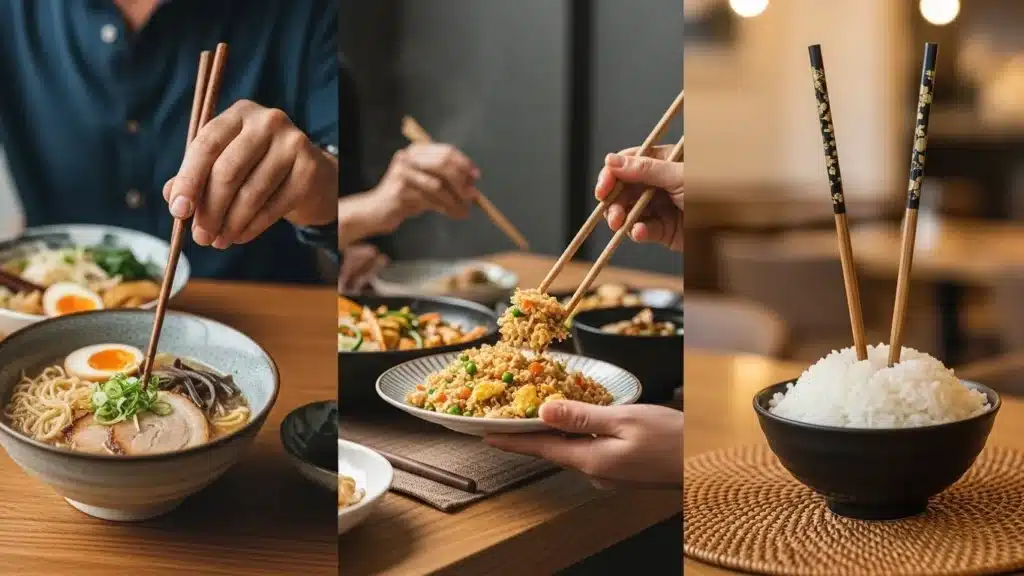
Avoid discussing sensitive political topics like Taiwan, Hong Kong, Tibet, Xinjiang, or Japanese war history. Steer clear of criticizing the government, asking personal financial questions, or disparaging local customs. At the table, do not use chopsticks to point, dig for food, or leave them upright in rice, and never pressure others to drink during toasts.
High-Risk Conversation Topics to Avoid
Political discussions are a primary area of risk. Topics concerning PRC–Taiwan relations, Hong Kong, Tibet, and Xinjiang are highly sensitive. Direct criticism of the Communist Party or government policies should be avoided entirely.
Historical grievances, particularly those related to Japanese war history, can also create significant discomfort. These subjects are often viewed through a lens of national sentiment and are best left unaddressed in a social business setting.
Inquiries into personal matters are considered intrusive. Avoid direct questions about an individual’s income, personal wealth, marital status, or whether they have children. The business meal is for building rapport, not personal investigation.
Overt criticism of local conditions can be perceived as disrespectful. Comments on Chinese customs, food safety, or environmental issues like air quality may offend your hosts and undermine the relationship-building purpose of the gathering.
The core principle is preserving ‘face’ (面子). Introducing these high-risk topics can force public disagreement or silent discomfort, causing a loss of face that is difficult to repair. The dining context is designed for harmony, not debate.
Non-Verbal Taboos and Table Manners
Chopstick etiquette is critical. Never use them to point at others, gesture while speaking, or stir food. Avoid stabbing food, digging through shared dishes to find a preferred piece, or twirling them. These actions are seen as rude or careless.
Placing chopsticks upright in a bowl of rice is a serious symbolic taboo. This resembles incense sticks placed in bowls of rice at funerals and is associated with death, making it highly inappropriate at a meal.
Toasting protocol requires participation. Do not refuse a toast outright; instead, participate with a non-alcoholic alternative like tea if necessary. It is impolite to urge others to drink or to pressure them about their alcohol capacity.
Be aware of status during toasts. When clinking glasses with someone significantly more senior, ensure your glass rim is not higher than theirs. A lower glass shows respect for their position.
The ultimate goal is to avoid causing anyone to lose composure. Publicly contradicting the host, fostering open disagreement, or any action that causes embarrassment constitutes a major breach of relationship etiquette. The entire interaction should maintain group harmony and preserve everyone’s dignity.
Who Pays the Bill? (The Fight for the Check)
In Chinese dining, the host or inviter is expected to pay the entire bill. Splitting the check is non-standard and can be awkward. Guests perform a symbolic ‘fight’ for the bill to show politeness, but must yield to the host to preserve their ‘face’ and avoid implying they cannot afford it.

The Unwritten Rule: The Host Always Pays
The person who invited or organized the meal is the default payer, especially for formal business banquets. Splitting checks, going Dutch, or requesting separate bills is non-standard and can be seen as rude or uncomfortable.
Tipping is not part of the custom in mainland China and can even be refused, as it is technically illegal in some contexts. Reciprocity is managed over time through future hosted meals, not by dividing a single bill.
Guests are expected to perform a symbolic gesture, such as reaching for the bill or verbally insisting to pay. This ‘fight’ is a face-saving ritual that publicly acknowledges generosity and status.
A guest must yield after a short, visible attempt; persisting too hard can challenge the host’s capability and cause loss of face. The correct sequence is to offer, be refused, and then graciously thank the host for their hospitality.
After Dinner: KTV & Tea House Culture
After a business dinner in China, activities often move to a KTV (karaoke) or a tea house. KTVs are regulated, high-noise venues with soundproofed rooms and professional AV systems, while tea houses are designed for quiet conversation with attention to air quality and traditional pouring etiquette.
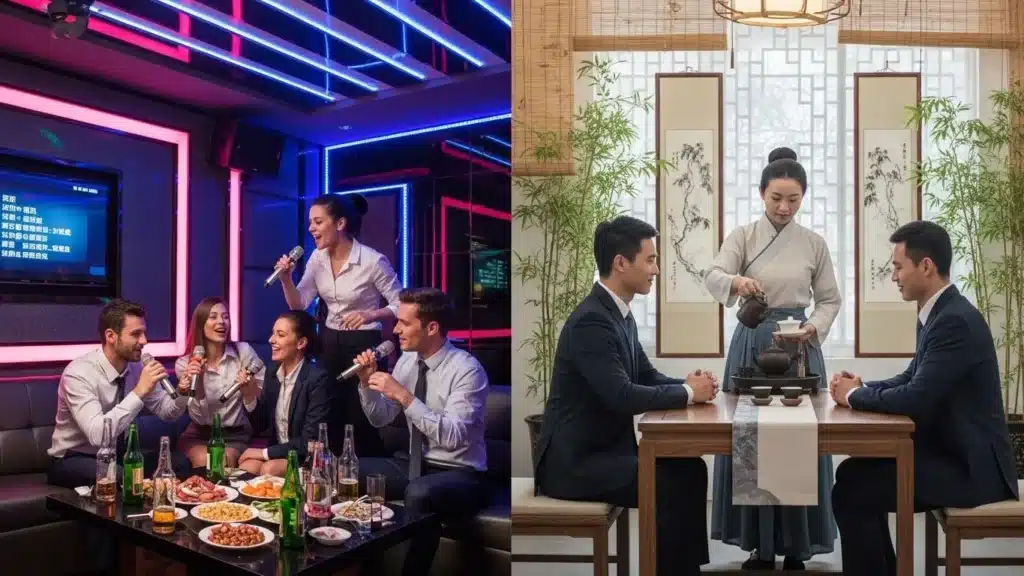
The KTV Environment: A Regulated, High-Energy Venue
KTVs are classified as singing and dancing entertainment venues under China’s Regulation on the Administration of Entertainment Venues (State Council Order No. 458). This classification requires operators to secure fire safety certification, submit noise control plans, and adhere to strict operating hours.
Private rooms are designed as acoustically isolated cells, typically ranging from 10 to 35 square meters. To contain the high sound levels, these rooms are constructed with double-layer gypsum board and mineral wool insulation, achieving sound insulation ratings (Rw/STC) between 45 and 55 decibels.
Inside a room, sound pressure levels can reach 85 to 100 dB(A) during singing, which is comparable to a nightclub. Under China’s occupational noise standard GBZ 2.2‑2007, staff exposed to levels of 85 dB(A) or higher for an 8-hour shift must be provided with hearing protection.
The standard audio-visual setup includes professional karaoke processors from brands like BMB, Yamaha, and Soundking. These drive powered speakers rated between 300 and 1000 watts, paired with 55 to 75-inch displays. Most venues use UHF wireless microphones operating in the 600–700 MHz band, often with frequency-hopping technology to prevent interference between rooms.
Tea House Culture: Quiet Spaces with Subtle Rules
Tea houses prioritize a quiet atmosphere conducive to conversation. Private rooms often target ambient noise levels below 50–60 dB(A), achieved through the use of soft furnishings, partitions, and carefully controlled background music.
These venues must comply with China’s indoor air quality standard (GB/T 18883‑2002), which sets limits for pollutants like formaldehyde (≤0.10 mg/m³) and benzene (≤0.11 mg/m³). This is particularly relevant given the often heavily decorated interiors with woodwork, paints, and new furniture.
A key informal rule of tea etiquette is to pour tea to about 70% full, known as “七分满”. This practical measure prevents spills and symbolically represents leaving room for friendship.
The environment supports specific business etiquette norms, including observing seating hierarchy and serving cups with both hands. The quiet acoustic design facilitates low-key conversation, making it suitable for continuing deal discussions in a more subdued setting than a KTV.
Final Thoughts
Navigating a Yiwu business dinner successfully means understanding that the meal itself is just one part of a larger social ritual. The real goal is building trust and demonstrating your commitment to a long-term relationship. By mastering the rules around face, seating, drinking, and conversation, you show respect for your hosts and their culture, which is the foundation of any successful business partnership.
The key takeaway is that these customs are not arbitrary obstacles, but a structured language of respect. When you correctly give face, follow the seating hierarchy, participate in the ganbei ritual, and avoid conversational pitfalls, you’re speaking that language fluently. This fluency signals that you are a reliable and respectful partner, paving the way for stronger guanxi and more fruitful business outcomes long after the last dish is cleared.
Frequently Asked Questions
What is Baijiu?
Baijiu is a Chinese distilled spirit defined by national standards as a liquor produced by solid-state fermentation and distillation of grain, typically using Daqu or Xiaoqu starter. It has a measured ethanol content generally between 28–65% vol and must meet specific sensory, physical‑chemical, and safety indices set out in the GB/T 10781 series of standards. These standards classify Baijiu into aroma types like strong aroma and sauce aroma, and prescribe limits for parameters including alcohol content, total acids, total esters, methanol, and heavy metals.
Do I need to tip in China?
No, tipping is not required or customary in China for restaurants, taxis, hotels, or most services. It is often considered unnecessary and may even be refused. The standard industry practice is zero gratuity expected. A small gratuity for escorted tour guides, typically in the range of ¥70–130 (US$10–20) per day, is a noted exception.
Where to sit at a round table?
For formal dining and banquets using round tables, the standard seating plan allocates 8 guests at a 60-inch (152 cm) round table and 10 guests at a 72-inch (183 cm) round table. This provides each guest with about 24 inches (61 cm) of table perimeter and roughly 10 square feet (0.93 m²) of floor area for comfortable seating and service.
Is it rude to leave food on the plate?
In Western and business-dining etiquette, it is not rude to leave food on your plate. Formal guides state you do not have to clean your plate and that it is polite to leave some food to signal you are satisfied. In Chinese dining etiquette specifically, leaving a small amount of food can indicate you were well hosted and are full.
What to wear to a business dinner?
For a formal business dinner, the standard is business formal attire: a dark suit (navy, charcoal, or black) with a light dress shirt and dress shoes for men, and a pantsuit, skirt suit, or conservative dress at or below the knee with closed‑toe dress shoes for women. For less formal corporate events like networking dinners, business casual to semi‑formal attire is typical, such as a collared shirt with dress trousers or a tailored dress, while avoiding denim, sneakers, and revealing styles.