 Justin
If you’re sourcing goods in Yiwu, you need a local bank account to pay suppliers quickly and avoid the high fees and compliance risks of international transfers. Without one, you’re locked out of China’s domestic payment systems and the official channels for cross-border trade.

This guide explains the specific documents you need, like a valid passport and a non-tourist visa, and compares the best banks for foreign traders. You’ll learn why a standard account can be opened with as little as 1 RMB, how the Yiwu Trade Card links to compliant settlement, and the critical step of connecting your account to Alipay for daily expenses.
Why You Need a Chinese Bank Account
A Chinese bank account is essential for integrating into China’s regulated financial infrastructure. It provides direct access to domestic payment systems, enables participation in the official foreign exchange quota, and is a prerequisite for compliant, scalable cross-border trade settlements, reducing the risk of payment delays or rejections.
Access to China’s Regulated Financial Infrastructure
A domestic RMB account is the gateway to China’s national clearing systems like CNAPS/BEPS, enabling direct and fast payments to suppliers.
It allows foreign individuals to participate in the official personal foreign exchange quota system, which limits conversions to USD 50,000 equivalent per year.
Cross-border trade settlements in RMB must be processed through licensed onshore banks under PBOC/SAFE rules; a local account is mandatory for this compliant pathway.
Using a local account aligns transactions with China’s anti-money laundering (AML) and foreign exchange monitoring frameworks, providing a documented audit trail.
Operational Requirements and Practical Benefits
Opening a standard account requires in-person verification, a valid non-tourist visa (work, study, residence), a Chinese mobile number, and proof of local address.
Accounts can be opened with minimal initial deposits; Bank of China, for example, may require as little as RMB 1 and a card fee up to RMB 5.
For businesses, a corporate RMB account is needed to handle export proceeds, make tax payments, run payroll, and use dedicated cross-border trade settlement products.
Settling large orders directly from a Chinese account minimizes intermediary bank fees, speeds up supplier payments through domestic clearing, and reduces the risk of funds being frozen due to compliance checks.
Documents Required (Passport, Visa, Residence?)
To open a bank account in Yiwu, you typically need your valid passport as the primary ID, a Chinese visa, and proof of your local address. The exact combination depends on the bank and your residency status, with some requiring additional tax forms or a local phone number.
| Document Category | Typical Requirement | Purpose & Notes |
|---|---|---|
| Primary Identity | Valid Foreign Passport | Mandatory government-issued photo ID for identity verification. Must often be valid for at least six months beyond the application date. |
| Immigration Status | Chinese Visa (e.g., M, Z, Residence Permit) | Proves legal entry and status in China. Required by banks for compliance and to determine account eligibility. |
| Residence Proof | Rental Contract or Utility Bill | Verifies your local address for KYC (Know Your Customer) and Anti-Money Laundering regulations. |
| Contact & Verification | Local Chinese Mobile Number | Essential for receiving SMS security codes and linking to digital banking services like Alipay or WeChat Pay. |
| Secondary ID (Bank-Specific) | Foreign Driver’s License or Home Country Bank Card | Some banks may request a second form of identification to further verify your identity. |
The Core Document Checklist
A valid foreign passport is the mandatory primary photo ID for identity verification. Banks use it to confirm your name, nationality, and date of birth against your visa details.
A Chinese visa, such as a business (M), work (Z), or residence permit, is required to prove your legal entry and status in the country. It is a key compliance document that determines your eligibility for certain account types.
Proof of local residence, such as a formal rental contract or a utility bill in your name, is needed for KYC (Know Your Customer) compliance. This addresses regulatory requirements to verify your physical location in China.
A local Chinese mobile phone number is almost always required to receive SMS verification codes and link to digital payment apps. This number will be registered to your account for all future security authentication.
Some banks may request a second form of ID, like a foreign driver’s license or a credit/debit card from your home country. This provides an additional layer of verification, especially if your passport information is being processed for the first time.
Practical Requirements and Bank-Specific Variations
Bank of China often requires an in-person visit and may ask for a work permit or proof of employment for certain account types. Their process tends to be thorough, aligning with their role as a major international and state-owned bank.
Yiwu Rural Commercial Bank, popular with traders, may have more flexible requirements but typically insists on a local address and phone number. Their focus is often on facilitating business transactions for the local market.
Your passport must generally be valid for at least six months beyond your application date, a common international banking standard. This reduces the risk of the document expiring while the account is active.
For non-residents or short-term visitors, some banks may accept a hotel registration document as temporary proof of address. This is not universally accepted and is often at the discretion of the branch manager.
The process is almost exclusively conducted in-branch; online pre-registration for foreigners is rarely available. You should be prepared to visit a branch with all original documents, and the procedure may take one to two hours.
The “Yiwu Trade Card” (采购商卡) Explained
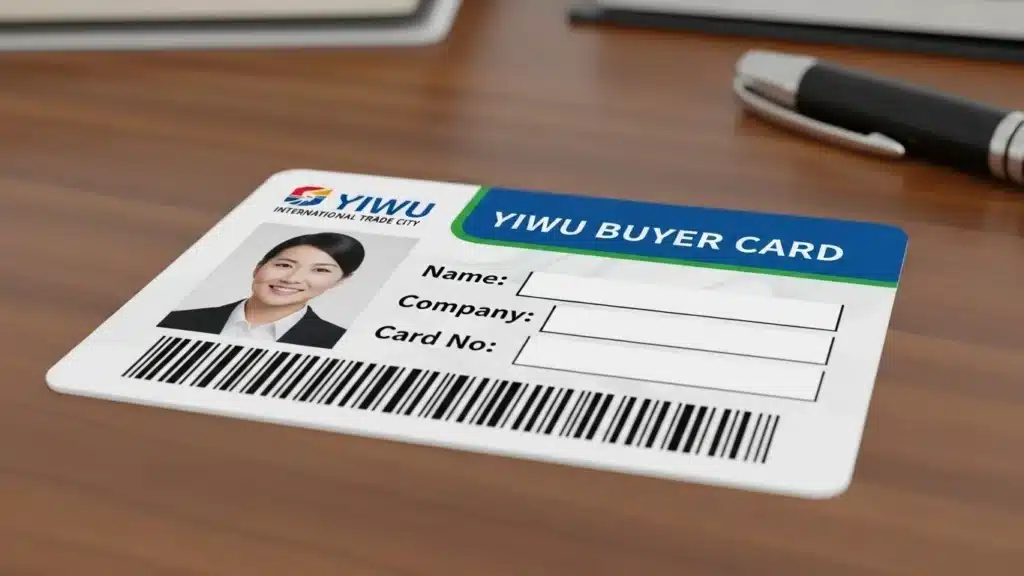
The Yiwu Trade Card is a buyer ID issued by the Yiwu International Trade City operator. It registers foreign purchasers within the official market procurement trade system, linking their identity to customs, banking, and foreign exchange platforms for compliant trade under China’s special regulations.
| Entity | Role/Function | Key Detail |
|---|---|---|
| Zhejiang China Commodity City Group Co., Ltd. | Issuer & System Operator | State-linked operator of Yiwu International Trade City; manages the card and the trade platform. |
| Yiwu Trade Card (采购商卡) | Foreign Buyer Identity Token | Registers identity, grants market hall access, and links to banking/regulatory systems for trade under code 1039. |
| Market Procurement Trade (Code 1039) | Regulatory Framework | National pilot allowing simplified export; single customs declaration capped at USD 150,000 per shipment. |
| Designated Banks (e.g., BOC, ICBC) | Financial Settlement Channel | Provide linked RMB settlement accounts and cross-border RMB services compliant with PBOC/SAFE rules. |
| Zhejiang E-Port / Yiwu Trade Platform | Central Information Hub | Ties cardholder data to systems used by Customs, MOFCOM, and the State Administration of Foreign Exchange (SAFE). |
What It Is and Why You Need One
The Yiwu Trade Card is issued and managed by Zhejiang China Commodity City Group Co., Ltd., the state-linked operator of Yiwu International Trade City. It serves as your official identity registration as a foreign buyer within the Yiwu market ecosystem.
You need this card to participate in China’s national pilot for “market procurement trade,” which operates under Customs supervision code 1039. This regime allows for simplified export procedures not available under standard trade codes. The card is also a practical token for market hall access and registration, and it is a prerequisite for opening the dedicated RMB settlement accounts required for formal, large-scale transactions with partner banks in Yiwu.
How It Works: Linking to Banking and Regulations
The card’s data is integrated into the Zhejiang E-Port, specifically the Yiwu Market Procurement Trade Networked Information Platform. This system is used by Chinese Customs and the State Administration of Foreign Exchange (SAFE) to monitor and regulate trade flows. This integration is what enables you to use cross-border RMB settlement services at designated banks like Bank of China and ICBC in Yiwu, ensuring all foreign exchange movements are compliant.
A critical function of this linked system is enforcing regulatory limits. The market procurement trade regime has a hard cap: single customs declarations cannot exceed USD 150,000 in value per shipment. This card and its backend ties are essential for transactions approaching this bracket. For smaller, on-the-spot purchases of a few hundred dollars, many vendors operate outside this formal system and typically only accept cash RMB, meaning the card is not used for those transactions.

Best Banks for Foreigners (Bank of China vs. Yiwu Rural)
For foreigners in Yiwu, Bank of China offers a safer, more scalable option with English support and established cross-border services. Yiwu Rural Commercial Bank, while local, carries a higher risk of account freezes if used for commercial foreign exchange transactions, as seen in recent enforcement actions.

Bank of China: The Established Choice for Foreigners
Bank of China is the recommended national bank for foreigners due to its stability and established procedures. Opening a standard personal account requires a passport, a non-tourist visa or residence permit, a Chinese mobile number, and a local address.
For a personal USD account, the typical minimum opening deposit is around 500 USD. The bank provides English-language online banking, wide branch and ATM coverage, and reliable channels for cross-border payments and foreign exchange conversions.
It is consistently a top choice for expats because of its predictable compliance framework. With proper documentation, such as contracts and tax receipts, customers can often negotiate higher transfer limits for outgoing foreign currency.
Yiwu Rural Banks: Understanding the Local Risk Profile
Yiwu Rural Commercial Bank falls under the smaller ‘rural commercial bank’ category. These institutions have far less compliance infrastructure and balance sheet scale compared to national banks like Bank of China.
In Yiwu, regulators have frozen many personal accounts used for commercial foreign exchange to enforce capital controls. There are documented cases where accounts with millions of RMB in working capital were locked due to investigations into much smaller alleged violations.
These local banks are more vulnerable to shifts in local enforcement. While they may work for basic retail banking, using a personal account at a Yiwu rural bank for regular, large trade payments carries a significantly higher risk of sudden account freezes and operational disruption.
For trade activities, Chinese regulators expect proper company accounts to be used. Large advance-payment contracts must be registered with the State Administration of Foreign Exchange (SAFE) within 15 working days of signing and again 15 days before the remittance. Failing to do so risks having transactions blocked.
Linking to Alipay/WeChat for Daily Life
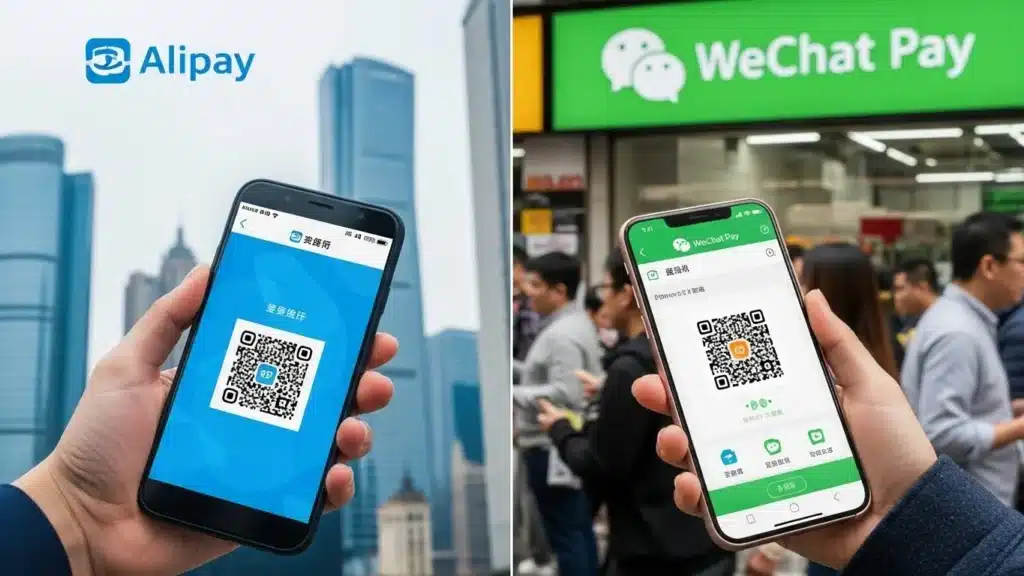
Linking a Chinese bank account to Alipay or WeChat Pay unlocks QR code payments for everything from meals and transport to shopping and bills. The setup involves adding your card details in the app’s wallet section and verifying with an SMS code. Once linked, payments draw directly from your account, making cash and cards largely unnecessary for daily life in China.
How to Link Your Bank Account
To connect your bank card to Alipay or WeChat Pay, start by downloading the app and creating an account. You can use a foreign phone number for the required SMS verification.
Navigate to the ‘Bank Cards’ or ‘Wallet’ section within the app and select ‘Add Card’. Input your card details, including the card number, expiry date, and CVV.
Complete the setup by entering the SMS verification code sent to your phone. For some users, the app may require an optional trial payment or ask you to upload a passport photo for identity verification and activation.
Tourists can link international debit or credit cards directly. However, success depends on your card issuer and its compatibility with the Chinese payment network, so results can vary.
Understanding Payment Limits and Daily Use
Transaction limits differ between platforms. WeChat Pay allows top-ups of up to RMB 50,000 per transaction per day from a single savings card. Alipay caps per-transaction top-ups at RMB 1,000 for cards but offers cash top-ups up to RMB 5,000 per transaction without a daily limit.
Daily transfer limits are typically RMB 200,000 across both platforms. Withdrawal caps are usually set at RMB 50,000 per transaction.
Use the apps for QR code payments at physical stores, within WeChat mini-programs, for public transport, utility bills, and peer-to-peer money transfers. These transactions are often secured with biometric authentication like fingerprint or facial recognition login.
You cannot transfer funds directly between your Alipay and WeChat Pay balances. To move money, you must use a shared, linked bank account as an intermediary.
Final Thoughts
Opening a bank account in Yiwu is a straightforward but essential step for any foreigner planning to live or do business there. The process centers on having the right documents—a valid passport, a non-tourist visa, proof of local address, and a Chinese mobile number—and visiting a branch in person. While local banks like Yiwu Rural Commercial Bank are an option, major state-owned banks such as Bank of China offer more reliable services, better English support, and a lower risk of account freezes, especially for handling trade-related transactions.
Beyond basic banking, your account is the key to integrating into China’s digital economy. Linking it to Alipay or WeChat Pay unlocks seamless QR code payments for daily life. For serious traders, obtaining a Yiwu Trade Card and using the formal market procurement system (code 1039) provides a compliant pathway for larger-scale, cross-border settlements. Ultimately, a local bank account is not just a convenience; it’s the foundation for operating smoothly and legally within China’s regulated financial and commercial systems.
Frequently Asked Questions
Can a foreigner open a bank account in China?
Yes, foreigners can open a personal bank account in Mainland China. Major banks typically require a non-tourist visa (such as for work, study, or residence), an in-person application at a branch, a Chinese mobile number, a local address, and an initial deposit of around 100 to 200 RMB. Tourist (L) visas are generally not accepted for opening new accounts.
What documents do I need to open a bank account?
The standard requirement for a personal account includes your valid passport, a Chinese visa (non-tourist), proof of local address in China (like a rental contract or utility bill), and a Chinese mobile number. You will also need to make an initial deposit, which is commonly between 100 and 200 RMB. Some banks may ask for additional documents like a work permit or student ID.
Can I open an account on a tourist visa?
Opening a standard personal bank account with a tourist (L) visa is very difficult and typically not permitted by major Chinese banks. Banks require a visa that demonstrates longer-term residence, such as a work (Z), study (X), or residence permit. If you are in China on a tourist visa, your options for formal banking services are extremely limited.
Which bank is best for foreigners in Yiwu?
For foreigners in Yiwu, Bank of China (BOC) and Industrial and Commercial Bank of China (ICBC) are often the top choices. These major banks have extensive ATM networks in the city, offer better support for international transactions and currency exchange, and their staff are more likely to have experience assisting foreign clients compared to smaller local banks.
How do I get a Yiwu Trade Card (采购商卡)?
The Yiwu Trade Card, or buyer’s badge, is issued free to overseas buyers. You can register online through the official Yiwu Fair system or via their WeChat platform before the event. Alternatively, you can register on-site at the Yiwu International Expo Center by presenting your passport and a business card. If you already have a Canton Fair trade badge, you can often exchange it directly for a Yiwu badge.