 Justin
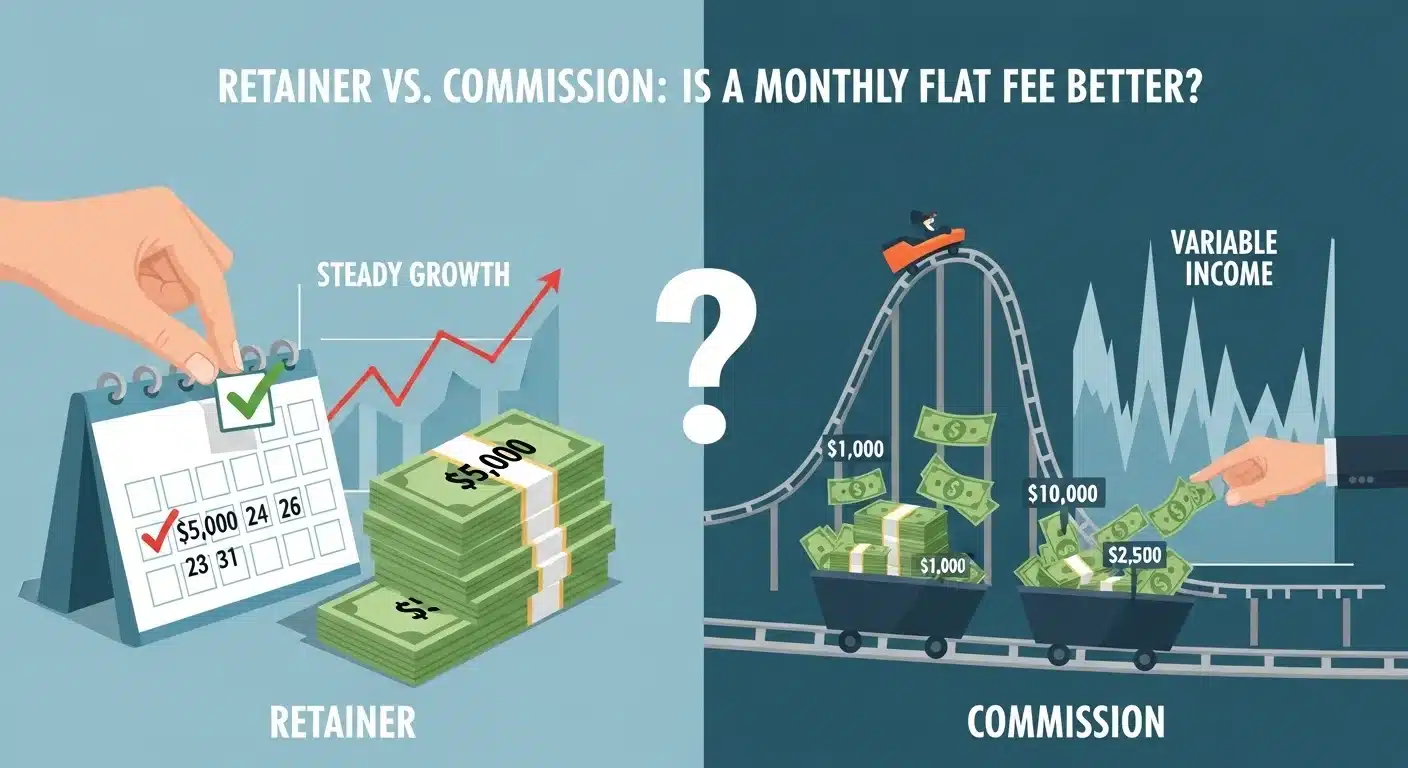
Choosing between a commission and a monthly retainer for your sourcing agent isn’t just about cost—it’s about aligning your payment structure with your business’s predictability and growth stage. A variable commission might seem logical, but it can create budgeting headaches and misaligned incentives if your monthly order volume is stable.
This article compares the core fee models for sourcing agents, using data to show when a flat monthly retainer becomes the smarter financial choice. We’ll examine the cost predictability of a retainer—where average annual fees are around $4,484—versus the variable nature of commissions, and explore how a hybrid model with a low base fee plus a small commission can work for growing businesses. You’ll also learn what specific services, like quality control and supplier management, are typically bundled into a retainer agreement.
The 3 Main Fee Models (Commission/Hourly/Retainer)
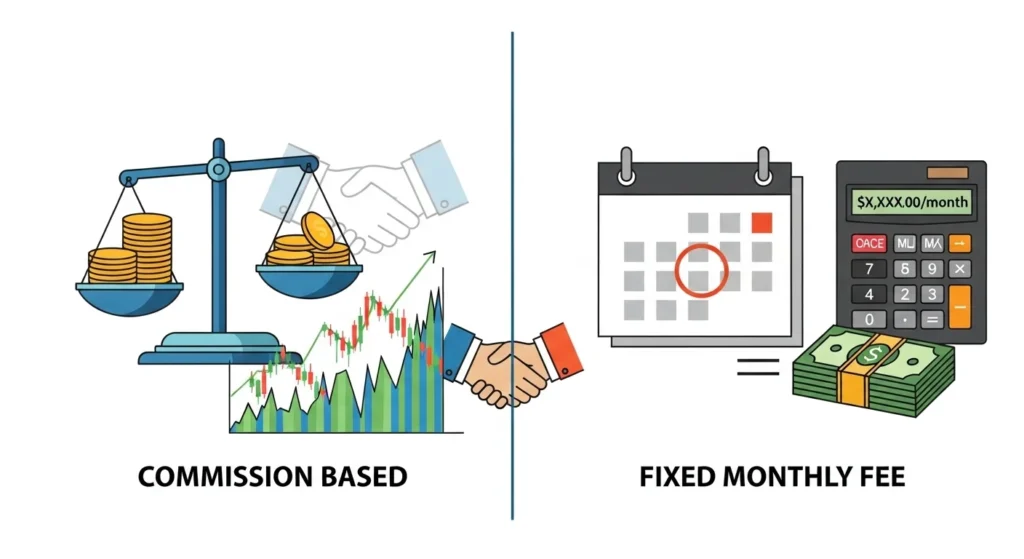
Sourcing agents typically charge via commission (a percentage of order value), hourly rates (billed for time spent), or retainers (a fixed monthly fee). Each model offers different benefits: commission aligns agent pay with order volume, hourly provides flexibility for variable work, and retainers ensure dedicated service and predictable budgeting.

How Each Model Works for Sourcing
The commission model applies a percentage to the total order value. This approach is common for straightforward procurement, where the agent’s effort naturally increases with the purchase volume.
With hourly billing, you pay for the actual time spent on specific tasks. This could include supplier negotiation, factory audits, or quality control inspections. It’s a flexible option for projects where the full scope of work isn’t clearly defined from the start.
A retainer is a fixed monthly fee. This secures a set amount of the agent’s time or a pre-defined bundle of services. It provides clients with priority access and makes costs predictable, which helps with long-term budgeting.
Comparing Costs, Risks, and Fit
Looking at financial advisory benchmarks, average hourly rates are around $268, while annual retainer fees average $4,484. This illustrates the cost predictability that comes with a fixed-fee structure.
The retainer model, used by roughly 16% of consultants, offers stability for both parties. It provides the agent with steady revenue and protects the client from budget overruns that can happen when a project’s scope expands unexpectedly.
Commission models shift performance risk to the agent, as their pay is tied directly to completing an order. This can be cost-effective for clients with high-volume, low-complexity purchases, as you pay primarily for results.
In practice, agency models often blend these structures. A hybrid approach might combine a lower fixed monthly retainer with variable hourly or commission-based components for specific tasks, creating an adaptable billing framework.
When to Switch to a Flat Monthly Fee
Switching to a flat monthly fee is ideal when your sourcing needs become predictable and routine, eliminating the administrative overhead of per-order billing. This model offers budget certainty and simplifies partnership management, especially for clients with steady, recurring purchase volumes or those who value a single point of contact for ongoing supplier management and quality oversight.
| Pricing Model | Key Metric | Data Point |
|---|---|---|
| Tiered Pricing (SaaS) | Average Revenue Per User (ARPU) | 44% higher than flat-rate models |
| Flat-Rate Pricing (SaaS) | Customer Acquisition Cost (CAC) | 14% lower than tiered models |
| Tiered Pricing (SaaS) | Free-to-Paid Conversion Rate | 27% higher than flat-rate models |
| Flat-Rate Credit Card Processing | All-in Rate (e.g., PayPal) | 2.7% per swiped transaction |
| Tiered Credit Card Processing | Qualified Rate | 1.69% |
| Tiered Credit Card Processing | Mid-Qualified Rate | 2.50% |

The Core Business Case for a Flat Retainer
A flat monthly retainer becomes the optimal choice when your sourcing operations are stable and predictable. This means you have consistent monthly order volumes or a regular cadence for new product development.
This model is for businesses that prioritize simplicity and budget certainty. The goal shifts from optimizing for marginal cost savings on each transaction to eliminating the administrative cost and complexity of tracking commissions, hourly work, or tiered fees.
A flat fee aligns with a strategic partnership. It supports the ongoing communication, supplier management, and market intelligence required beyond discrete transactions. It fits a low-variance environment where product categories and supplier networks are well-established, minimizing the need for intensive, variable-cost discovery work.
Data-Driven Thresholds and Comparative Metrics
Data from other industries helps quantify the decision. In SaaS, flat-rate models show a 14% lower customer acquisition cost but can cap revenue potential. Tiered models, in contrast, boost average revenue per user by 44%.
Payment processing offers a direct analogy. A flat all-in rate of 2.7% per transaction simplifies billing for low-volume operations. Tiered rates, which can range from 1.69% to 2.50%, require more volume to become cost-effective but offer lower rates at scale.
A key financial indicator is your predictable ‘effective rate’ for total sourcing costs. A flat fee stabilizes this cost as a percentage of your processed volume. The switch is advantageous when the value of predictable monthly overhead and reduced administrative work exceeds the potential savings from a variable, volume-based commission structure.
The “Hybrid Model”: Low Retainer + Low %
This model blends a predictable monthly fee with a small commission tied to order value. It offers clients budget stability while aligning the agent’s incentives with sourcing success, making it suitable for growing, volume-based relationships.

How the Hybrid Model Works: Structure and Rationale
This approach combines a base retainer fee, typically between $2,000 and $4,000 per month, with a low commission on the total order value, often in the 1-3% range.
The fixed retainer covers the core operational costs of the sourcing service. This includes ongoing supplier communication, initial quality control setup, and project management, ensuring the agent’s availability and foundational work are consistently funded.
The low percentage commission directly ties the agent’s additional compensation to the client’s sourcing volume and success. This creates an incentive for the agent to maximize order value and efficiency without imposing a significant variable cost burden on the client.
For the client, this structure provides budget predictability from the retainer while the agent is motivated to grow the business. It’s common to implement this model after an initial period, such as six months of a fixed-fee arrangement, to establish a reliable performance baseline before introducing variable components.
Implementation and Performance Metrics
This model fits clients with consistent monthly order volumes who seek to control variable costs. Data indicates that clients on hybrid pricing structures show a 79% retention rate, generating an average monthly revenue of $12,600 for the service provider.
A break-even analysis is useful to compare the total cost of the hybrid model against pure commission or pure retainer models at different order volumes. This helps clients understand the cost-benefit at their specific scale.
Defining the scope covered by the retainer is critical. It usually includes standard quality control inspections (like AQL Level II), logistics coordination, and ongoing supplier management. Success depends on transparent reporting and agreed-upon key performance indicators, such as on-time delivery rates and defect percentages identified during inspections.

Project-Based Fees for One-Off Sourcing
A project-based fee is a fixed price for a defined sourcing task, like finding a new supplier or managing a single production run. It offers clients predictable costs and a clear scope of work, contrasting with open-ended hourly billing. This model is ideal for one-off needs where the deliverables and timeline are specific.

How Project-Based Pricing Works for Sourcing
This model defines a specific deliverable, such as securing three verified supplier quotes or managing a complete production run from order to shipment.
A common payment structure is a 50% deposit to start, 25% at a project midpoint like sample approval, and 25% upon final deliverable completion.
The fee is calculated to cover all service costs, including labor, overhead, and a buffer for project management and minor scope adjustments.
It provides budget predictability for clients, eliminating the uncertainty of hourly billing where time overruns increase costs.
Calculating Fees and Managing Project Scope
A standard pricing formula targets a 70% delivery margin: Minimum Project Price = Total Delivery Cost ÷ 0.3. For example, a $5,000 cost requires a minimum project price of $16,667.
Effective hourly rates can be 20-40% lower than standard billable rates after accounting for unbilled time, revisions, and scope creep, which is why fixed pricing includes buffers.
Clear scope definition is critical, specifying details like the number of supplier quotes, revision rounds for samples, and exact inspection standards (e.g., AQL Level II).
Healthy projects keep scope change incidents below 20% of the project value. Any major changes should trigger a formal change order, billed separately.
Calculating the Break-Even Point (Volume)
The break-even point is the number of units you must sell to cover all your costs. It’s calculated by dividing your total fixed costs by the profit you make on each unit after paying variable costs. This tells you the minimum volume needed before you start making money.
| Cost Type | Definition | Sourcing Example |
|---|---|---|
| Fixed Costs | Expenses that do not change with production volume. | Monthly retainer fees, software subscriptions, salaried staff. |
| Variable Cost per Unit | Costs that scale directly with each unit produced. | Factory price per item, material costs, per-unit inspection fees. |
| Contribution Margin | Selling price minus variable cost; the profit per unit available to cover fixed costs. | If you sell an item for $7 and its variable cost is $2, the contribution margin is $5. |

The Break-Even Formula and Its Components
The standard formula is: Break-Even Point (Units) = Fixed Costs ÷ (Selling Price per Unit − Variable Cost per Unit).
Fixed Costs are expenses that don’t change with order volume, like monthly retainer fees, software subscriptions, or salaried staff.
Variable Cost per Unit includes all costs that scale directly with production, such as factory price per item, material costs, and per-unit inspection fees.
The result (Selling Price − Variable Cost) is the Contribution Margin, which is the profit from each unit available to cover your fixed costs.
Applying the Calculation to a Sourcing Project
For a project with $6,000 in fixed service fees, a $7 retail price, and a $2 factory cost per unit, the break-even volume is 1,200 units ($6,000 ÷ ($7 – $2)).
This calculation helps decide between fee models: a high-volume order may justify a lower per-unit commission, while a small batch might need a higher flat project fee to cover fixed costs.
The analysis should include all variable costs like quality control, shipping, and customs duties to get an accurate per-unit cost for the formula.
What’s Included in a Retainer? (QC/Dev/Logs)
A sourcing retainer typically bundles recurring services into a predictable monthly fee. This includes ongoing quality control (QC) inspections, supplier development (Dev) tasks like vetting new factories, and operational logs for monitoring production and shipments. The agreement defines clear boundaries like maximum monthly hours and response times to prevent scope creep.

Core Retainer Services: QC, Development, and Monitoring
The retainer is built on three interconnected service pillars that provide continuous oversight and improvement for your supply chain.
Quality Control (QC): This involves routine AQL Level II inspections at the warehouse to check bulk order quality against agreed standards. It also covers verifying pre-production samples before manufacturing begins and managing the immediate return of any defective goods to the factory for correction.
Supplier Development (Dev): These are the ongoing tasks required to maintain and improve your supplier base. Activities include vetting and onboarding new factories, negotiating terms or pricing with existing partners, and managing minor product updates or modifications as needed.
Logs & Monitoring: This pillar ensures full supply chain transparency. It involves continuous oversight of production timelines, tracking shipment status from factory to port, and maintaining detailed communication logs. This creates a clear, auditable record of all activities and milestones.
Service Boundaries, SLAs, and Agreement Terms
Clear operational limits and performance standards are essential for a successful retainer relationship, ensuring both parties understand what is covered and how work is prioritized.
Defined Scope Exclusions: Retainers are designed for recurring maintenance and support. They explicitly exclude major new projects, such as full product implementations or developing entirely new product lines, which require separate project-based agreements and scoping.
Service Level Agreements (SLAs): These define performance expectations. Standard response times are typically set for emails (within 4-6 business hours) and phone calls (within 24 hours). Procedures for handling urgent matters, which are explicitly defined, require a response within 2 hours. The retainer also includes a maximum number of hours per month, with a separate process for approving and handling any work that exceeds this cap.
Agreement Structure: Initial retainer contracts are typically structured with annual review and renewal periods. It is common for these ongoing partnerships to have a total engagement framework lasting up to five years, providing long-term stability and continuous improvement.
Final Thoughts
The best fee model depends on the predictability of your sourcing needs. For businesses with stable, recurring orders, a flat monthly retainer provides budget certainty and simplifies partnership management. If your sourcing is project-based or highly variable, commission or hourly models might offer more flexibility. The hybrid model, combining a low retainer with a small commission, often strikes the right balance for growing businesses, aligning incentives while maintaining some cost predictability.
Your choice ultimately shapes the relationship with your sourcing agent. A retainer fosters a strategic, ongoing partnership focused on long-term supply chain health, while transactional models prioritize individual project outcomes. Consider your operational rhythm, financial priorities, and the level of ongoing support you need to decide which structure unlocks the most value for your specific business.
Frequently Asked Questions
How much is a sourcing agent retainer?
Industry standard sourcing agent retainer fees range from $500 to $5,000 per month. Common structures include a $500 monthly fee plus commission, a $1,000 monthly fee in a hybrid model, and fees up to $5,000 for comprehensive, ongoing services that cover supplier management, quality control, and logistics.
Is commission better for small orders?
No, commission is generally not better for small orders. Flat rate models are more cost-effective because a commission takes a higher relative percentage of the order value. For example, a 20% commission on a $2,500 order costs $500, which often exceeds a standard flat transaction fee.
What is the average sourcing fee percentage?
The industry standard for commission-based sourcing agent fees is 3-10% of the total order value. For product sourcing specifically, common rates are typically between 5% and 10%.
Can I hire an agent hourly?
Yes, you can hire an agent on an hourly basis. Rates vary significantly by service type and location. For BPO or call center agents, offshore rates range from $8–$15/hour, nearshore from $20–$30/hour, and onshore from $40–$60/hour. Agency or specialized marketing agent services can range from $75 to $250 per hour.
What is the cost of a full-time sourcing agent in China?
The standard cost for a dedicated, full-time sourcing agent based in China is approximately $1,500 per month. This is often structured as a transparent fixed salary where the buyer pays the agent directly for their services while managing factory payments separately.