
 Justin
If you’re sourcing from multiple suppliers in China, you’re likely dealing with a tangle of separate shipments, each adding its own paperwork, fees, and risk of delay. This fragmented approach doesn’t just complicate logistics—it inflates costs and creates unnecessary vulnerabilities in your supply chain.
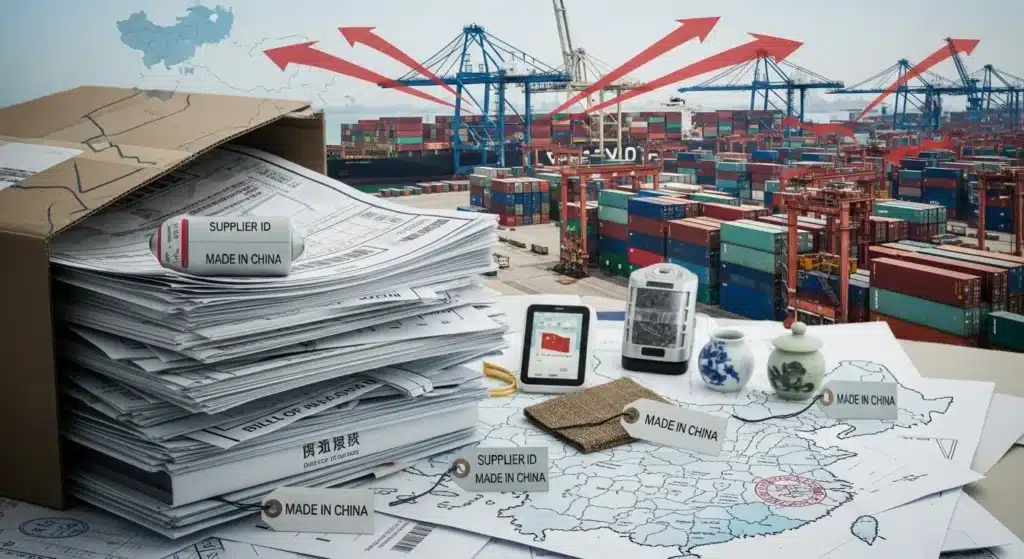
This guide explains how shipment consolidation turns that complexity into a single, streamlined process. We’ll break down the operational workflow, show you the precise volume threshold (13-15 CBM) where switching to a full container becomes cheaper, and detail how proper documentation like packing lists and HS codes is critical for avoiding customs holds.
The Logistics Nightmare of Multiple Suppliers
Managing multiple suppliers means juggling separate shipments, each with its own paperwork and handling stages. This fragments your logistics, multiplying the risk of delays, errors, and damage. Consolidation solves this by merging goods from various sources into a single, streamlined shipment.
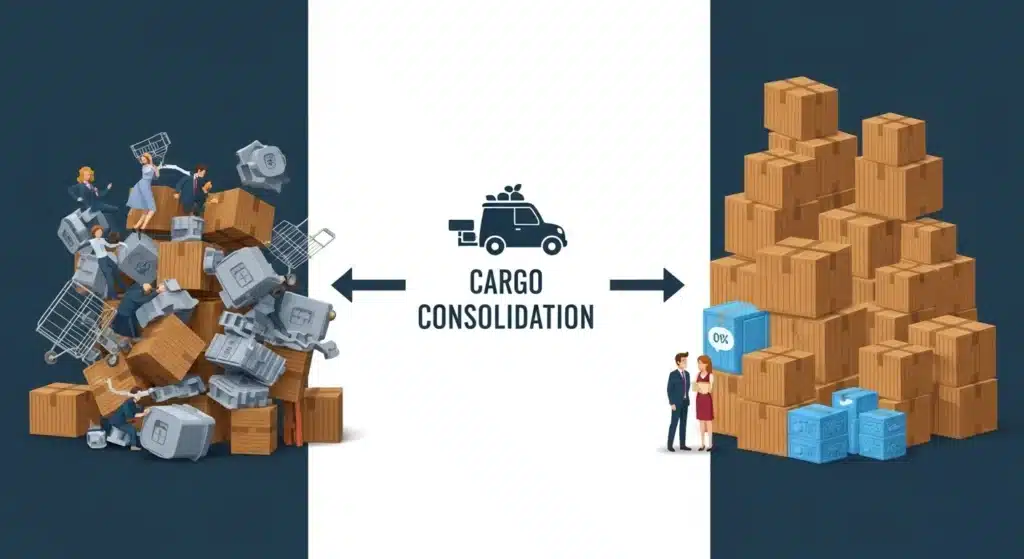
The Compounding Complexity of Multi-Vendor Shipments
Each supplier’s shipment typically passes through 4–6 separate handling stages, from local pickup to final delivery. Every handoff—from the supplier to a local carrier, then to an origin consolidation hub, onto a line-haul container, through a destination hub, and finally to the last-mile carrier—introduces a new opportunity for damage or delay.
The administrative burden grows exponentially. Every shipment inside a consolidated container requires its own House Bill of Lading, packing list, and compliance filings. A single 40-foot LCL container can contain 20–50 individual HBLs, creating a mountain of paperwork compared to a single FCL Bill of Lading.
For each supplier, forwarders must track unique SKUs, carton counts, HS codes, and precise weight and dimension data, then bill each one separately. This “documentation overload” is a primary source of manual error, as noted by logistics platforms like Magaya.
How Integrated Systems and Hub Operations Mitigate the Chaos
Managing this complexity requires specific infrastructure. Effective multi-vendor consolidation depends on a central hub or Container Freight Station (CFS). Here, goods from multiple suppliers are received, sorted, re-labeled, and palletized before being loaded into optimized containers for a single consignee.
Modern logistics systems use explicit rules to automate the grouping process. They factor in dimensional weight, carrier capacity limits, delivery promise windows, and routing rules to decide how to best merge orders from different suppliers into a single, cube-optimized container move.
This process is far more manageable with an integrated technology platform. When shipping, warehousing, and accounting functions are connected in a single TMS/WMS/ERP system, it automates billing and tracking across all suppliers. This integration eliminates the need for manual, shipment-by-shipment reconciliation, which is a major pain point in multi-vendor logistics.
How Consolidation Works (Step-by-Step)
Consolidation is a multi-stage operational workflow. Individual shipments are first collected and documented. They are then sorted and grouped at a central hub, where they are strategically loaded into a container or truck to maximize space. The combined load moves as one unit to a destination hub, where it is finally broken down for last-mile delivery to each consignee.
| Stage | Core Action | Key Objective |
|---|---|---|
| 1. Intake & Collection | Weigh, count, label, and condition-check each piece against paperwork. | Accurate documentation and validation for correct routing assignment. |
| 2. Hub Receipt & Sorting | Move shipments to a consolidation hub; sort and group by destination and schedule. | Build dense, economical loads that meet cut-off times. |
| 3. Grouping & Loading | Apply space-optimization rules (cube utilization, stackability, weight distribution). | Maximize container/truck capacity while meeting carrier safety constraints. |
| 4. Line-Haul Transport | Move the consolidated load as a single shipment. | Leverage truckload/FCL pricing and faster transit; maintain individual shipment traceability. |
| 5. Deconsolidation & Breakdown | Separate the load at a destination hub by final consignee. | Prepare each original shipment for last-mile delivery. |
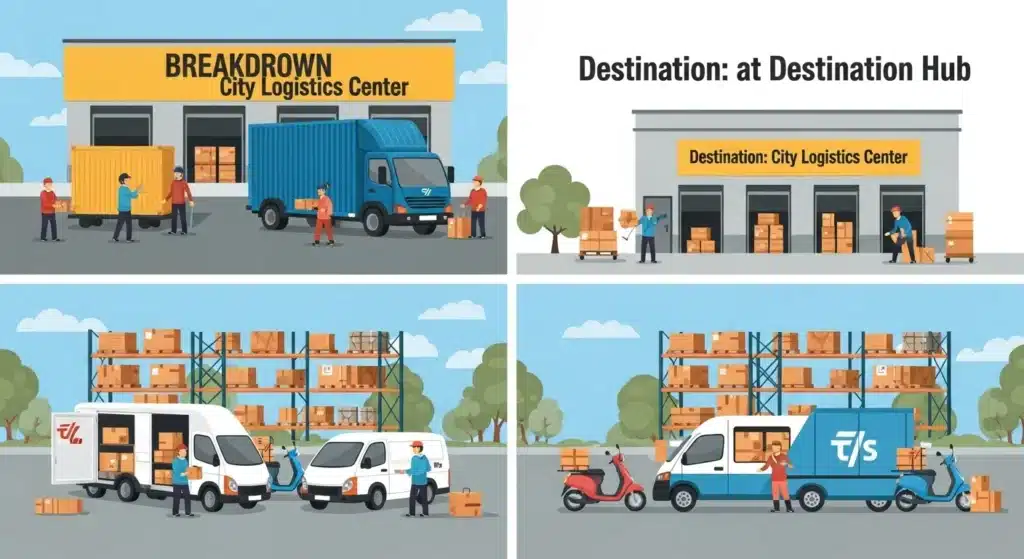
The 5-Stage Operational Workflow
The process begins with Intake & Collection, where each piece is weighed, counted, labeled, and its condition checked against paperwork.
Shipments move to a Consolidation Hub for sorting and grouping by destination and schedule to build dense loads.
Operators then Group & Load freight, applying space-optimization rules for cube utilization (CBM), stackability, and weight distribution in a container or truck.
The consolidated unit travels as a Single Line-Haul Shipment, benefiting from truckload or FCL pricing and faster transit compared to individual LCL moves.
The process concludes with Deconsolidation & Breakdown at a destination hub, where freight is separated for final delivery to each consignee.
Consolidation Models and Planning Logic
Common engineering models include Pooling (multiple origins into one steady route), Cross-Docking (rapid transfer with minimal storage), Hub Consolidation, and Scheduled Consolidation with fixed departures.
For e-commerce and parcel shipping, order-level systems use software to group orders by delivery location and promise date, then calculate dimensional weight (DIM) and check carrier capacity limits.
Advanced planning applies pre-set business rules to decide whether to consolidate orders or ship them individually, balancing speed against cost savings.
A key data point shows FCL moves approximately 10–20% faster than LCL because consolidated LCL loads add handling and coordination time at hubs.
FCL vs. LCL: When to Switch?
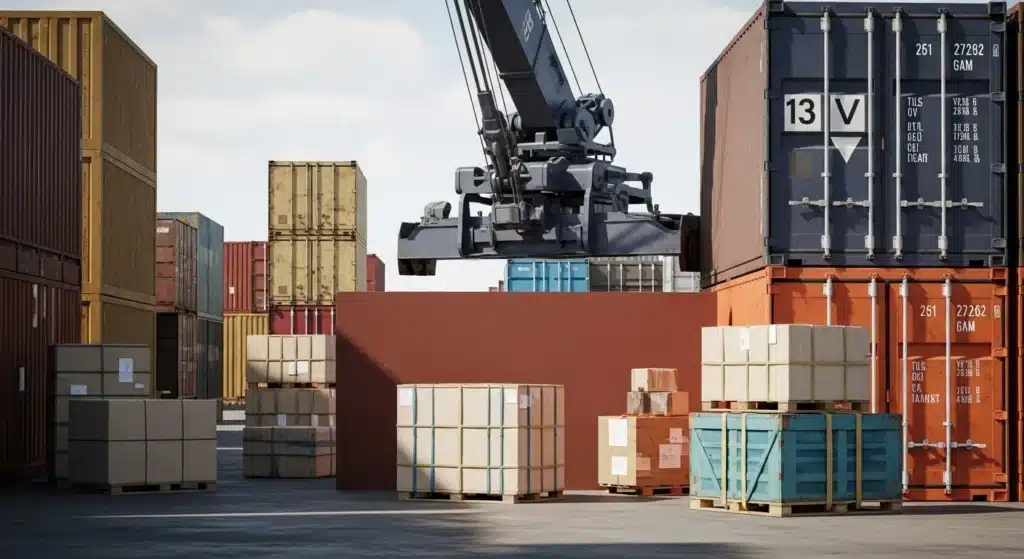
The primary decision is based on your shipment’s total volume. LCL is typically cost-effective for shipments under 13-15 cubic meters (CBM). Once your volume exceeds this range, a 20-foot FCL container often becomes cheaper and faster, even if it’s not completely full. Other factors like security, transit time, and handling complexity also play a role.
| Volume (CBM) | Recommended Mode | Key Considerations |
|---|---|---|
| < 2 CBM | LCL | Minimum handling charges can make it proportionally expensive. |
| 2 – 13 CBM | LCL (Sweet Spot) | Per-CBM cost is usually lower than the flat FCL rate. |
| 13 – 15+ CBM | Evaluate 20′ FCL | The economic crossover point; FCL often becomes cheaper and faster. |
| > 25 – 26 CBM | 20′ FCL | FCL is almost always more economical on a per-unit basis. |
The Core Decision: Volume and Cost
LCL freight is charged per cubic meter (CBM) or per metric ton, whichever is higher. This is known as the ‘W/M’ rule. In contrast, FCL is a flat rate for the entire container, regardless of how much space you use inside it.
The key tipping point is between 13 and 15 CBM. Below this volume, LCL’s per-unit cost is typically lower. Above it, the flat FCL rate becomes more economical. Major logistics providers like Maersk and CEVA Logistics use 15 CBM as a standard review point for comparing FCL and LCL costs.
For very small shipments under 2 CBM, LCL is still the standard mode, but minimum handling charges can make it proportionally expensive.
Operational Impact and Practical Guidelines
FCL is faster and more secure. The container is sealed at origin and goes directly to the destination port, bypassing the consolidation terminals used in LCL. LCL involves more handling points—consolidation and deconsolidation—which increases transit time and the risk of damage or loss.
Your practical workflow should start by calculating your total CBM (Length x Width x Height in meters for all packages). Use the volume bands as a guide: under 2 CBM (use LCL, but watch for minimum charges), 2-13 CBM (the LCL ‘sweet spot’), 13-15+ CBM (start pricing a 20′ FCL), and over 25-26 CBM (where a 20′ FCL is almost always better).
A standard 20-foot ISO container (ISO 668) has a theoretical capacity of about 33 CBM, but practical loading is slightly less due to pallets and bracing. For planning, treat 15 CBM as the trigger to seriously evaluate a 20′ FCL, as it represents using about 45-50% of the container’s usable space.
Your Direct Line to Yiwu. Save 10%, Avoid the Headache.

Volumetric Weight vs. Actual Weight
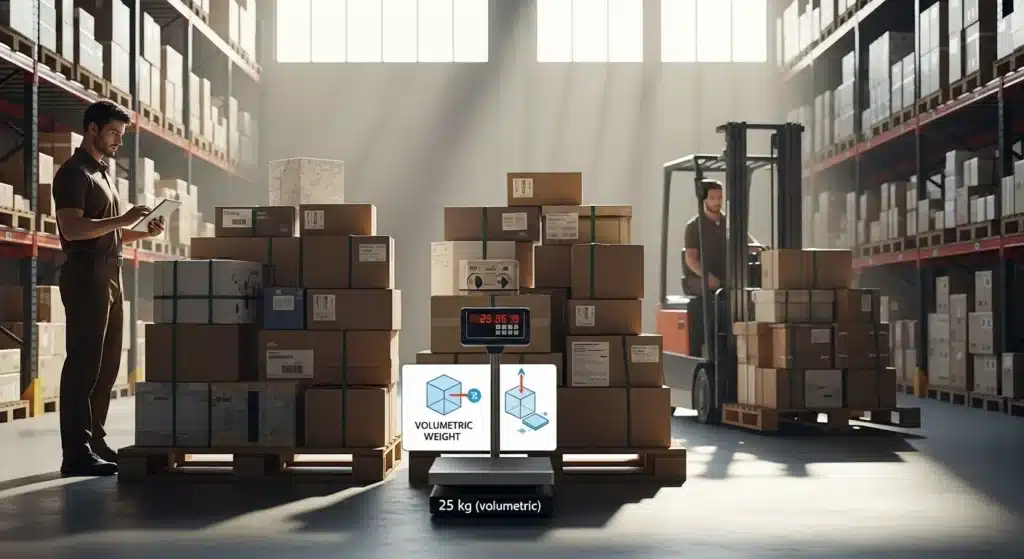
Freight carriers bill based on chargeable weight, which is the greater of a shipment’s actual physical weight or its volumetric weight. Volumetric weight converts the package’s cubic volume into an equivalent weight using a standard factor, ensuring carriers are paid for the space low-density cargo occupies. Understanding this calculation is essential for accurate cost forecasting and packaging optimization.
Understanding the Two Weights and Why Both Matter
Actual weight is the physical mass of your goods measured on a scale, typically in kilograms or pounds.
Volumetric weight is a calculated equivalent weight based on the cargo’s dimensions, converting the space it occupies into a billable kilogram figure.
The universal rule is that the chargeable weight for billing is always the higher of the actual weight or the volumetric weight.
This system aligns carrier revenue with capacity utilization, as vehicles and containers often fill up on space before reaching their maximum weight limit.
For dense items like machinery, actual weight usually dictates cost. For low-density goods like apparel or padded parcels, volumetric weight becomes the cost driver.
How to Calculate and Apply the Formulas
For metric measurements, the common industry factor is 5,000 cubic centimeters per kilogram: Volumetric Weight (kg) = Length (cm) × Width (cm) × Height (cm) ÷ 5,000.
For air freight and couriers using imperial measurements, common factors are 366 cubic inches per kilogram or 139 cubic inches per pound.
Example (Metric): A carton measuring 70cm × 50cm × 30cm has a volumetric weight of 105,000 cm³ ÷ 5,000 = 21 kg. If its actual weight is 10 kg, the 21 kg becomes the billable chargeable weight.
Example (Imperial): A 24in × 18in × 16in box has a volumetric weight of 6,912 in³ ÷ 366 ≈ 19 kg. An actual weight of 10 kg means 19 kg is billed.
Optimizing packaging by reducing carton size or using knock-down designs directly lowers volumetric weight and can significantly reduce shipping costs for low-density items.
Documentation: Packing Lists & HS Codes
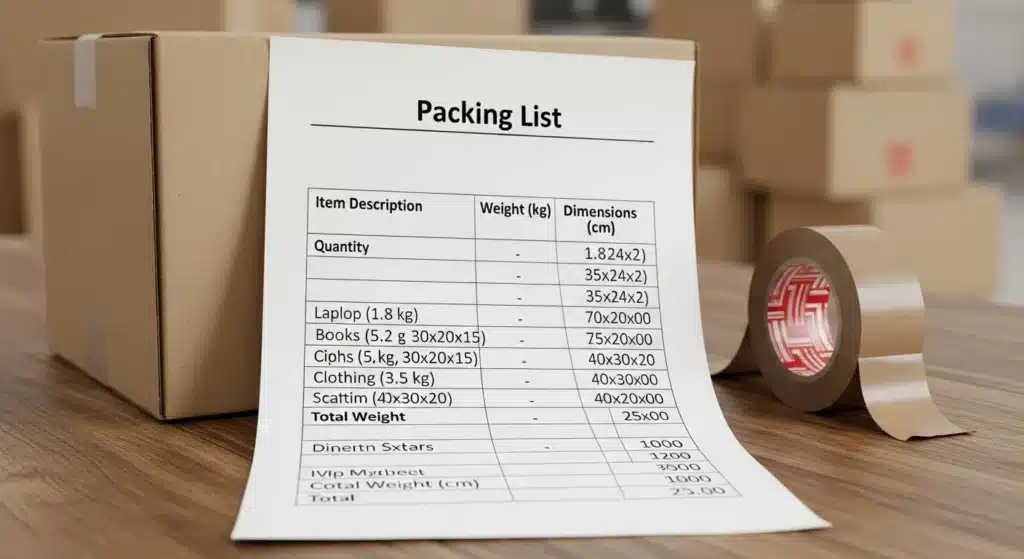
A packing list is a mandatory document that itemizes the contents, weights, and dimensions of every package and container. It is used by freight forwarders to calculate shipping costs and by customs officials to verify shipments. The Harmonized System (HS) code is a standardized classification number required on commercial invoices for determining import duties and taxes. Together, they form the essential paperwork for moving goods across borders.
The Mandatory Packing List: Your Shipment’s Control Document
A packing list is a detailed itemization of every package’s contents, required for both individual boxes and the full container. Specifications like CTI Systems INS CP001 mandate one list inside each package and another copy attached externally in a waterproof envelope.
Required data includes a description of goods, quantity, net/gross weight in kilograms, dimensions in centimeters, total package count, total volume, and container/seal numbers. Abbreviations are not allowed; all information must be type-written in English.
This document acts as a hard gate. Consignments without a compliant packing list, as per standards from CTI and Santos Ltd., will be refused and returned to the supplier at their cost.
Beyond customs, forwarders use this data to determine freight charges based on volumetric weight (CBM) versus actual weight, making accurate dimensions critical for cost control.
Linking Physical Goods to Customs: The Role of HS Codes
The Harmonized System (HS) code is a 6-10 digit international classification number that identifies products for customs. It determines the import duty rate, taxes, and any trade restrictions applied to a shipment.
For international clearance, standards like Santos CD‑034 require the first six digits of the HS code to be declared on the commercial invoice. This invoice, alongside the packing list and certificate of origin, forms the core export documentation.
The packing list provides the physical audit trail (what’s in the box), while the HS code on the invoice provides the legal and financial classification. This link is essential for customs brokers to clear goods efficiently.
Incorrect or missing HS codes are a primary cause for customs delays, holds, and unexpected duty assessments, directly impacting the ‘shipping nightmare’ of goods being stuck at port.
DDP Shipping for Amazon Sellers
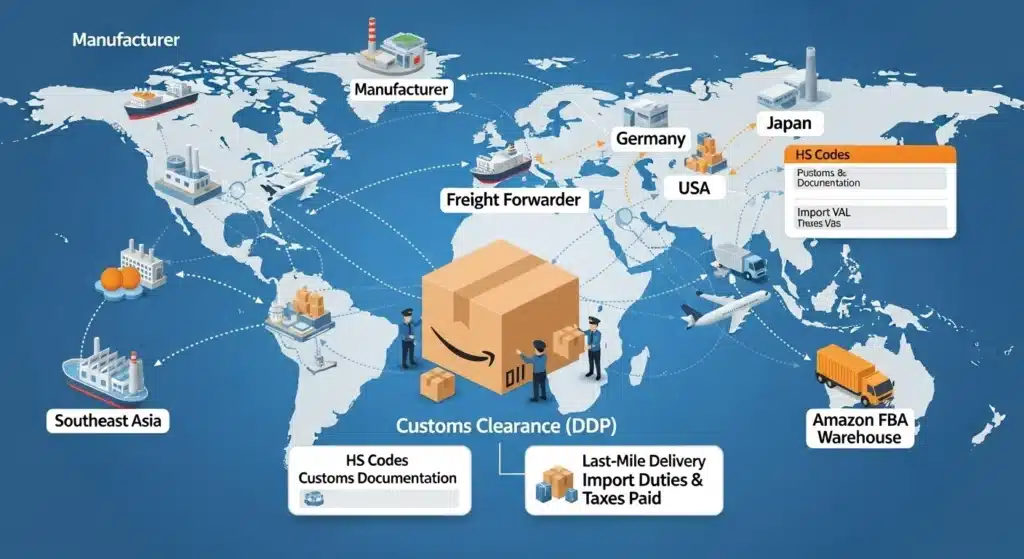
DDP (Delivered Duty Paid) is an Incoterm where the seller handles all logistics, pays all duties and taxes, and delivers goods directly to the buyer’s location, such as an Amazon FBA warehouse. For Amazon sellers, using DDP is often mandatory to ensure smooth customs clearance and avoid shipment holds. This process involves managing a complex documentation stack and coordinating with multiple service providers over a typical 15-30 day ocean freight timeline.
What DDP Means for Your Amazon Business
DDP is an ICC-standard Incoterm where the seller assumes full risk and cost for export procedures, main carriage (ocean/air freight), import customs clearance, payment of all duties and taxes, and final delivery to the buyer’s specified address.
Amazon FBA mandates shipments use DDP terms; the shipper or seller is responsible for all import formalities and costs to prevent delays at Amazon’s receiving centers.
This shifts logistical complexity and upfront costs to the seller but provides the buyer (or Amazon) with a fully cleared, door-delivered shipment, streamlining cash flow and reducing unexpected charges.
Managing the DDP Process and Costs
A standard DDP ocean shipment involves 7 critical handoff points over 15-30 days, including export clearance, cargo booking, ocean transit, destination customs, and final delivery confirmation.
Required documents include a commercial invoice with accurate HS codes and declared values, a packing list matching physical quantities, a power of attorney for the customs broker, import licenses (e.g., FDA registration), and proof of duties/taxes payment.
Suppliers often add an 8-15% markup on actual logistics costs for DDP services. Sellers should negotiate for a breakdown of freight, duties, and broker fees, and include clauses for cost overruns and FBA appointment scheduling.
Handling Sensitive Goods (Batteries/Liquids)
Shipping batteries and liquids requires strict adherence to IATA Dangerous Goods Regulations and UN classifications. Lithium batteries have specific state-of-charge limits and packaging rules to prevent short circuits and fires, while wet batteries need leak-proof containers and absorbent materials. Proper documentation, labeling, and carrier vetting are mandatory to mitigate risks and ensure smooth customs clearance.

Understanding the Core Regulations and Classifications
The foundation for shipping sensitive goods is built on specific UN numbers and hazard classes. Lithium ion batteries shipped alone are classified as UN3480, while those packed with or contained in equipment are UN3481. Each classification has distinct rules governing packaging, documentation, and handling.
Wet batteries, such as flooded lead-acid types, are classified as Class 8 Corrosive goods due to their sulfuric acid electrolyte. This classification dictates the entire packaging and labeling strategy to manage leakage risks.
IATA Packing Instructions provide the operational framework. Section IA/IB applies to fully regulated dangerous goods, requiring UN-specification packaging. Section II covers items like smaller lithium batteries that have passed specific safety tests but still require compliant packaging.
Key safety thresholds create exemptions that simplify logistics. For example, standalone lithium ion batteries (UN3480) must be shipped at a state of charge of 30% or less. Batteries with a capacity of 100 Watt-hours (Wh) or less are often exempt from the formal Shipper’s Declaration of Dangerous Goods, though other labeling rules still apply.
Packaging, Testing, and Compliance Procedures
Physical packaging is the first line of defense. Lithium batteries must be individually packed with non-conductive material like plastic bags or dividers to prevent contact and short circuits. This inner packaging must then be placed within a robust outer box designed to withstand the shocks and vibrations of transport.
For wet batteries, the requirements are more stringent. Each battery needs to be sealed in its own leak-proof container, such as a heavy-duty plastic bag. This container is then placed inside a UN-specification outer box that includes an acid-proof liner and absorbent pads, like vermiculite, to contain any potential spill.
Mandatory safety testing underpins these rules. All lithium cells and batteries must pass the UN Manual of Tests and Criteria, specifically Part III, Subsection 38.3. This test simulates transport conditions to ensure the battery can handle altitude changes, thermal cycles, vibration, shock, and short circuit scenarios without failing dangerously.
Correct labeling is non-negotiable for compliance and safety. Shipments require Class 9 hazard labels for lithium batteries, specific Lithium Battery Handling Labels, and, for certain fully regulated shipments, a “Cargo Aircraft Only” label. Proper documentation, including the correct UN number and shipping name, must accompany the package.
When shipping electrolyte fluids separately, they must be contained in bottles of 1.0 liter or less, with a maximum total of 24 liters per outer package. This limits the volume of any potential leak and aligns with international dangerous goods packing guidelines.
Final Thoughts
Consolidating shipments from multiple suppliers in China isn’t just a cost-saving tactic; it’s a strategic approach to simplify a complex process. By merging goods into a single shipment, you directly address the core challenges of multi-vendor logistics: fragmented tracking, excessive paperwork, and the compounded risk of delays at every handoff. The operational workflow, from intake at a central hub to final deconsolidation, is designed to replace chaos with control.
The decision to consolidate, and whether to use LCL or switch to FCL, hinges on understanding your total volume and the true cost drivers like volumetric weight. Accurate documentation, including detailed packing lists and correct HS codes, is non-negotiable for smooth customs clearance, especially under DDP terms for platforms like Amazon. For specialized goods like batteries, strict adherence to international regulations is essential. Ultimately, successful consolidation relies on clear planning, precise data, and often, partnering with a forwarder that has the right hub infrastructure and integrated systems to manage the complexity for you.
Frequently Asked Questions
How do you calculate CBM for mixed cartons?
Calculate the cubic volume of each carton type using the formula CBM = Length × Width × Height (in meters). For each size, multiply the CBM by the quantity of cartons. Sum the results of all carton types to get the total CBM. If dimensions are in centimeters, use the formula CBM = (L(cm) × W(cm) × H(cm)) / 1,000,000 for each carton, then sum the totals. The key formula is Total CBM = Σ (L × W × H × quantity) with all dimensions in meters.
What is the difference between FCL and LCL?
FCL (Full Container Load) means one shipper uses an entire container, which is best for shipments over 13 CBM. It offers faster transit, lower damage risk, and higher weight limits. LCL (Less-than-Container Load) means multiple shippers share a container, with charges based on volume or weight. It’s suitable for shipments under 13 CBM but involves more handling and a lower per-CBM weight limit. The industry standard threshold for choosing between them is typically 13 CBM.
Can you consolidate goods from different cities?
Yes, freight forwarders can consolidate cargo from multiple cities. Shipments are collected from various origins and transported to a central hub, where they are combined into a single truckload or container for the same destination route. This practice is standard for LTL or LCL shipments, which are volumes under a full container load, before they are merged into an FCL shipment. There is no legal barrier to this multi-origin consolidation as long as documentation is correct.
Who handles the export declaration for mixed items?
The legal exporter, or exporter of record, is responsible for filing the export declaration, even for shipments with mixed products. This responsibility can be delegated in writing to a customs broker or freight forwarder, but the exporter remains ultimately liable under customs regulations. In the U.S., an export declaration is required if any single item in the shipment has a value over $2,500 or needs an export license.
How long is free warehousing in Yiwu?
Free warehousing periods offered by providers in Yiwu vary, commonly ranging from 7 to 90 days. Typical durations include 7 days, 28 days, 60 days, or 1-2 months, depending on the sourcing agent or service company. A frequently cited standard free storage period is 60 days.
Do I need a bond for DDP shipping?
For DDP shipments into the United States, a customs bond is required if the shipment value exceeds $2,500, making it a formal entry. In a DDP arrangement, the seller acts as the Importer of Record and must obtain this bond, typically through a U.S. broker. The standard minimum for a continuous bond is $50,000. Shipments under the $2,500 de minimis value may not need a bond, but most commercial DDP shipments will require one.