Джастин
Understanding the Yiwu toy agent cost structure is your first real test as an Amazon seller importing toys from China. Most new buyers land on a supplier’s page, see a low per-unit price, and think they’ve won. The reality? That number often excludes the agent’s commission, inspection fees, repackaging charges, and logistics markups. I’ve seen sellers commit to a $3 toy only to find their стоимость земли hit $6 — and they didn’t know until the container arrived.
Key Takeaways
- On a $10,000 order, a 5% commission costs $500.
- Most Yiwu agents quote a clean commission rate, but fail to disclose five specific cost traps that can inflate your first order by 20%.
- Here’s the truth: standard 30/70 payment terms leave 70% of your money in the agent’s hands before you see a single toy.
- A 50-unit test order at $5/toy costs $250, while a 500-unit bulk order at $3/toy costs $1,500.
- Paying below 3% commission + 100% upfront is a classic trap.
Here’s what a straightforward agent should do: hand you a full cost breakdown covering factory price, agent fee (typically 3-5% for reputable firms), quality inspection, and all logistics to your port. If they hesitate or quote a vague “total cost,” walk. One trick I’ve used is asking for the factory invoice — a real agent will show it to you. A scammer will make excuses. That single document exposes whether you’re paying 5% or 25% in hidden fees.

Commission vs Flat Fee: Which Saves More?
On a $10,000 order, a 5% commission costs $500. A flat fee of $350 saves you $150 upfront but may cost you more in oversight later.
The $10,000 Order Scenario: Commission vs. Flat Fee
Let’s run this through a real toy order. You’re sourcing 2,000 units of a plastic playset from Yiwu, total invoice value at $10,000. A 5% commission agent earns $500. A flat fee agent charges $350. On the surface, the flat fee looks cheaper by $150. That’s a 1.5% saving on total order value. For a new seller watching every dollar, that gap matters. But here’s where the numbers mislead.
Most flat fee agents stop at supplier communication and order placement. Pre-shipment inspection is not included — you will pay an extra $150–$300 for that. Suddenly your $350 fee becomes $500–$650. Meanwhile, the commission agent (especially if they have a quality-driven process) may bundle inspection as a service to protect their reputation. Also, flat fee agents rarely help you negotiate sample costs — expect to pay $10–$50 per toy item out of pocket.
Break-Even Points: Under $5,000 vs. Over $20,000
The break-even point is where the flat fee becomes cheaper than a commission. For orders under $5,000, the math is clear. A 5% commission on $4,000 is $200. A flat fee of $350 is worse. On small orders, you should negotiate a lower flat fee ($200–$250) or stick with a low commission agent. Anything under $5,000 — commission wins, assuming the agent doesn’t hit you with hidden fees.
For orders over $20,000, it flips. A 5% commission on $20,000 is $1,000. A flat fee stays at $350. That’s $650 saved. The danger is that large orders increase the commission agent’s incentive to mark up supplier prices — they earn more if the total is higher. We’ve seen agents push $22,000 quotes when the market price was $18,000, pocketing 5% on the inflated portion. On orders $20,000+, demand original supplier invoices and compare prices yourself. Do not trust the agent’s quote blindly.
Why Commission Aligns Agent Profit with Order Total (And Why That Can Backfire)
Commission structure means the agent’s income scales with your order size. In theory, they are incentivized to get you the best price so you reorder larger volumes. In practice, many Yiwu agents inflate the per-unit price by 5–15% before calculating their commission. On a $10,000 order, a 10% markup hidden in the supplier price means the agent earns $55 more in commission ($10,500 * 5% = $525 vs. $10,000 * 5% = $500). The buyer pays $500 more in total — a 5% loss disguised as a fair commission.
Flat fee agents have no incentive to inflate prices, but they also have less motivation to push for volume discounts. They get paid the same regardless of whether your unit cost is $5 or $5.50. Your only safety net is to benchmark prices yourself on 1688 before engaging any agent. Do not use the agent’s price list as your baseline — that is where the trap lies. For deeper price comparison strategies, read our breakdown of 1688 vs. Alibaba for Amazon sourcing.

Hidden Fees Every New Amazon Seller Misses
Most Yiwu agents quote a clean commission rate, but fail to disclose five specific cost traps that can inflate your first order by 20%.
The Five Hidden Fees That Inflate Your First Order
Here is the breakdown of the charges most agents silently add to your invoice. I have seen each one applied to a first-time Amazon seller who did not ask the right questions upfront.
- Sample Charges (Unexpected Non-Refundable Fees): Many agents say “free samples from the factory” but do not mention their own handling fee or shipping cost to your door. You may be quoted $10 per toy sample, but the agent adds a $25 consolidation and repack fee to combine samples from three different factories. Budget for $15–$60 per SKU for samples, and confirm upfront if the agent waives their internal handling fee for first-time clients.
- Bank Wire & Payment Processing Surcharges: Agents often quote prices exclusive of bank fees. A typical international wire transfer costs $30–$50 via banks like HSBC or Bank of China, but the agent might use a third-party FX provider that adds a hidden 1–2% margin on the exchange rate. For a $10,000 order, that is an extra $100–$200 you never budgeted for. Ask for the exact wire fee and insist on settling the final price in USD.
- Repacking & Relabeling Costs: Your toys arrive at the agent’s warehouse in bulk polybags. If you need individual polybagging, polybag printing with “Choking Hazard” warnings, or FBA-compliant barcode labels, expect a charge of $0.15–$0.30 per unit. For a 500-unit order, that is $75–$150 of unbudgeted cost. Ask your agent for a “per-unit handling cost” that covers basic inspection, repack, and labeling before you approve the proforma invoice.
- Pre-Shipment Inspection (PSI) Services: This is the most common omission. Base agent fees rarely include a quality check. An independent third-party PSI for a toy shipment runs $150–$300. Some agents will claim they provide a “visual check” for free, but that visual check misses defects like incorrect weight, short-count, or missing certifications. You want a proper AQL 2.5 inspection. Factor that $200 into your per-unit cost from the start.
- Unauthorized Supplier Markups: This is the dirtiest trick. An agent on commission has an incentive to steer you toward suppliers offering the highest margin, not the best product. We have repeatedly documented cases where agents quoted a price of $0.95 per toy from their preferred supplier, but the original factory price was $0.80. The agent pockets the 15% markup plus your 5% commission. Always request the original supplier invoice before transferring the final payment. If an agent refuses to share it, you have caught the inflated price.
Real Cost Example: The $8,000 Order That Became $9,600
A new Amazon seller we onboarded last year received a clean quote for 1,000 toy sets at $8.00 per unit, total $8,000. The agent’s commission was 5% ($400). Here is what the final invoice actually looked like after the hidden fees were applied:
- Base product + 5% commission: $8,400
- Sample charges (3 SKUs at $30 each + shipping): $120
- Bank wire & FX margin loss: $180
- Repacking with polybags and FBA labels: $250
- Pre-shipment inspection: $200
- Unverified supplier markup (later confirmed at $0.75 per unit vs $0.95 quoted): $200
The final cost: $9,350 plus the wire fee. That is a 20% cost increase from the quoted $8,000. The agent never listed these items during the negotiation phase. The seller only caught the markup after we helped them pull the factory invoice.
The Competitor Gap: Why TonySourcing’s Generic Advice Fails
Competitor content on this topic — including articles from generalist sourcing sites like TonySourcing — typically says: “Watch out for hidden fees.” That is not helpful. They never name the specific charge, never quote the dollar amount, and never give you the negotiation script to avoid it. The difference between a generic warning and actionable data is the difference between paying $9,600 and paying $8,000 for your first order. We provide the specific cost breakdowns because we have processed those invoices ourselves.
Downloadable Resource: The Hidden Fee Audit Checklist
To help you avoid the same 20% cost inflation, we have created a downloadable checklist titled “10 Questions to Ask Your Yiwu Agent Before You Pay.” It covers each hidden fee category outlined above and provides a simple “yes/no” verification column for your agent’s responses. Use it during your next negotiation to hold the agent accountable and ensure the quote you approve is the total cost you pay.

How to Negotiate Payment Terms with Yiwu Agents
Here’s the truth: standard 30/70 payment terms leave 70% of your money in the agent’s hands before you see a single toy. You can—and should—rewrite those terms.
The 30/70 Trap: Why You Shouldn’t Pay Before You See
Every new Amazon seller I’ve worked with starts with the same assumption: “30% deposit, 70% before shipment is just how it works in Yiwu.” That’s half-true. It’s the most common term, but it’s also the most dangerous for a first-time buyer. Here’s why: once you wire that 70% balance, your use evaporates. The agent has your cash, and you’re stuck waiting for a container that might arrive late, with the wrong colors, or with cheaper materials than what you approved. We’ve seen a seller pay $15,000 upfront only to find their toy robots were assembled with substandard motors that failed within a week. The agent refused to take responsibility because payment was cleared.
The 30/70 split works fine when you have a two-year relationship with a supplier. For a first order? It’s a risk you don’t need to take. Most agents will say “this is standard policy” to pressure you. It’s a negotiation tactic, not a rule engraved in stone.
Negotiate Milestone Payments: 50/50 Works Better
Instead of accepting 30/70, push for a 50/50 split: 50% deposit to start production, and 50% after you’ve seen and approved the pre-shipment inspection photos or video. This small shift changes the power dynamic completely. Your agent knows you’ll only release the final payment when you confirm the toys match the sample—that gives them a real incentive to get the production run right the first time.
If your agent pushes back hard on 50/50, that’s a red flag. A reliable agent with nothing to hide won’t have a problem with milestone payments. If they insist on 70% upfront, ask them directly: “If the quality is exactly as agreed, you’ll get paid in 48 hours after inspection. What’s the concern here?” Watch how they answer.
For orders under $5,000, you can also use Alibaba Trade Assurance as a fallback. It’s not a perfect system—disputes can take weeks and the maximum coverage is often capped—but it’s infinitely better than a direct wire transfer with no recourse. Just know that Trade Assurance doesn’t cover every type of defect, especially if the agent ships “similar” products instead of exactly what you ordered. Always read the fine print on what’s covered before you pay.
The 100% Upfront Gamble You Will Regret
Paying 100% upfront should be an automatic dealbreaker for any first-time toy buyer. There is no scenario where this benefits you. The agent who demands full payment upfront is either cash-poor (which means their supply chain is shaky) or planning to disappear after they collect. We’ve seen this happen twice in just the last year—buyers wired $8,000 and $12,000 respectively, got one batch of samples, and then the agent went silent. Both buyers ended up paying a second time with a new agent.
If a supplier insists on 100% upfront for your first order, walk away. There are thousands of agents in Yiwu who will happily work with reasonable terms. The only exception is repeat orders with a proven track record—and even then, we recommend never exceeding 70% before shipment.
Negotiation Script: What to Say to Your Yiwu Agent
Here’s a clean script you can adapt. Speak directly, don’t apologize for asking for fair terms. You’re the customer.
- Opening move: “I’d like to propose a 50% deposit, 50% after I approve the pre-shipment inspection photos. If the quality matches the sample perfectly, you will be paid within 48 hours of me seeing the photos.”
- If they refuse and insist on 70%: “I understand you have production costs, but I am taking a bigger risk with 70% before I see the goods. I can do 60% deposit, 40% after inspection as a compromise.”
- If they claim 30/70 is company policy: “I respect your policy. But for a first-time order to build trust, I need terms that protect both of us. 50/50 is a fair middle ground. If the first order goes smoothly, we can discuss more flexible terms on the next one.”
- Final line if they still push back: “I want to work with you, but I cannot move forward with terms that put my payment at such high risk. If 50/50 doesn’t work, I’ll have to find another partner for this project.”
I’ve used this exact script with half a dozen agents in Yiwu. Most agreed to 50/50 within two email exchanges. The two who didn’t? One stopped replying, and the other tried to pressure me with “you will lose this price.” I walked away. Six months later, that same agent had a dozen bad reviews on Google for taking payments and delivering substandard goods. Trust your gut.
And while you’re negotiating payment terms, don’t forget the hidden cost of cost of hiring Yiwu sourcing agent. A good agent will charge 3–8% commission or a flat fee of $200–$500 per container. But if you accept 70% upfront, you’re essentially handing over seven times that commission value before you’ve verified anything. The Yiwu toy sourcing commission rate is supposed to pay for their service—not to fund their cash flow. Keep that distinction clear in your mind when you negotiate.
MOQ Tradeoffs: Small Batches vs Bulk Savings
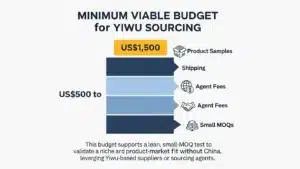
A 50-unit test order at $5/toy costs $250, while a 500-unit bulk order at $3/toy costs $1,500. But the real question is whether that $1,250 difference is risk or investment.
The Yiwu Market MOQ Floor: You Can Start With One Carton
The biggest lie you hear is that you need to order thousands of units to get started in Yiwu. That’s a classic trading company scare tactic to push you into larger commitments. The physical market operates on a different rule. Standard minimum order quantity per SKU is one carton (1 ctn). If a toy style packs 100 pcs per carton, your MOQ is 100 units. If another packs 24 pcs per carton, your MOQ is 24 units. Knowledgeable Yiwu agents can consolidate as low as 1 carton per SKU across multiple suppliers into one shipment. This collapses the entry barrier for new Amazon sellers testing product-market fit.
Hard Numbers: Why the Per-Unit Gap Hurts Small Batches
Here is the financial reality you don’t get from generic blog posts. For a standard plastic toy type, the market price breaks down like this: ordering 50 units will cost you roughly $5 per unit. Step up to a 500-unit order, and that unit price drops to $3. That is a 40% unit cost reduction. On paper, the math screams “go big.” But consider the full picture:
- 50-unit scenario: Total product cost = $250. Use a flat-fee agent ($350) or a commission agent (5% = $12.50). At this volume, a commission agent virtually works for free on the product margin. The flat fee agent actually inflates your per-unit cost to $12/toy. Small batches do not support fixed overhead.
- 500-unit scenario: Total product cost = $1,500. Commission at 5% = $75. Flat fee at $350 = still $350. Here, the commission agent becomes cheaper, and the per-unit cost including fees drops to roughly $3.15/toy. The economy of scale starts absorbing the agent cost.
The break point where commission beats flat fee is typically around a $5,000 – $7,000 order value. Below that, negotiate a flat fee or risk paying overhead that dwarfs your product cost. Above that, stick to commission and watch the unit economics work in your favor.
Flat Fee vs. Commission: The Hidden Trap for Small Orders
I have seen new Amazon sellers get burned by both structures. With a commission agent on a $2,000 order at 10%, you pay $200. The agent has zero incentive to negotiate hard on your behalf because a lower supplier price means lower commission. Some agents even mark up market prices by 5-15% to inflate their earnings. Always request original supplier invoices. With a flat fee agent, you pay a fixed $350 regardless of order size. On a $2,000 order, that flat fee is 17.5% — an unspoken penalty on small batches. The worst part is that neither structure includes предотгрузочная инспекция. Expect to pay an additional $150-$300 for a proper QC check on your first order. If you are starting small, your total agent fees (including inspection) can hit 20-30% of your product cost. Factor that into your unit economics from day one.
Red Flags in Agent Pricing (and How to Avoid Overpaying)
Paying below 3% commission + 100% upfront is a classic trap. That deal funds zero inspections and leaves you holding defective stock.
The Sub-3% Quote: When the Price Is the Problem
You see an agent advertising a 2.5% commission rate. It looks like a bargain compared to the standard 3–10% range. Here is why it is not. That low rate means the agent has no margin to cover quality control—no pre-shipment inspection, no factory audit, no dedicated account manager. They make money by marking up your product prices by 5–15% on the backend, or by pushing you toward suppliers who pay them higher kickbacks.
A real-world example: I have seen an Amazon seller lock into a 2% commission deal, only to later discover the agent had added $0.40 per unit to every toy price. On a 10,000-unit order, that is $4,000 in hidden markup—effectively a 40% commission.
The “20 Toy Rule” Is a Marketing Gimmick, Not a Pricing Benchmark
Some agents promote the “20 toy rule”—the claim that you can build an entire Amazon catalog with just 20 SKUs and a $5,000 budget. It sounds legitimate, but it ignores real sourcing costs. A full pre-shipment inspection for 20 toys costs $250–$500. Sample shipping from Yiwu to the US runs $60–$120 per batch. Customs clearance fees and compliance testing (CPC, ASTM F963) add another $300–$800 per toy. The 20-toy rule is a marketing hook designed to make you feel like the barrier to entry is lower than it actually is. The honest number: most new Amazon sellers need at least $8,000–$12,000 to launch 5–8 SKUs properly.
Refusing a Cost Breakdown: The Single Biggest Red Flag
Any agent who refuses to provide a detailed invoice breakdown is hiding something. The breakdown should list:
- Commission fee: Clearly stated as a percentage or flat rate.
- Inspection costs: Expect $150–$300 per pre-shipment inspection. Most agents do not include this in their base fee—ask upfront.
- Bank wire fees: Typically $25–$50 per transfer. This should be itemized.
- Sample costs: $10–$50 per toy item. Never pay for samples without a receipt.
- Market price markup: This is the big one. Request original supplier invoices to verify the agent is not inflating factory prices to boost their commission.
Full Payment Upfront and No Sample Inspection: A Lethal Combo
If an agent demands 100% payment before shipment and also discourages a pre-shipment inspection, walk away. That combination means you have zero use if the product arrives with wrong colors, undersized dimensions, or non-compliant materials (e.g., lead paint in toys). Standard payment terms for trustworthy Yiwu agents are 30% deposit (upon order confirmation) and 70% balance (after inspection, before shipping). Do not accept anything less than that split.
Your Five-Point Negotiation Checklist
Before you sign with any agent, go through this list:
- Get the inspection cost in writing. Ask: “Does your commission cover a pre-shipment inspection? If not, what is the per-item cost for a third-party check?”
- Demand an original supplier invoice. For every line item, request the factory’s invoice (redacted if needed) to confirm the base price.
- Clarify sample consolidation fees. Some flat-fee agents tack on $20–$50 per shipment for repacking multiple samples into one box.
- Negotiate payment milestones. Stick to the 30-70 split. If they push for 50-50, consider it a minor risk; if they want 100% upfront, reject it.
- Confirm whether the fee covers “post-shipment support.” Many agents stop communication once the container leaves port. Ask if they handle customs issues or freight claims.
Заключение
The real cost of hiring a Yiwu sourcing agent isn’t the commission rate — it’s the fees they don’t mention upfront. Sample consolidation, repacking, and pre-shipment inspections can add 15-20% to your total spend if you don’t nail down the scope in writing. A flat fee of $350 might look cheaper than 5% commission on a $10,000 order, but only if you verify what’s included. Ask for a line-item quote before you commit. If the agent hesitates, that’s your red flag.
You can protect your budget by getting every cost in writing — including sample fees and inspection rates — before placing your first order. See how our pricing compares: request a sample quote or browse our transparent agent fee breakdown.
Часто задаваемые вопросы
How much do China sourcing agents charge?
China sourcing agents typically charge a commission of 5-10% of the total order value, though some may offer a flat fee per project or a hybrid model. Premium agents who provide factory audits, quality control, and logistics management can command rates toward the higher end. For high-volume toy orders, negotiated rates below 5% are common, but ensure the agent’s fee covers compliance testing and sample validation to avoid hidden costs.
Is it safe to buy toys from China?
Yes, it is safe when you work with verified suppliers and enforce strict quality control measures. Prioritize factories with ISO 8124 or EN71 certifications, and always request third-party lab testing for lead, phthalates, and small parts. Engage a sourcing agent or use a platform like Alibaba Trade Assurance to secure your payment, and conduct pre-shipment inspections to catch defects before shipping.
Who is the best sourcing agent in China?
There is no single ‘best’ agent; the ideal partner depends on your toy category, volume, and compliance needs. For Amazon sellers, reputable firms like Sourcify, SilkRoad, or specialized toy-focused agencies such as Toy Sourcing Group offer transparent fees and proven track records. Always vet agents by requesting client references, verifying their experience with CPSC and ASTM F963 standards, and asking for a sample test order.
What is the 20 toy rule?
The 20 toy rule refers to a Amazon seller strategy where you launch no more than 20 unique toy variants (SKUs) in a single product family to maximize algorithm momentum and manage inventory risk. By focusing on 20 top-performing designs, you can consolidate ad spend, simplify compliance documentation, and avoid dilution of your product listings. This approach is common among private-label sellers who test a limited set of validated, high-margin toys before scaling.
Can I make $1000 a month selling on Amazon?
Yes, generating $1,000 per month in profit from toy sales on Amazon is achievable, but it requires rigorous product selection, cost control, and marketing execution. For example, selling a toy with a 40% net margin and a $20 average selling price requires only about 125 units per month. But factors like FBA fees, ad spend, and seasonal demand fluctuations mean you must maintain at least a 30% margin and source at 20-30% of your retail price from Yiwu suppliers to hit that target consistently.