

 Джастин
When a supplier is short of one component, release complete retail sets according to the approved contents list, not according to the percentage of cartons that arrived. Convert accepted stock to individual component units, subtract prior allocations and use the lowest whole-set quantity across all required components. That quantity is a physical limit; the buyer must still authorize the partial shipment and its destination requirements.
A box of accessories can be the smallest line on the freight quote and the item that prevents every set from being sold. This guide turns that shortage into a component reservation and a precise release instruction. Its examples are illustrative arithmetic, not a customer shipment or a freight quotation.
Key takeaways
- Count units of each required component, not total cartons alone.
- Use the approved set contents and revision before calculating.
- Exclude damaged, held or already allocated stock from the available quantity.
- The limiting component sets the maximum complete-set count.
- Reserve every component consumed by the approved release.
- Shipping complete sets from part of an order still requires authorization to split the order.
A public Sage user question about partial kit shipments asks whether components of a two-pen-and-stapler kit may ship at different times even when partial shipments are allowed. That is a software-specific question; this guide does not diagnose Sage or NetSuite settings. It addresses the underlying physical release decision for an importer: shipping fewer complete kits and shipping incomplete kits are different instructions. Agree which instruction the buyer intends before reserving stock.
 ▶ Open the kitting demonstration video player
Lock the set definition before recounting stock
Write the finished set SKU and its required components, quantities and approved variants. A set requiring two cups and one tray is different from a carton containing two cups and one tray for transport convenience. Use the buyer’s approved sellable-unit definition. A warehouse should not decide that a missing tray is optional because its value looks small.

Infor’s kit-handling guide distinguishes shipping an order complete from shipping kits complete. Under its named Ship Kit Complete constraint, fewer items than ordered may ship only as complete kit structures. This is a useful conceptual distinction, not a claim that a Yiwu warehouse uses that software or that its setting governs your contract.
If the buyer changes the set contents, record a new revision and assess packaging, product description and destination acceptance before using the new definition. Calling an incomplete set a different SKU in an email does not itself make that change acceptable.
Calculate the number of complete sets
For each component, available units equal accepted physical stock minus stock already reserved elsewhere. Divide available units by units needed per set, round down to a whole number, and take the smallest result. The minimum is the component-constrained capacity for this one set definition. It is not a forecast of arriving stock.
Illustrative inputs: the buyer ordered 300 sets, each containing two cups and one tray. All quantities below are counted individual items. The cup count includes a reservation for another order; the tray count excludes held goods.
| Компонент | Accepted stock, units | Existing allocation, units | Available units | Units per set | Whole sets supported |
|---|---|---|---|---|---|
| Cup, approved variant | 620 | 40 | 580 | 2 | 290 |
| Tray, approved variant | 260 | 0 | 260 | 1 | 260 |
The stock supports min(290, 260) = 260 complete sets. The 40-set balance requires 80 cups and 40 trays. After reserving 520 cups and 260 trays for the first release, 60 unallocated cups remain for that balance. Another 20 cups and 40 trays are still needed. The separate 40-cup allocation belongs to the other order throughout; it cannot be counted a second time.
Do not confuse the 60 remaining cups with 60 saleable sets. Nor should the pending 40 trays be treated as available because the supplier promises delivery tomorrow. Recalculate when the missing items have actually been received and accepted.
Reserve the components before approving a second release
For the proposed 260 sets, reserve both components in the actual stock record and identify the location or carton identifiers that contain them. If goods are packed into finished sets, record the conversion from component stock to finished-set stock. Otherwise the same cups may still appear available to another order after the first order has consumed them.

iyibir WMS’s kitting explanation distinguishes components leaving stock from sets entering stock and highlights component reservations. The operational lesson is to make that conversion visible in whatever controlled record the warehouse actually uses. A spreadsheet can express the arithmetic; it cannot prove a physical count or prevent a second operator from allocating the same cartons unless the workflow honors it.
Change one input in the example: another approved order reserves 100 of the 260 trays before this release is committed. Available trays fall to 160, so the maximum becomes 160 sets. The old 260-set instruction is now invalid. Reserve 320 cups and 160 trays for this 160-set release. From the original 620 accepted cups, 40 remain allocated to the earlier order, leaving 580 available before this release and 260 unallocated cups afterward. All 260 accepted trays are now reserved: 100 for the other approved order and 160 for this release. There are no unallocated trays left. The remaining balance on this 300-set order is 140 sets, requiring 280 cups and 140 trays. Compared with its remaining unallocated stock, that balance still needs 20 additional cups and 140 trays. The other order owns its 100 trays; they cannot also satisfy this order. Reservation time and ownership therefore matter as much as the count.
Choose the release instruction
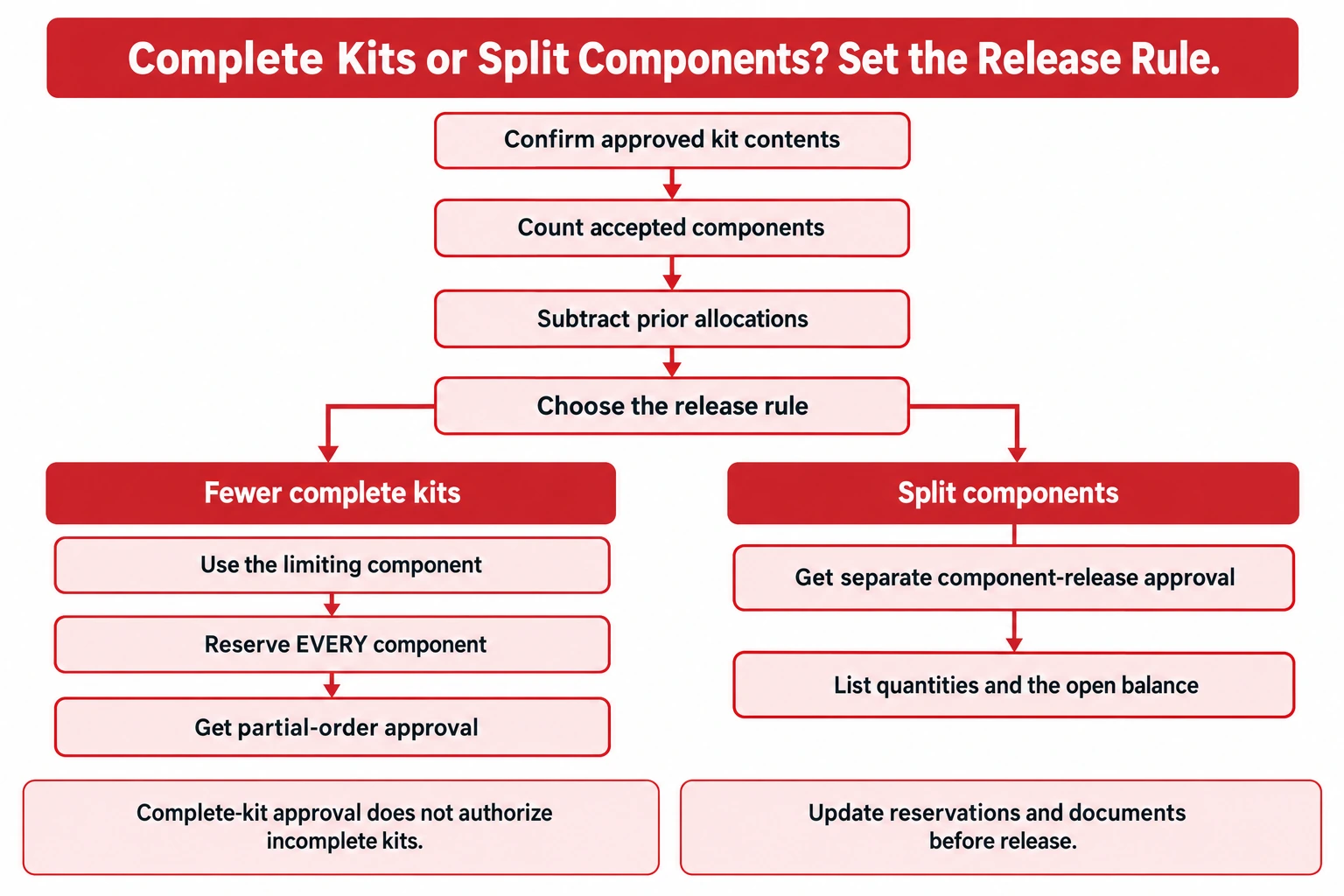
- Confirm approved kit contents
- Count accepted components
- Subtract prior allocations
- Choose the release rule
For fewer complete kits: use the limiting component, reserve EVERY component and obtain partial-order approval. For split components: get separate component-release approval and list quantities and the open balance. Complete-kit approval does not authorize incomplete kits. Update reservations and documents before release.
Separate complete-set capacity from permission to split
The following table returns to the original scenario: no new 100-tray reservation has been made for the other order. Its 260-set capacity must not be used after that reservation changes availability to 160 sets.
| Condition | Physical result | Release decision |
|---|---|---|
| 260 complete sets; split order authorized | 260 sets can be built from allocated stock | Prepare a defined partial release after packing and destination checks |
| 260 complete sets; contract requires all 300 together | Stock capacity remains 260 | Hold pending authorized change or sufficient accepted stock |
| Cups available; required trays unavailable | No complete sets under this definition | Hold this set SKU; do not call loose components complete sets |
There is no universal cheapest choice between waiting and splitting. Obtain actual booking options, cutoff times, extra handling or storage charges and the effect on the buyer’s delivery commitments. This article supplies no freight rates, customs ruling or destination-specific set-labeling instruction.
Write the release as: “Subject to buyer approval, release 260 complete sets of SKU [reference], contents revision [reference], using the reserved cup and tray quantities and identified finished cartons. Keep the 40-set balance open. Do not substitute variants or release incomplete sets. Update the packing record to the quantities actually packed.” Attach the allocation and revised packing list; confirm who owns the balance delivery and which quantities remain outstanding.
For help assessing whether a sourcing service can handle the proposed work, Submit the set specification for a service-scope check. Include the set contents, counts by unit, allocations, destination, packing requirements and requested release date. Counting, kitting, storage and shipment coordination must be confirmed for the actual assignment; no price or service availability is implied here.
Заключение
Keep the scenarios separate: the original allocation supports 260 sets; the counterfactual 100-tray reservation reduces this order to 160 sets and leaves a 140-set balance. The final instruction must use the stock reservation actually approved for this order.
A partial order can contain complete products. The useful release quantity comes from accepted unallocated components and the approved set definition, followed by a separate authorization to split. In the example that means 260 sets now, with a precisely reconciled 40-set balance rather than a pile of unexplained leftover cups.
Frequently asked questions
Can spare components ship alongside the sets?
Only as separately identified, authorized contents. Do not include them in the finished-set count or consume stock reserved for another order.
The simple minimum formula applies to one definition after allocations. Agree priorities and reserve the shared stock across both SKUs before calculating each release; independent calculations would double-count it.
Does the calculation prove the sets are ready to sell?
No. It establishes component capacity. Inspection, packing, labeling, documentation and destination acceptance remain separate checks.
