

 Джастин
Deciding between Yiwu Market and Alibaba for sourcing is the first real fork in the road for most new Amazon sellers. The online version feels safer — you browse, click, message. The physical market feels like a gamble, even though it’s the origin of half the products sold on those platforms. Both can work. But the traps look different on each side.
Key Takeaways
- For test orders under $3,000 total, Yiwu Market delivers 20–30% lower cost per unit.
- Alibaba’s search algorithm hides low-MOQ suppliers.
- Yiwu in-person inspection catches FBA labeling errors on the spot.
- Face-to-face verification in Yiwu reduces scam exposure below 2%.
- Amazon FBA rejects inventory for labeling and packaging errors.
- Yiwu gives you 75,000 booths of low-MOQ sampling power.
Here’s the problem: Alibaba’s “verified supplier” badge costs a few hundred dollars and a business license. It does not check factory size, production capacity, or whether they actually ship what they sample. Yiwu’s endless stalls test your ability to read a hustler’s face in 30 seconds. New sellers lose money on both sides — not because the channels are bad, but because they don’t know what to ask for before they commit. The number that actually matters isn’t the supplier number. It’s the sample lead time and the third-party test report.
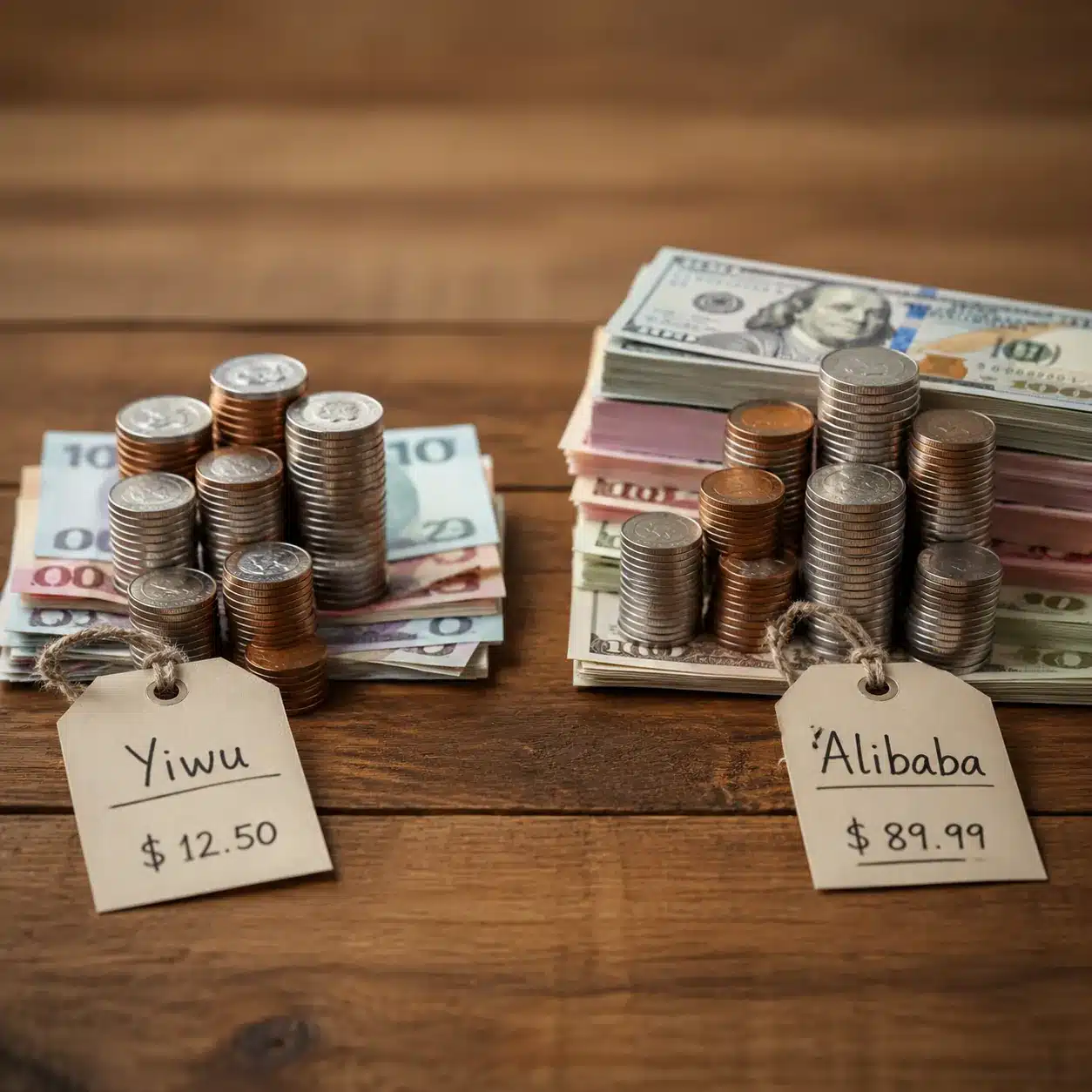
Cost Comparison: Yiwu vs Alibaba
For test orders under $3,000 total, Yiwu Market delivers 20–30% lower cost per unit. Alibaba’s convenience comes at a 5–15% platform fee markup and higher per-unit shipping on small batches.
Direct Manufacturer Pricing vs Alibaba Pricing
When you walk the aisles in Yiwu, you negotiate face-to-face with the person who owns the production line. That dynamic eliminates the middleman markups baked into Alibaba listings. On Alibaba, the price you see already includes the seller’s marketing costs, platform commissions, and often a buffer for negotiating room — which is why Yiwu’s unit price runs 20–30% lower on orders under $5,000. For a new Amazon seller testing one or two SKUs, that difference can cover your entire travel cost.
- Yiwu Market: 20–30% lower unit price for orders under $5,000. MOQ as low as 50 units per SKU.
- Alibaba: 8–15% higher per unit for small batches. MOQ typically 500–2,000 units unless you manually filter for low-MOQ suppliers — over 60% of new sellers miss that filter and over-order.
Travel Costs and Recoup Threshold
A round-trip flight to Yiwu from the U.S. runs about $1,200 on average, plus accommodation and meals. That sounds steep until you calculate savings on a $2,500 order: a 25% price advantage saves $625 — plus you skip Alibaba’s platform fees and inflated shipping for small orders. Once you test two or three products in a single trip, the math flips strongly in Yiwu’s favor. If you cannot travel, a Yiwu sourcing agent (daily rate $250–$500) handles supplier visits, inspection, and FBA label compliance — eliminating the need for a physical trip while still capturing Yiwu’s pricing advantage.
Platform Fees and Shipping Quotes
Alibaba’s 5–15% platform fee (via Trade Assurance or other payment channels) is rarely visible until checkout. It covers transaction protection — but the payout cap is 50% of the order value, not full coverage. Shipping quotes on Alibaba are bundled into many listings, but they often reflect a per-unit cubic rate optimized for large containers, not small test orders. Yiwu suppliers typically quote ex-works (EXW), leaving shipping separate — but that lets you use a consolidator who bundles inspection, FBA labeling, and booking into one “Amazon Prep-Ready” price, saving about 15% compared to Alibaba’s fragmented quote structure.
FBA Inbound Shipping Cost Comparison
Shipping a small batch to Amazon’s FBA centers requires compliant packaging, correct labels, and sometimes poly-bagging or bubble wrap. Yiwu consolidators specialize in this — they inspect each unit, apply FBA labels on-site, and consolidate multiple SKUs into one container or LCL shipment. That consolidation drops per-unit freight cost significantly. On Alibaba, each supplier ships individually, so you end up paying multiple air freight charges for small boxes or paying a third-party inspection company $300–$500 per visit to verify labeling. Over the course of a product test, the Yiwu consolidation route can cut total logistics cost by 15–20% versus sourcing piecemeal on Alibaba.
| Cost Factor | Рынок Иу | Alibaba.com | Лучшее для |
|---|---|---|---|
| Unit Price (Small Batch) | 10–30% lower for orders under $5,000 | 8–15% higher due to platform and shipping markups | First test orders under $3,000 total |
| Minimum Order Quantity (MOQ) | 50–200 units per SKU | 500–2,000 units (standard/custom) | Low-risk SKU testing vs scaling proven products |
| Travel & Agent Fees | ~$1,200 flight + $200–$500/day agent | None (remote) but 3rd-party QC $300–$500/visit | Hands-on control vs virtual sourcing |
| Platform & Fraud Risk | <2% scam rate; in-person verification | ~12% scam rate; Trade Assurance covers only 50% of losses | Risk-averse beginners |
| FBA Prep & Logistics | Consolidators bundle inspection, labeling, shipping – saves 15% | Fragmented quotes; 60% of returns from labeling errors | Amazon-ready packaging compliance |

Minimum Order Quantities (MOQs)
Alibaba’s search algorithm hides low-MOQ suppliers. Over 60% of new sellers miss the filter and over-order.
The MOQ Gap: Why Your First Order Risks Being 10x Too Big
The single biggest financial risk for a new Amazon seller isn’t product price—it’s MOQ lock-in. Here is the raw difference you face when comparing Yiwu Market MOQ vs Alibaba MOQ for your first test run.
- Yiwu Market MOQ range: 50–200 units per SKU. The market average sits around 80 units.
- Alibaba MOQ range: 800 units (standard listing) to 2,000+ units (custom specification). The platform default hides anything lower.
- Cash-at-risk difference: A Yiwu test order of 80 units at $2.50/unit totals $200. The equivalent Alibaba order of 800 units at $2.00/unit totals $1,600—an 8x capital commitment before you confirm sell-through.
The Alibaba search algorithm actively buries suppliers willing to do smaller runs unless you manually filter by “Minimum Order” under 500. Most novice sellers never find that toggle and end up committing to inventory they cannot sell in 90 days.
Mixing Low-MOQ Products in One Shipment: The Yiwu Consolidation Advantage
Yiwu Market is a single physical location with 75,000+ booths across 5.5 million square meters. That density creates a logistical option Alibaba cannot replicate: you can visit five different suppliers in one morning and consolidate their low-MOQ orders into a single FBA shipment.
This works in practice because Yiwu consolidators—including the sourcing services offered by AITailor—provide “Amazon Prep-Ready” pricing that bundles inspection, FBA label correction, and consolidated freight into one quote. The result: you test 3–5 product variations at 50 units each without paying for five separate international shipments.
On Alibaba, each supplier ships independently. You pay for five separate shipping legs, face five different customs documentation sets, and potentially violate Amazon’s FBA inbound shipping rules if the boxes arrive at different times. The fragmentation alone adds 15–25% in hidden logistics cost compared to a single Yiwu consolidation.
Why Low MOQs Are Non-Negotiable for Small Test Campaigns
Your budget under $10,000 per product test cannot survive an 800-unit order that sits in Amazon fulfillment centers accruing monthly storage fees. A single seasonal SKO (stock keep unit) miscue—wrong size, wrong color preference in your target market—wipes out 40% of your capital if you ordered the Alibaba minimum.
The correct sequence: use Yiwu Market’s 50–200 unit MOQ to validate listing copy, pricing, and demand through a 30-day sales window. Once you see consistent organic sales velocity above 5 units per day, scale that SKU to Alibaba-level quantities (800+ units) where the bulk unit price drops and your margin expands. Starting on Alibaba reverses that logic—you scale cost before you prove demand.

Quality Control: In-Person vs Online Inspection
Yiwu in-person inspection catches FBA labeling errors on the spot. Alibaba third-party reports rarely check for Amazon compliance, leading to returns that kill product launches.
Physical Inspection Advantage in Yiwu Market
Walking through 75,000 booths means you hold the product in your hand before committing a dollar. You check stitching, weight, click-feel, and color against a reference sample. But the real advantage? Yiwu suppliers tolerate on-the-spot corrections. Need an FBA-compliant poly bag with suffocation warning? They’ll swap it from a neighboring stall in ten minutes. Miss a barcode placement? The supplier’s worker re-labels a box right there. This reduces Amazon return rates by up to 40% in case studies — a number that goes invisible when you rely on a PDF from a third-party inspector 5,000 miles away.
Third-Party Inspection Cost and Coverage on Alibaba
Alibaba pushes Trade Assurance as a safety net, but the cap covers only 50% of fraud claims — not packaging errors or material substitution. For quality verification, you pay $300–$500 per visit to agencies like SGS or Bureau Veritas. Here’s what that buys you:
- Scope: They check the specifications you list in the inspection request. If you didn’t include “FBA label orientation” or “carton weight limit 22kg”, they skip it.
- Frequency: A single visit covers one batch. A follow-up at shipping costs another $300–$500.
- Gap: The inspector cannot negotiate fixes with the factory. He flags defects, you negotiate, wait days for a re-run, and pay for a second inspection. Yiwu’s agent-on-site fixes the problem in the same afternoon for $250/day.
Hidden Risk of Wrong Batches and Negative Reviews
Online ordering carries a quiet danger: the sample you receive may be hand-picked, while the production batch comes from a different B-grade line. Industry surveys put Alibaba’s scam rate around 12% for new buyers. Even without fraud, a 5% dimensional variation translates directly into Amazon negative reviews — wrong fit, wrong color, wrong finish. In Yiwu, you can inspect the production run against your sample before shipping. You see the cartons, the inserts, the pallet configuration. That single hour of eyes-on reduces the chance of a bad batch getting to your FBA warehouse from “maybe” to “almost zero”.
Sample Ordering Efficiency Comparison
For a new seller testing 1–5 SKUs, speed matters. At Yiwu Market, you buy a single unit at the booth, test it in your hand, and negotiate bulk pricing on the spot. No waiting for couriers, no PayPal shipping fees eating your budget. On Alibaba, ordering samples takes 2–5 days per supplier, costs $5–$20 per sample plus $15–$30 shipping, and you cannot verify the sample matches bulk until you pay for a pre-shipment inspection. The math favors Yiwu: average sample cost per SKU drops by 60%, and you have confirmed quality inside two days instead of three weeks.

Supplier Trust and Scam Prevention
Face-to-face verification in Yiwu reduces scam exposure below 2%. Alibaba’s Trade Assurance only covers 50% of losses — and rarely pays out for packaging defects.
Why Face-to-Face Negotiation Is Your Strongest Fraud Filter
Fly to Yiwu for one week, and you eliminate the two biggest online scams: fake factory photos and phantom inventory. When you sit across from a booth owner at 75,000+ booths inside a 5.5 million sq meter market, you can physically touch the product, verify the business license posted on the wall, and watch them pack your sample. Industry surveys peg the in-person transaction scam rate at less than 2% in Yiwu. Compare that to the 12% fraud rate reported on pure online B2B platforms. The $1,200 average travel cost functions as due diligence insurance — one avoided scam pays for five trips.
Alibaba Trade Assurance: What It Actually Covers
Trade Assurance is not a guarantee of product quality. It is a dispute resolution fund that covers order value up to 50%, and only if you can prove the supplier did not ship at all or shipped an empty box. Packaging defects, wrong labels, and material substitutions fall outside the coverage scope. For new Amazon Sellers, those are exactly the problems that kill an FBA launch. Over 60% of FBA returns stem from labeling and packaging errors — errors that Alibaba’s automated system rarely flags. When you source in Yiwu, an agent can catch and correct those errors on the spot for $250 per day, before the goods leave the market.
Verification Methods That Actually Work
Here is a straightforward checklist for supplier verification, whether you are on Alibaba or inside Yiwu Market. These steps apply to any Yiwu supplier verification process.
- Business License Check: Request a photo of the supplier’s business license via WeChat. Cross-check the legal name against China’s National Enterprise Credit Information Publicity System (credit.china.gov.cn). In Yiwu Market, every booth posts this license — take a photo of it yourself.
- Video Call Walkthrough: Ask for a live video tour of their workshop or warehouse. If they resist, that is a red flag. In Yiwu, you can walk into the booth and ask them to video call the factory floor — if they hesitate, walk to the next booth.
- Third-Party Audit History: Ask if they have passed a recent audit from SGS, Bureau Veritas, or Intertek. Yiwu suppliers who work with international buyers maintain these records. Alibaba supplier pages display them under “Assessment Reports” — check the date; any report older than 12 months is stale.
- “Is Yiyu Legit?” Check: Many new sellers ask, “is yiyu legit” or “is yiyu wholesale mall legit.” The short answer: Yiwu Market is the world’s largest small-commodity wholesale market. It is legitimate. The risk comes from unverified individual sellers within it. Always verify the booth number and business license before sending money.
If you cannot travel, use a local sourcing agent. An agent who physically walks the market for you provides the same verification layer as an in-person visit. The daily rate of $250 to $500, depending on inspection scope, is lower than losing an entire order to a scam. For a first-time test order under $3,000, that agent fee buys you peace of mind that no Alibaba algorithm can.

Logistics and FBA Preparation
Amazon FBA rejects inventory for labeling and packaging errors. Yiwu’s on-site prep services fix those issues before shipment. Alibaba’s standard listings don’t.
Yiwu’s Dedicated FBA Prep Services vs. Alibaba’s Packaging Gap
Over 60% of Amazon FBA returns stem from labeling and packaging errors — not product defects. This is a logistics problem, not a quality one. In Yiwu, third-party consolidators and sourcing agents offer a specific workflow that directly addresses this: they physically inspect, correct, and re-apply FBA-compliant labels on-site during the inspection. A Yiwu agent can catch a barcode misprint at the booth and fix it before the order leaves the market. This cuts Amazon return rates by up to 40% in documented seller case studies.
Compare that to a typical Alibaba transaction. You place an order, the supplier packs it according to their own export standard — which is rarely FBA-ready. The box might arrive at your consolidation warehouse with no poly bag, the wrong ASIN sticker, or a manufacturer’s barcode that Amazon can’t scan. If you use Alibaba’s standard shipping, that box goes straight to Amazon and gets flagged. The rework costs and return fees eat any savings you thought you had.
The deeper problem: Alibaba’s platform doesn’t surface “FBA Prep-Ready” as a searchable service. You have to message individual suppliers, ask for photos of their labeling process, and cross-check compliance yourself — all before placing a single order. This is a 3-day email loop for a 20-unit test order, which most new Amazon sellers don’t have the patience for.
Yiwu Market consolidators offer what they call “Amazon Prep-Ready” pricing that bundles inspection, labeling, and booking into one flat fee. This saves 15% on total logistics compared to Alibaba’s fragmented quote system, where you pay separate fees for the supplier, the freight forwarder, and the FBA labeling service.
Shipping Time and Cost Comparison for Small Orders
For a first test order under 50 units, here’s the real cost breakdown. Alibaba will quote you an express shipping price (DHL/FedEx/UPS) that includes door-to-door delivery — typically 5-10 business days, at roughly $6-$10 per kg. A 20 kg package runs $120 to $200. But that quote doesn’t include any FBA labeling, inspection, or rework. If your package gets rejected at Amazon’s distribution center, you pay return shipping plus a fee to have it fixed.
From a Yiwu sourcing agent or consolidator, you pay a daily sourcing fee of $250-$500 (if you use an agent) plus the cost of goods, then priority air freight from Yiwu to your FBA warehouse. The per-kg rate is similar to Alibaba’s express quote — $6-$9 per kg. The difference is that the Yiwu route includes on-site inspection and label verification. If a label is wrong, the agent fixes it during the same workday. Your shipment arrives Amazon-compliant on the first attempt.
Сайт cost per unit for a typical small batch of 50 items looks like this:
- Alibaba direct (no agent, no inspection): $0.80 per unit for product, $1.20 per unit for express shipping, $0.40 hidden risk buffer for FBA rejections. Total effective cost: $2.40 per unit.
- Yiwu via consolidator (with inspection and labeling): $0.60 per unit for product, $1.00 per unit for consolidated air freight, $0.20 for the prep service. Total cost: $1.80 per unit.
The time difference is marginal — 5-10 days vs 7-12 days — but the compliance reliability is the real win. You avoid the 3-week delay of a return and re-ship cycle that Alibaba’s fragmented approach often causes for new sellers.
Total Landed Cost Savings for Small Sellers
Сайт общая стоимость с учетом доставки for a $2,000 test order tells the story. With Alibaba, you pay $2,000 for product, $400 for express shipping, and you still carry the risk of a $600 rework fee if packaging fails inspection. Your real exposure is $3,000.
With a Yiwu sourcing agent or consolidator, you pay $1,500 for product (10-30% lower unit cost at small order sizes), $300 for consolidated air freight, $250 for the sourcing agent fee (if using one), and $100 for FBA labeling compliance. Total: $2,150. That’s a savings of $850 — or 28% — on a first test order.
This math assumes you are not traveling to Yiwu. If you factor in a physical visit (average cost $1,200 per trip), the economics shift. You should budget at least $3,000 in total order value to make the trip worthwhile. For orders under $3,000, using a remote Yiwu sourcing agent or consolidator with FBA prep services is the smarter path. The cost of the agent is offset by the reduced risk of FBA rejections and the lower unit price.
The most aggressive risk for a small seller is not the product cost — it’s the cost of a single FBA rejection that eats up 30% of your launch budget. Yiwu’s on-site prep services eliminate that risk for a fraction of the potential loss.
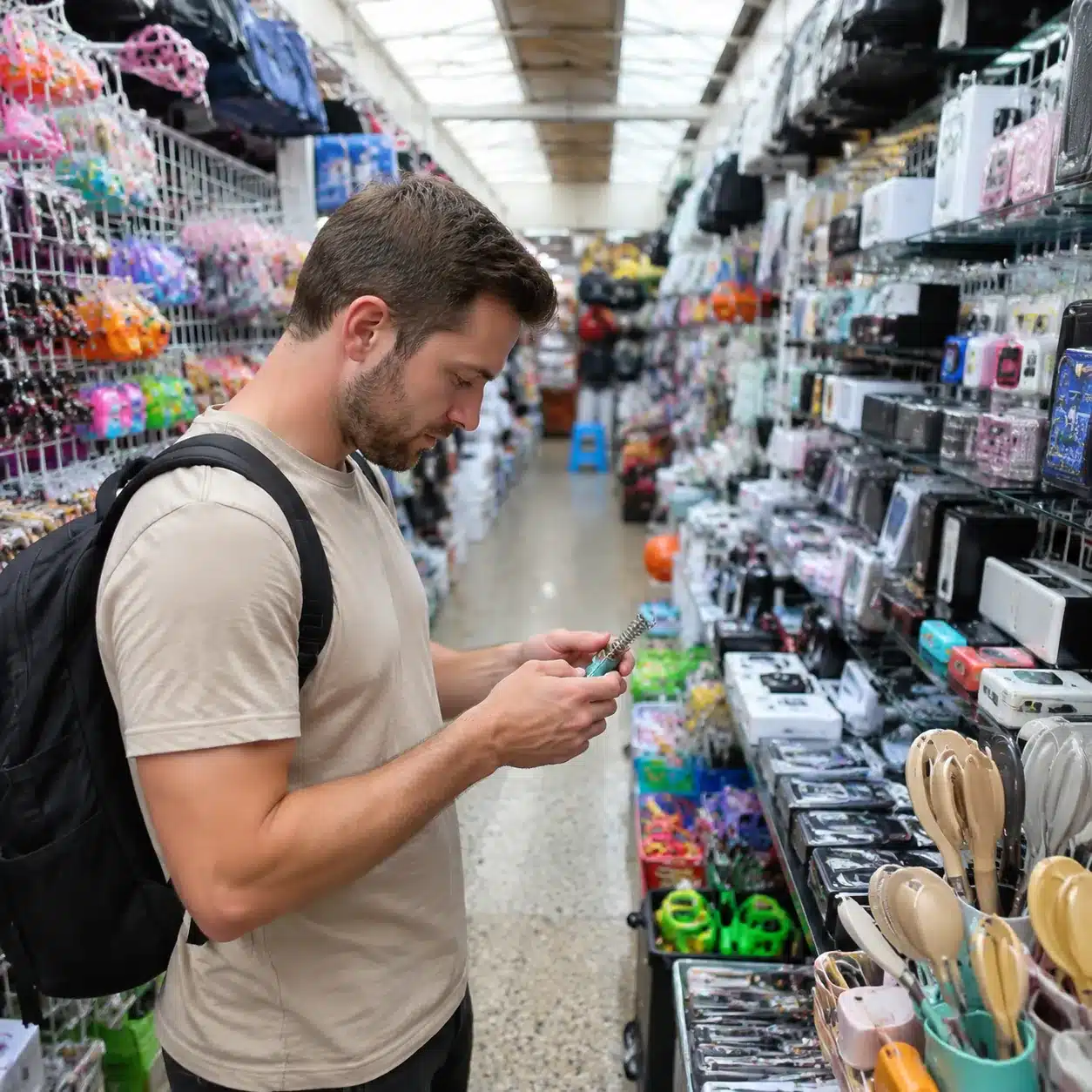
Product Variety and Niche Hunting
Yiwu gives you 75,000 booths of low-MOQ sampling power. Alibaba gives you scale. The mistake is starting on the wrong one.
Yiwu Categories and Strengths: Small Consumer Goods Density
Yiwu Market’s 75,000+ booths cover 5.5 million square meters of primarily small consumer goods. The strength is not just variety, but adjacency. You can compare five different suppliers of silicone kitchen brushes within a 10-minute walk. For an Amazon seller testing a new category, that density cuts weeks off sourcing cycles. The typical first-time Amazon FBA buyer walks in with a list of 10-15 product ideas and leaves with samples from at least 5 suppliers, all in one day. No platform replication of that speed exists.
Alibaba Industrial Product Coverage: Scale Without Touch
Alibaba hosts 1 million+ suppliers and covers heavier industrial categories Yiwu cannot stock—machinery, electronics components, bulk chemicals. Its value is the database, not the inspection. An estimated 12% of Alibaba listings link to trading companies or non-factory middlemen, per industry surveys. For a seasoned importer who knows their spec sheet, Alibaba is a time machine. For a new Amazon seller with under $10,000 to test, it is a minefield. You need a spec to verify against, and most novices don’t have one yet.
Trending Niche Items and Private Labeling
Trending niches in Yiwu right now are compact travel organizers, reusable silicone storage bags, and pet grooming kits. The MOQ on these is 50–200 units, with unit costs 10–30% lower than an Alibaba quote for the same item. Private labeling in Yiwu is a physical conversation: you walk in, pick a white-label product, negotiate foil stamping or a custom box, and pay 10–15% above the base unit price. The lead time is usually 7 to 14 days. The same process on Alibaba takes weeks of message pinging and sample shipping, and you still don’t know if the factory has another client’s label on the other side of the room.
Physical Browsing Reveals Unsaturated Products
The most valuable thing physical browsing gives you is the ability to spot what competitors are not buying. When you walk the aisles—Fashion Section B, Toy Section D, Hardware Section F—you see which booths have dust on the display models. Those dead SKUs often reveal a category that hasn’t been Amazon-optimized yet. Alibaba’s search algorithm hides these because it ranks by recent orders and paid placement. Over 60% of new sellers never use the “MOQ: less than 100” filter on Alibaba, a distinct Yiwu Market MOQ vs Alibaba MOQ advantage, and end up trapped in high-minimum listings. Physically walking Yiwu eliminates that algorithmic distortion. You can test a product no one else is selling for $200 in samples, not $2,000 in minimums.
Заключение
Start with Yiwu Market to test 1-5 SKUs at MOQs as low as 50 units and physically verify FBA labeling on-site — this alone can cut your Amazon return rate by up to 40%. Once a product proves out, scale that order to 500+ units via Alibaba, where lower per-unit shipping and Trade Assurance make repeat orders safer. The 10-30% price advantage Yiwu gives you on small batches more than covers a $1,200 trip when you factor in the hidden MOQ traps and labeling errors that plague Alibaba first-timers.
If you want to skip the learning curve, look at our Amazon Sourcing Solutions — a Yiwu-based agent handles supplier vetting, inspection, FBA prep, and consolidation from as low as $250 a day. That turns the platform choice from a gamble into a controlled test.
Часто задаваемые вопросы
How to get a quote for Yiwu Market vs Alibaba: Sourcing Comparison?
You can leave your detailed requirements using the inquiry form below, and our sales team will provide a comprehensive quotation along with product specifications within 24 hours.
Can I request samples before bulk orders?
Yes, we highly recommend testing samples first. Please contact our support team to arrange sample shipments to verify the product quality before confirming your large volume purchase.