Джастин.
A ‘free storage’ period can quickly become a costly trap if you don’t understand the fine print. For B2B importers managing inventory from China, the difference between a grace period and a monthly storage fee is the difference between a streamlined supply chain and an unexpected expense that erodes your margins.

This article breaks down the real costs of warehousing in China for 2026. We’ll clarify the standard 7-30 day free storage windows, explain the typical long-term rate of $5-$10 per CBM per month, and detail additional fees for labor and palletizing that impact your total landed cost.
Standard Free Storage Periods (7-30 Days)
Free storage is a temporary grace period, not a permanent solution, offered by logistics providers to give you time to arrange onward transport. Standard periods range from 4-7 days at ports to 7-30 days in warehouses, with daily fees applying immediately after the free period ends.

The Core Concept: What ‘Free Storage’ Really Means
Free storage is a temporary grace period offered by logistics providers, not a permanent solution. The purpose is to give you time to arrange onward transport without incurring immediate fees.
This period starts when your goods are officially received into the warehouse’s custody. For port terminals, this concept is called ‘free demurrage’ and is typically much shorter, often 4-7 days.
Typical Timeframes and Where They Apply
Warehouse consolidation, like the service offered by Chineseyiwu.com, commonly provides 7 to 30 days of free storage. Port and terminal free storage (demurrage) is usually stricter, ranging from 4 to 7 days for containers.
Shipping lines often grant 7 days of free container usage from pickup at the yard. High-volume shippers with established contracts can sometimes negotiate extended free periods of 14-20 days for containers.
What Happens When the Free Period Ends?
Exceeding the free storage limit triggers daily storage or demurrage fees. At ports, these fees can range from $75 to $150 per container per day, and often increase for longer overages.
In a warehouse, standard monthly storage rates apply after the free period expires. The exact terms, including the free period length and subsequent charges, are defined in your shipping contract or service agreement with the provider.
Long-Term Storage Rates ($5-$10/CBM/Month)
Long-term warehouse storage typically costs between $5 and $10 per cubic meter (CBM) per month. This range is an industry standard, often derived from converting common U.S. cubic foot pricing and applying volume discounts for extended contracts.
| Provider/Type | Rate per CBM/Month | Notes |
|---|---|---|
| Industry Avg (3PLs) | $5-$10 (equiv.) | Base rates of $0.43-$0.78/ft³ convert to ~$15-$27/CBM; long-term discounts bring it down to $5-$10. |
| Amazon FBA (off-peak) | ~$27.50 | Based on $0.78/ft³; rates can peak at $85/CBM during holiday seasons. |
| Walmart WFS | ~$26.50 | Based on $0.75/ft³, generally consistent year-round. |
| CrossDock (CBM example) | ~$23 | Based on $0.65/ft³ for mixed-size shipments. |
| Brimich Group Avg | ~$16-$18 | Based on $0.45-$0.50/ft³ for pallet-equivalent storage. |

What Long-Term Storage Rates Mean for Your Business
Long-term storage is a standard service for goods you need to store for several months, with costs calculated per cubic meter (CBM) per month.
The typical rate of $5 to $10 per CBM per month is an industry average, derived from converting common U.S. cubic foot pricing and applying long-term volume discounts.
This model allows for predictable budgeting; for example, storing 10 CBM of inventory at a $7 monthly rate costs $70 per month.
How Rates Are Calculated and What Affects Them
The core formula for calculating monthly storage cost is: Average Daily CBM Volume × Agreed Rate × (Storage Days / 30).
Rates vary significantly based on location (urban warehouses can be 20-50% more expensive), access frequency, and the nature of goods (e.g., hazardous materials may incur a 25% surcharge).
Climate-controlled storage for sensitive items typically adds an extra $2 to $10 per CBM per month to the base rate.
Major e-commerce platforms like Amazon FBA and Walmart WFS have distinct, often higher, rate structures that can triple during peak holiday seasons.
Critical Fees and Surcharges to Plan For
Aged inventory surcharges are a major cost factor, where fees increase by 25% to 100% for goods stored beyond 90 to 180 days.
Peak season surcharges, especially from October to December, can cause standard rates to triple on platforms like Amazon FBA.
The $5-$10/CBM range generally applies to standard, long-term agreements; short-term or on-demand storage often costs more.
Loading & Unloading Fees (The Labor Cost)
Loading and unloading fees are labor charges for physically moving goods into or out of a warehouse or container. These costs are separate from freight and storage, covering the manual work essential for services like product consolidation, inspection, and Amazon FBA preparation.

What Are Loading and Unloading Fees?
Loading and unloading fees are labor charges for physically moving goods into or out of a warehouse or container.
These costs are separate from freight, storage, and other logistics fees.
They cover the manual work of handling goods, which is essential for services like product consolidation, inspection, and preparing shipments for Amazon FBA.
Typical Cost Ranges and Key Factors
Labor costs for loading and unloading typically range from $40 to $80 per hour, with an average around $68 per hour.
Most service providers enforce a minimum charge, often for 2 to 3 hours of work.
Specific rates vary by provider and location. For example, U-Haul Moving Help charges about $44 per hour, while labor-only movers may cost $38 to $75 per person.
Additional fees apply for complex access, such as navigating stairs or elevators, which can add $50 to $200 or more to the total cost.
Seasonal demand, particularly from May to September, can increase rates by 20% to 30%.
How This Relates to Your Sourcing and Warehousing
When using a service partner like Chineseyiwu.com, these labor costs are often bundled into the comprehensive service fee for consolidation and inspection.
The 3,000 sqm warehouse facility handles the loading, unloading, and internal movement of goods as part of its quality control and shipment preparation process.
Understanding these fees helps you budget accurately, especially for time-sensitive operations like Amazon FBA prep, where goods need to be palletized, labeled, and loaded for final shipment.

Palletizing vs. Loose Cartons Cost
Palletized shipping typically has higher upfront costs due to palletization fees and materials, while floor-loaded (loose carton) shipping offers lower initial costs and better container space use. However, palletized freight unloads much faster at the destination, which can reduce labor costs and offset the initial investment.

Upfront Costs and Operational Efficiency
Palletized shipping typically incurs higher initial costs due to palletization fees, material costs, and additional handling labor.
Floor-loaded (loose carton) shipping offers lower upfront costs with no palletization fees and better container space utilization.
However, palletized freight unloads significantly faster at destination warehouses, reducing labor time and costs for unloading operations.
Choosing the Right Method for Your Shipment
Floor-loaded cartons are often more cost-effective for smaller, varied orders, LTL freight, and shipments where longer unloading times are acceptable.
Palletizing is generally preferable for full truckload (FTL) shipments, bulk orders, and goods bound for streamlined operations like Amazon FBA fulfillment centers.
Fragile items and international exports often require palletization for stability and to meet standards like ISPM 15 compliance.
Why “Free Warehousing” usually has a Time Limit
“Free warehousing” in logistics typically has time limits of 2-7 days depending on the mode of transport to prevent port/terminal congestion, manage high operational costs, and ensure efficient cargo turnover before demurrage fees apply.

The Core Reasons: Cost, Capacity, and Control
The primary purpose of a free storage period is to balance customer convenience with the harsh realities of logistics operations.
Warehouses and ports operate on thin margins; space is their primary asset. Extended free storage ties up this asset, preventing them from serving new cargo and generating revenue.
Without time limits, facilities would face severe congestion, leading to operational bottlenecks and delays for all customers.
The policy encourages just-in-time pickup, ensuring a smooth and efficient turnover of goods, which is critical for global supply chain fluidity.
Standard Free Time Limits by Transport Mode
For Ocean FCL (Full Container Load): The standard is 5 business days from the arrival notice. Overstaying typically incurs demurrage fees ranging from $100 to $300 per container per day.
For Ocean LCL (Less than Container Load): Goods usually have 7 calendar days of free time after deconsolidation at the Container Freight Station (CFS).
For Air Freight: Free time is shortest, typically 2 to 3 days (48-72 hours) from terminal arrival, reflecting the higher operational costs of air cargo hubs.
For Rail Freight: In major hubs, free time can be as short as 2 days, including weekends, with IoT tracking now common to monitor dwell time.
Consequences of Exceeding the Free Period
Immediate financial penalties apply, known as demurrage (port/terminal charges) or storage (warehouse charges). These fees escalate daily, quickly eroding profit margins.
Prolonged storage, or ‘dwell time,’ creates logistical bottlenecks that can delay subsequent shipments and disrupt your entire supply chain schedule.
In extreme cases, such as in bonded warehouses, goods left beyond legal limits (e.g., 5 years in the U.S.) risk being seized by customs or sold at auction.
For dropshippers and Amazon FBA sellers, failing to move inventory on time can lead to stockouts, missed sales, and additional long-term storage fees from Amazon.
Inventory Management Fees for Dropshippers
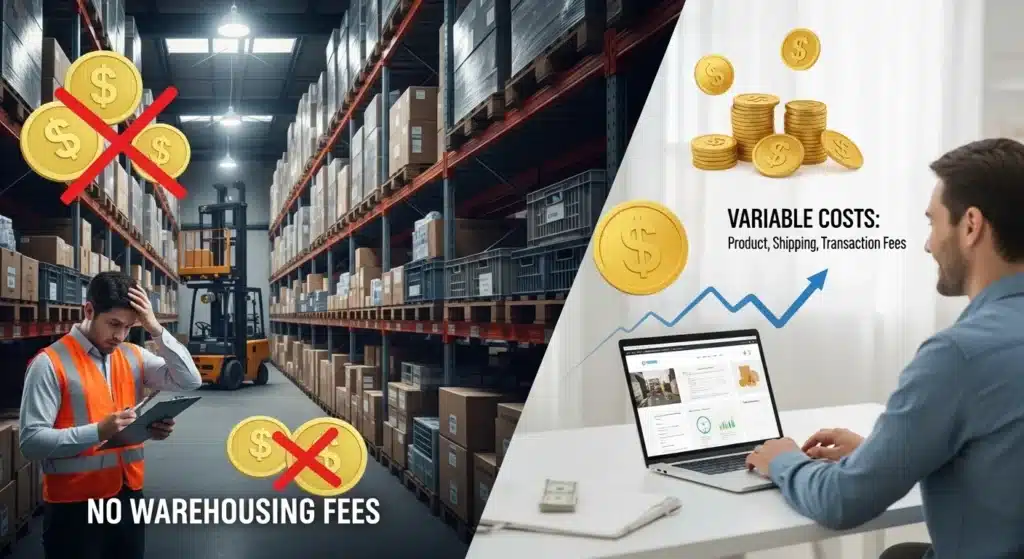
Dropshippers typically do not pay inventory management or storage fees because they do not hold physical stock. Suppliers handle storage and fulfillment directly, eliminating traditional warehousing costs. The primary costs for dropshippers are variable fees tied to order volume, such as supplier product costs, shipping, and platform transaction fees.
Why Dropshippers Typically Don’t Pay Inventory Fees
Dropshippers do not hold physical inventory themselves; suppliers handle storage and fulfillment directly.
This model eliminates traditional warehousing or long-term storage costs, as merchants never buy stock upfront.
For novices, this means you can effectively ‘leave’ inventory with suppliers indefinitely at no direct cost to you.
Understanding the Real Costs: Supplier and Platform Fees
While inventory fees are absent, other variable costs apply, scaling with order volume, not held stock.
Some suppliers charge small per-order dropshipping fees (e.g., $1 for the first item + $0.25 per additional) or monthly subscriptions for access to their catalogs.
Key variable costs for 2026 include Supplier Product Cost (~120% of revenue), Supplier Shipping (~30%), Platform Transaction Fees (~25%), and Payment Gateway fees (~15%).
Total fixed overhead for a professional operation can be around $12,100 per month, which includes SaaS tools like e-commerce platforms.
Advanced Planning for Veterans and Hybrid Models
Veterans modeling for peak seasons like Q4 focus on projecting revenue against variable costs (120–190% of revenue), not CBM-based storage.
If using a hybrid model with pre-stocked inventory for speed, cost calculation shifts to supplier rates based on volume (CBM), weight, and distance.
The path to profitability requires scaling average order value and negotiating supplier tiers; breakeven can require a ~15-month runway and significant cash reserves.
Часто задаваемые вопросы
How much is warehouse storage in China?
Warehouse storage in China typically costs between $5 and $40 per CBM per month, or $1 to $1.25 per CBM per day. The rate depends on the warehouse type and location. General warehouses charge $5–$15/CBM/month, while bonded warehouses can cost $20–$40/CBM/month. Many providers offer a free storage period of 15 to 30 days before daily charges apply. Additional services like receiving, pick and pack, labeling, and palletizing incur extra fees.
Do agents offer free warehousing?
No, logistics agents do not generally offer free physical warehousing. Services are charged based on the space used, duration of storage, and specific handling required. Some providers offer flexible, contract-free options where you only pay for the space and time you use, but these are not free. The term ‘free warehousing’ in search results often refers to warehouse management software, not actual storage space.
What is the cost of palletizing in China?
The cost for palletizing as a service, such as having a warehouse prepare your goods on pallets, is typically around $35 per pallet. If you are inquiring about purchasing palletizing equipment, industrial systems like column mechanical palletizers can cost between $50,000 and $150,000 per unit. The automation market in China is significant due to rising labor costs, with payback periods for such investments often under 18 months.
What are container loading fees?
Container loading fees are charges for physically loading cargo into a shipping container, often at a warehouse or port. These are separate from ocean freight. A major component is the Terminal Handling Charge (THC), which covers loading at the origin port and unloading at the destination, typically ranging from $150 to $400 per container at each end. Other factors influencing cost include container size, cargo weight and volume, and specific port charges. Prolonged use of a container beyond the allotted free time incurs separate demurrage or detention fees.
Are warehouses in Yiwu cheap?
Yes, warehouse storage in Yiwu is generally more affordable than in major port cities like Shanghai or Shenzhen. Rental rates can range from $35 to $95 per square meter per year. For shared or third-party logistics (3PL) storage, costs are often around $1 to $1.25 per CBM per day after an initial free period (typically 15-30 days), equating to roughly $30 to $37.50 per CBM per month. Locations further from the city core can be 20-50% cheaper. Yiwu is a cost-effective hub for importers consolidating goods from the wholesale market for medium to long-term storage.
Заключительные размышления
Understanding China’s warehousing costs in 2026 comes down to balancing short-term grace periods with long-term planning. The “free” storage you often see is a strategic buffer, not a permanent perk. It’s designed to give you time to arrange onward shipping without immediate penalty, but daily fees kick in quickly once that window closes. For long-term needs, the $5 to $10 per CBM monthly rate provides a predictable baseline, but your final cost will depend heavily on your goods, location, and contract terms.
The key to managing these expenses is viewing each fee—from loading labor to palletizing—as part of a connected system. A decision that saves money upfront, like opting for loose cartons, might lead to higher unloading costs later. For dropshippers, the cost structure shifts entirely away from storage to variable order fees. By planning around these timelines and fees, you can avoid unexpected charges, optimize your logistics budget, and ensure your goods move through the supply chain efficiently and cost-effectively.