Justin
If you’re scaling a dropshipping business, you’ve likely hit a wall with AliExpress. The platform’s affordable shipping lanes take 15-45 days, forcing you to choose between slow delivery that frustrates customers and expensive express upgrades that can erase your entire $5-$10 profit margin on a single order.

This article explains how a Yiwu-based private agent offers a professional alternative. We’ll detail how their dedicated warehouse model operates with a Warehouse Management System to achieve 99.5% order accuracy, compare shipping lines like YunExpress and 4PX for faster 7-15 day delivery, and outline the technical process for integrating their services directly with your Shopify or WooCommerce store.
Why AliExpress is Too Slow (and Expensive)
AliExpress shipping is slow because its dominant, affordable options like Standard Shipping take 15-45 days. To match the 3-7 day delivery standard set by Amazon, you must upgrade to expensive express couriers, which erodes profit margins for dropshippers.

The Structural Reality of AliExpress Shipping Times
AliExpress Standard and Economy shipping lanes are built for 15 to 45+ day transit times from China, plus 1-5 days for seller processing before dispatch.
Even faster options like AliExpress Premium or ePacket still take 7-20 days, far from the 3-7 business day delivery expected by US and EU customers.
This slow cadence stems from ocean transit, multiple logistics handoffs, and customs clearance, making it unsuitable for competitive dropshipping.
The Cost Trade-Off: Speed Comes at a Premium
The platform presents a harsh trade-off: cheap lanes are very slow, and fast lanes are very expensive.
Upgrading a shipment from a 30-40 day economy lane to a ~7 day delivery with DHL or FedEx can cost 10x more, rated 1/10 on cost versus economy methods.
For a dropshipper, repeatedly paying these express premiums to meet customer expectations can completely erase the slim $5-$10 margin on a low-ticket product.
The “Private Agent” Model: Warehousing & fulfillment
A private agent’s warehouse operates like a dedicated contract 3PL, with exclusive space and staff for your brand. It uses a professional Warehouse Management System (WMS) to achieve industry-standard SLAs: ≥99.5% inventory and order accuracy, ≥95% on-time shipping, and damage rates below 0.1%. This engineered setup enables custom packaging, quality control, and faster, more reliable fulfillment than standard dropshipping.
| Key Aspect | Professional Standard | AliExpress / Basic Dropshipping |
|---|---|---|
| Operational Model | Dedicated contract warehousing with exclusive space, equipment, and staff. | Shared, public warehouse space with no dedicated resources. |
| Core Technology | Tier-1 WMS (e.g., Korber One) with real-time inventory and scanner-guided workflows. | Manual processes or basic spreadsheets; limited visibility. |
| Performance SLA | ≥99.5% inventory/order accuracy, ≥95% on-time shipping, <0.1% damage rate. | No formal SLAs; high error and damage rates are common. |
| Security & Compliance | 24/7 monitoring, controlled access, CCTV. Certifications like ISO 9001, SQF, FDA. | Minimal security; no compliance certifications for regulated goods. |
| Economic Model | Pay-as-you-go, scalable capacity without capital expenditure. | Per-order fees with hidden costs and no capacity planning. |
| Service Scope | B2C & B2B fulfillment, value-added services (labeling, assembly, returns). | Basic parcel shipping only; no customization or added services. |

How a Professional Private Agent Warehouse Actually Operates
A serious private agent runs their warehouse on a dedicated contract model. This means they allocate exclusive racking, equipment, and trained staff specifically for your brand. This exclusivity is what allows for custom standard operating procedures, whether for kitting products together, applying custom packaging, or executing quality control checks.
The core of this operation is a professional Warehouse Management System (WMS), similar to platforms like Korber One used by major 3PLs. This software provides real-time, bin-level visibility into your stock and guides warehouse staff with scanner-led workflows to virtually eliminate picking and packing errors. It’s the digital backbone that makes high accuracy rates possible.
Physically, the facility mirrors legitimate logistics centers. Security is a baseline requirement, featuring 24/7 monitoring, controlled access points, and comprehensive CCTV coverage. The layout itself is engineered for speed, utilizing concepts like cellular micro-fulfillment cells and optimized aisle widths to minimize the travel time for workers picking your fastest-moving products.
The service mix extends well beyond simple parcel shipping. A professional agent’s setup typically handles both B2C ecommerce and B2B retail orders. They offer flexible storage options—shared or dedicated—and provide value-added services like product labeling, light assembly, and streamlined returns processing. This turns a storage space into a full-service fulfillment partner.
Benchmarks, Compliance, and What to Demand from Your Agent
You should judge an agent’s fulfillment capabilities by concrete metrics. Demand that their Service Level Agreement includes hard targets: Inventory and Order Accuracy at 99.5% or higher, an On-Time Shipping Rate of at least 95%, and a Damage Rate kept below 0.1%. These are the standard KPIs for professional contract warehousing.
For brands shipping regulated goods like food, supplements, or cosmetics, compliance is non-negotiable. Verify that the warehouse holds relevant certifications, such as ISO 9001 for quality management, SQF for food safety, FDA registration, or C-TPAT for supply chain security in cross-border trade.
Before onboarding, a professional agent will require specific data to plan your space and labor effectively. Be prepared to provide 24 months of shipping volume history to illustrate seasonality, plus a complete SKU catalog with dimensions, weight, and any special storage needs like temperature control or hazardous material handling.
The economic model is a key advantage. Like a 3PL, you pay only for the storage space and labor you use, scaling up or down without the massive capital outlay of leasing your own private warehouse. This pay-as-you-go structure is often how brands achieve significant savings—sometimes $2 or more per order—compared to AliExpress shipping.
Finally, seamless integration is critical. The agent’s WMS must connect via API to your ecommerce platform (like Shopify or WooCommerce) or Order Management System. The best systems provide unified dashboards that can even show inventory held in external locations, such as Amazon FBA, giving you a complete picture of your stock.
MOQ for Dropshipping: Is it really 1 piece?
For pure dropshipping, the MOQ is effectively one piece because suppliers fulfill individual retail orders on-demand, without requiring the seller to buy inventory upfront. This differs from wholesale or manufacturing, where higher MOQs (like 50-500 units) are standard to cover production costs.

In dropshipping, the true MOQ is effectively one piece. Suppliers fulfill individual retail orders without mandating bulk purchases from the seller. This distinguishes it from wholesale or manufacturing models, where MOQs ensure profitability through economies of scale. Suppliers set higher MOQs to cover fixed costs like setup, raw materials, and production runs, but dropshipping bypasses this by leveraging on-demand fulfillment.
The 1-Piece MOQ: How Pure Dropshipping Works
The core operational model allows for a true one-piece minimum. Suppliers ship only the quantity sold per customer order, with no upfront bulk purchase required from the seller. This separates the seller’s risk from inventory holding, as payment from the end customer funds the order.
Print-on-demand services are a prime example, producing items individually with no MOQ. Dropshipping suppliers typically have an MOQ of one unit per customer order, as they ship only the quantity sold without upfront bulk requirements.
When MOQs Apply: Wholesale, Manufacturing, and Hybrid Models
Higher MOQs are standard in contexts outside pure dropshipping. Manufacturers and wholesalers set MOQs from 50 units for partnerships up to 500 units per custom design to cover setup and material costs. For example, MOQs can range from 200 units for a product batch to 300 kg of raw materials needed for a production run.
Sourcing directly from platforms like Alibaba often shows volume discounts starting at 15-30 units, with per-unit prices dropping significantly compared to ordering a single piece. This reflects the wholesale model’s reliance on volume.
A hybrid dropshipping model may involve a small MOQ, such as stocking 50 units with an agent, to enable faster shipping times compared to pure on-demand fulfillment. This approach blends inventory holding with the dropshipping structure for speed, though pure dropshipping avoids MOQ entirely.
Stop Overpaying. Start Sourcing Smarter in Yiwu.

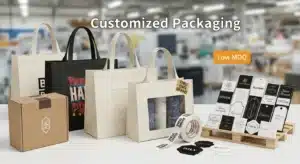
Custom Packaging for Dropshippers (Blind Shipping)
Blind shipping is a fulfillment method where a supplier ships goods directly to a customer without revealing their identity. This requires custom packaging, branded labels, and modified shipping documents like a Blind Bill of Lading to remove all supplier information, creating a seamless, brand-controlled delivery experience for the end customer.

What is Blind Shipping and Why Dropshippers Need It
Blind shipping conceals the original supplier’s identity from the end customer, allowing dropshippers to appear as the sole seller.
The primary goal is brand control: preventing customers from discovering the source and potentially cutting out the retailer.
Single-blind shipping hides the supplier from the customer only, while double-blind also hides the customer from the supplier.
Triple-blind shipping uses encrypted documents and neutral facilities to conceal identities from all parties, including the carrier.
The Technical Process: Packaging, Labels, and Documents
The process starts with the retailer sending an order to a fulfillment partner who coordinates with the supplier for direct shipment.
All external packaging and internal materials must exclude supplier logos, using only retailer-branded or neutral information.
A Blind Bill of Lading (BOL) is created, customizing shipper details; multiple versions may be needed for the carrier, consignee, and internal records.
Carrier protocols require special instructions and pre-approved labels; re-labeling at hubs may incur additional accessorial charges.
Return processes use branded RMA labels and neutral return addresses to maintain the blind throughout the product lifecycle.
Shipping Lines: YunExpress vs. 4PX vs. ePacket
ePacket is a postal service best for sub-2kg, low-value items with slow but safe returns. YunExpress and 4PX are commercial B2C lines offering faster 7-15 day delivery at similar cost, but they destroy failed parcels and have strict regional limits. The choice hinges on speed versus risk tolerance.

The Core Operational Models: Postal vs. Commercial Consolidation
ePacket operates as a UPU postal product. It has a 2 kg weight limit and strict size restrictions (L+W+H ≤ 90 cm). Its most critical feature for risk management is that undeliverable parcels are returned to China for free, making it a safer option for shipments with potential address errors.
YunExpress and 4PX function as commercial B2C consolidators. They aggregate parcels, use dedicated linehaul, clear customs as Delivered Duty Paid (DDP), and then inject shipments into local carriers like USPS for the final delivery leg.
This creates a fundamental trade-off. ePacket offers slower, less predictable transit times (typically 15-30+ days) but with the safety net of returned items. YunExpress and 4PX provide significantly faster transit (7-15 days) but treat failed deliveries as a total loss, typically destroying them after about 15 days with no free return to the sender.
Technical Specifications, Costs, and Lane Restrictions
YunExpress and 4PX use volumetric weight for pricing, calculated as L×W×H / 8000 (or /6000 on some lanes), which incentivizes compact packaging. For common dropshipping items under 2 kg, their rates are often slightly cheaper than ePacket’s while providing faster service.
Operational restrictions are a key differentiator. YunExpress and 4PX commonly exclude remote regions like Alaska, Hawaii, Puerto Rico, and APO/FPO addresses, and they require a recipient phone number. ePacket has broader postal coverage but cannot ship pure batteries, liquids, or powders.
Loss compensation for YunExpress and 4PX is typically limited to 100 RMB plus the paid shipping fee. For parcels between 2–5 kg, these commercial lines become the recommended choice, especially for items like vacuum-packed apparel where minimizing volumetric weight is crucial for cost control.
Integrating with Shopify/WooCommerce
Connecting your Shopify or WooCommerce store to a private agent’s warehouse involves using their respective APIs to sync products, inventory, and orders. The key is standardizing SKUs as the primary identifier and implementing a middleware layer to manage data flow, authentication, and error handling. For operations handling 50-200 orders per day, real-time sync is critical to prevent overselling, with a typical integration taking 4-6 weeks to complete.

Core Components and API Setup
The technical connection starts with API credentials. Shopify uses an Admin API access token and your store URL for authorization, while WooCommerce uses REST API keys (consumer key and secret) generated in its admin panel.
A critical technical hurdle is that Shopify and WooCommerce use different internal IDs for products. Shopify uses Variant IDs and WooCommerce uses Post IDs. To sync data accurately, you must rely on matching text SKUs as the canonical identifier across both platforms and the warehouse system.
You’ll need to map several key data domains. This includes product details like titles, descriptions, prices, variants, and images, as well as customer information and order data such as line items, taxes, and fulfillment status.
Architecture and Implementation Roadmap
For a stable, scalable operation, a three-system architecture is standard. Your store connects to a middleware layer, which then connects to the 3PL’s Warehouse Management System (WMS). This middleware handles the critical tasks of data translation, authentication, and error management, ensuring smooth communication between your storefront and the warehouse.
If your store processes 50-200 orders per day per location, real-time synchronization for orders and inventory is recommended. This immediate data flow prevents overselling and helps manage API rate limits effectively.
A realistic timeline for a multi-location integration is 4-6 weeks from planning to stable go-live. This period covers essential phases like detailed data mapping, staged testing in a development environment, and setting up monitoring for the ongoing sync process.
Final Thoughts
While AliExpress offers a convenient entry point for dropshipping, its fundamental logistics model creates a bottleneck for growth. The trade-off between slow, affordable shipping and fast, expensive delivery makes it difficult to compete on speed or protect profit margins. For sellers looking to build a sustainable brand and meet modern customer expectations, this limitation is significant.
A private agent based in a sourcing hub like Yiwu provides a clear path forward. By shifting to a model built on dedicated warehousing, professional systems, and direct logistics partnerships, you gain control over the customer experience. This setup enables faster shipping, custom packaging, and reliable fulfillment—key advantages that can transform a basic dropshipping store into a professional e-commerce operation.
Frequently Asked Questions
How do I find a private dropshipping agent?
Look for agents on platforms like Upwork or Fiverr, focusing on those with expertise in your product category or China sourcing. Evaluate them based on client reviews, communication speed (ideally replying within hours), location near factories, and flexibility with order minimums—avoid agents requiring inflexible minimums like 50 orders per day. A good agent should have a direct factory network, bypassing platforms like Alibaba.
Is Yiwu better than AliExpress for dropshipping?
No, Yiwu is not better for a standard dropshipping model. AliExpress is built for it, offering tools like DSers for automated order processing, inventory sync, and supplier filtering for single-piece orders. The Yiwu market provides direct factory access and lower unit prices, but typically requires bulk purchases (MOQs of 100+ pieces) and lacks the dedicated dropshipping automation and support that AliExpress provides.
What are the shipping times from Yiwu to the USA?
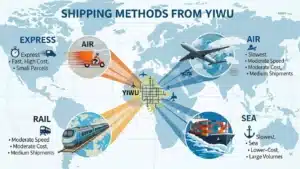
Shipping times depend on the method. Express shipping is the fastest, taking 2 to 5 days door-to-door. Air freight takes 4 to 10 days, while sea freight is the slowest, typically requiring 25 to 45 days for door-to-door delivery. For context, a standard sea freight route from Ningbo to Los Angeles takes about 15 to 22 days port-to-port.
Can a dropshipping agent integrate with my Shopify store?
Yes, modern agents can integrate with Shopify. The standard method is for the agent to provide a Shopify app or a private API. Your store then connects using Shopify’s webhooks and Admin API to automatically send orders and receive fulfillment and tracking updates. Shopify’s official documentation, including templates for AI agent integrations, supports this as a standard capability.
Do I need to buy inventory upfront for dropshipping?
No, a core principle of dropshipping is that you do not purchase stock upfront. You only buy a product from your supplier after a customer has placed and paid for an order on your store. Your starting capital is used for other essentials like your e-commerce platform, apps, product samples, and initial advertising, not for bulk inventory.