 Justin
If you’re importing from China, the price you pay your supplier is just the beginning. Hidden freight fees, unexpected duties, and complex port charges can easily add 40% or more to your final cost, turning a profitable order into a loss.
This guide breaks down the full landed cost formula, from product price to your warehouse door. We’ll show you how to calculate sea freight using CBM and density rules, explain how to find your exact duty rate with HS codes, and detail specific fees like the PierPass TMF (approximately $34–$35 per TEU) that impact your bottom line.
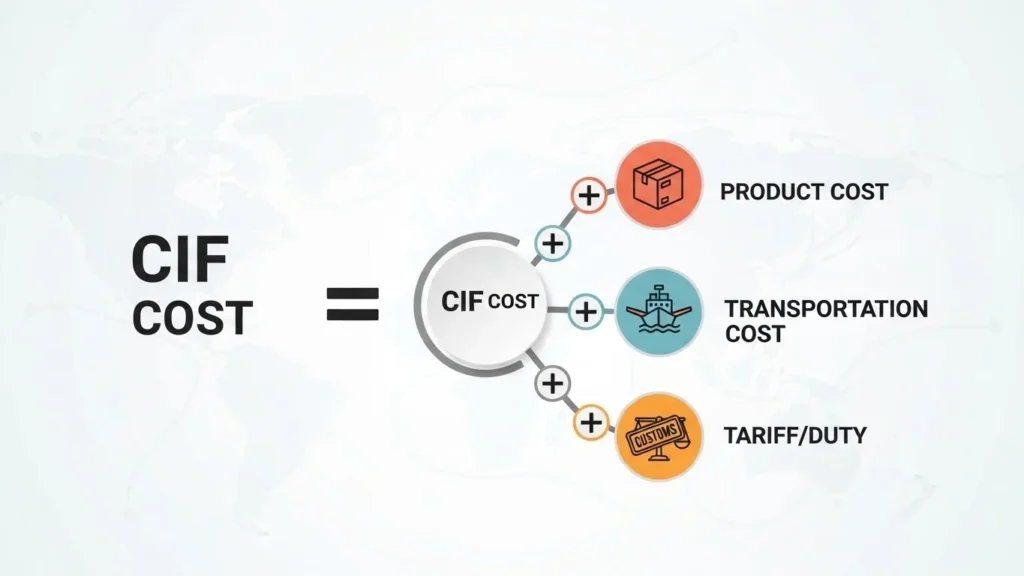
The Landed Cost Formula (Product + Shipping + Duty)
Landed cost is the total price to get a product from a foreign factory to your door. It’s calculated by adding the product cost, all transportation and shipping fees, customs duties and taxes, insurance, and handling or overhead charges. This formula ensures you know the true cost of imported goods.
| Cost Component | Description | Example Items |
|---|---|---|
| Product Cost | The purchase price paid to the supplier (COGS). | Unit cost, ex-works price. |
| Transportation/Shipping | All costs to move goods from origin to destination. | Ocean/air freight, drayage, terminal handling, last-mile delivery. |
| Customs Duties & Taxes | Government-imposed fees based on product classification and value. | Import duty, tariffs, value-added tax (VAT), goods and services tax (GST). |
| Insurance | Coverage for goods against loss or damage during transit. | Marine cargo insurance. |
| Handling/Operating Costs | Fees for services required to process and manage the shipment. | Customs brokerage, warehousing, storage, loading/unloading, port charges. |
The Core Formula and Its Components
The standard formula used by logistics and ERP providers is: Landed Cost = Product Cost + Transportation/Shipping + Customs Duties & Taxes + Insurance + Handling/Operating/Overhead Costs.
Product Cost refers to the purchase price from the supplier, also known as the cost of goods sold (COGS). This is your starting point.
Transportation/Shipping includes all logistics fees: ocean or air freight, drayage (trucking to/from ports), terminal handling charges, and final delivery. This is often the most variable and substantial add-on cost.
Customs Duties & Taxes are calculated based on the product’s Harmonized System (HS) code and the importing country’s specific regulations. This is not a flat fee but a percentage of the product’s declared value.
Insurance covers the goods during transit against loss or damage, protecting your investment.
Handling/Operating Costs encompass the operational fees that accumulate: warehousing, storage, loading/unloading, customs brokerage fees, and other port or compliance charges. These are the costs of doing business that get allocated to each shipment.
Worked Examples and Cost Impact
In one example, a business imported 1,000 units at $10 each, for a product cost of $10,000. Freight charges added $3,300, customs duty was $500, and insurance cost $250. The total landed cost was $14,050, which breaks down to $14.05 per unit.
Another case shows a factory cost of $4.95 per unit. A 3.2% duty rate (based on HTS code 4419.90.9000) added $0.16 per piece. Drayage, customs brokerage, and freight added another $0.63 per piece. The final landed cost per unit was $6.41.
These examples show that shipping, duty, and handling fees can add over 40% to the base product cost. This validates why a detailed calculation is necessary; a simple “product + shipping” estimate misses significant expenses that directly impact your unit economics and profit margins.
Estimating Sea Freight: CBM & Density
Sea freight costs for less-than-container-load shipments are based on chargeable units, which are the greater of the shipment’s actual weight or its volume. Volume is measured in cubic meters, and a standard density rule of 1,000 kg per CBM is used to convert between weight and space for billing.
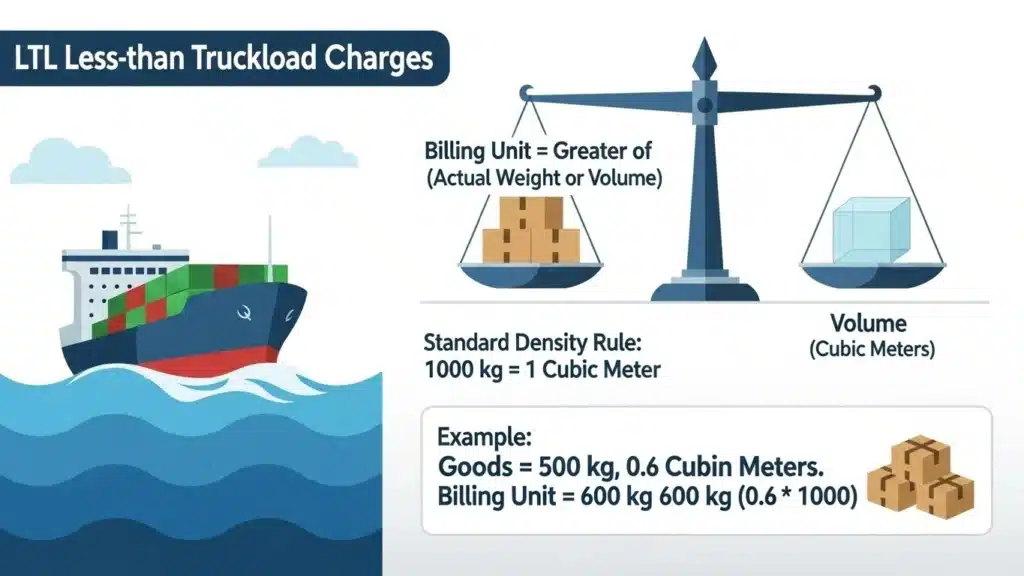
How CBM and Density Determine Your Freight Cost
The fundamental rule for LCL sea freight is that 1 cubic meter is treated as equivalent to 1 metric ton (1,000 kg). Carriers calculate a ‘chargeable weight’ by comparing the shipment’s actual gross weight against its volumetric weight, which is the total CBM multiplied by 1,000 kg.
You are billed based on whichever unit—actual weight in metric tons or total CBM—yields the higher number of chargeable units. This system ensures carriers are compensated fairly for both heavy, dense cargo that consumes weight capacity and light, bulky cargo that consumes container space.
Practical Calculations and Container Capacity
Calculate CBM for rectangular boxes: Length (m) × Width (m) × Height (m). For cylindrical items, use π × radius² (m) × height (m). A practical example: cargo weighing 100 kg with a volume of 0.5 CBM has a density of 200 kg/CBM. Since this is below the 1,000 kg/CBM benchmark, the 0.5 CBM volume would be the chargeable unit.
For planning Full Container Loads, use ‘usable’ capacity, not theoretical maximums. A standard 20-foot container holds about 25–28 CBM, while a 40-foot standard holds about 55–58 CBM. Contrast this with air freight, which uses a much lower volumetric density of roughly 167 kg per CBM, making it significantly more expensive for low-density goods.
Duty Rates: HS Code Lookup & Section 301 Tariffs
Every product imported into the U.S. must be classified under a 10-digit HTSUS code to determine its base duty rate. For goods from countries like China, additional Section 301 tariffs from HTSUS Chapter 99 often apply on top of the base rate. Accurate classification is critical for calculating your total landed cost.
The Foundation: HS Codes and the HTSUS
HS codes are 6-digit international identifiers; the U.S. uses a 10-digit version called the HTSUS (Harmonized Tariff Schedule of the United States).
The U.S. International Trade Commission (USITC) maintains the official HTSUS, which contains over 17,000 product classifications with base duty rates ranging from 0% to over 100%.
The correct 10-digit HTSUS code must be declared on all shipping documents, including the commercial invoice and bill of lading, for customs clearance.
Finding Your Rate: Official Tools and the Section 301 Layer
Use the USITC HTS Search (hts.usitc.gov) to find the official 10-digit code and its base Column 1 duty rate. For complex items, check CBP’s CROSS database for precedent rulings.
For goods from China, you must add Section 301 tariffs. These are implemented through HTSUS Chapter 99, subheading 9903.88.xx, and are applied on top of the base duty rate.
Tools like the Customs Info Database Global Tariff Lookup Tool (via trade.gov) allow you to input a 6-digit HS code to see applied duty rates and local taxes for over 160 countries, streamlining landed cost estimates.

Hidden Port Fees: DTHC, Chassis, & Pier Pass
Hidden port fees are mandatory charges beyond ocean freight that cover terminal operations and equipment. The three main fees are DTHC for container handling at the destination port, chassis fees for the rental of trailer frames for truck drayage, and PierPass (Traffic Mitigation Fee) specific to the Ports of Los Angeles and Long Beach. These fees are typically charged per container or per day and can significantly increase your total landed cost.
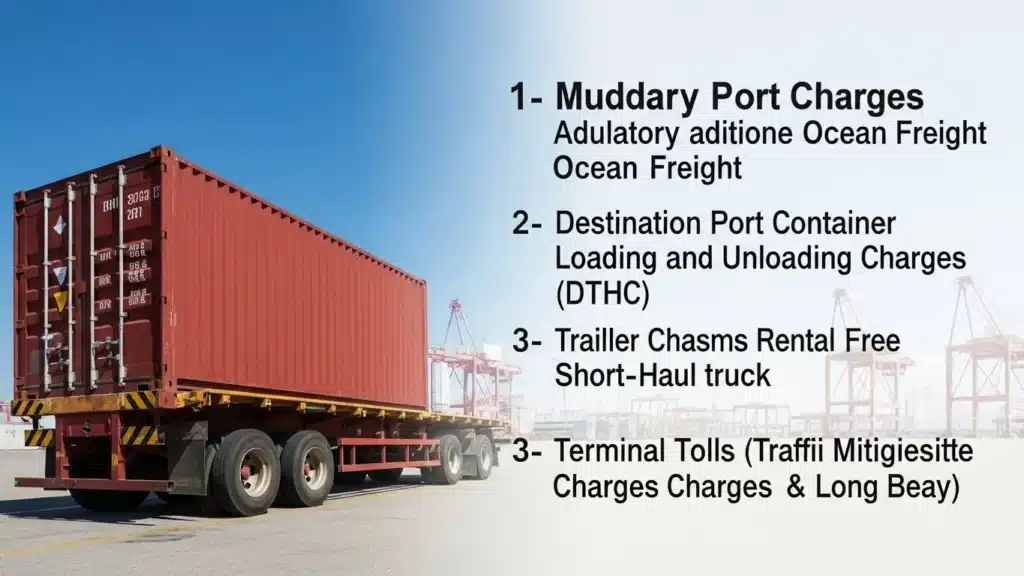
What Are DTHC, Chassis, and PierPass Fees?
DTHC (Destination Terminal Handling Charge) is a bundled fee for lifting the container on/off the vessel, yard moves, stacking, and related administration at the destination port. It’s typically paid by the consignee.
Chassis fees are daily rental charges for the wheeled trailer frame used to move a container by truck or rail within the destination country. These are usually billed to the trucking company or NVOCC, who then pass the cost to the shipper.
PierPass, officially the Traffic Mitigation Fee (TMF), is a congestion fee applied to loaded containers moving through the terminals at the Ports of Los Angeles and Long Beach. It is charged per TEU/FEU on most gate moves.
How These Fees Are Calculated and Applied
DTHC is charged per container (e.g., 20GP, 40HQ), with rates set annually by ports or terminals. For example, the export THC from Rotterdam averages around USD 235 for a 20-foot container, which can be about 30% of the base ocean freight cost on that lane.
Chassis fees are assessed per chassis per day, with typical market rates ranging from USD 20 to 35 per day for standard 20’/40′ chassis in major U.S. gateways. Rates vary by provider, location, and chassis type.
PierPass TMF is charged per TEU (Twenty-foot Equivalent Unit) or FEU (Forty-foot Equivalent Unit). Current rates under the OffPeak program are approximately USD 34–35 per TEU and USD 69–70 per FEU for most loaded containers moving through LA/LB terminals.
Agent Fees & Exchange Rate Buffers
Agent fees in landed cost fall into two buckets: commercial sourcing commissions (typically 5–10% of order value) and formal port/ship agency tariffs. Carriers and large shippers use buffer mechanisms like the Currency Adjustment Factor (CAF) and Bunker Adjustment Factor (BAF), which include defined ‘buffer zones’ to absorb normal market volatility before triggering price changes.

Commercial Sourcing and Port Agency Fees
Commercial sourcing agents typically charge a commission of 5–10% of the total order value. This rate can be reduced for clients with higher annual purchase volumes. These fees are common when sourcing from major export hubs like China.
Hybrid fee models are also prevalent. One example is a monthly retainer of $500–$1,000 plus a 5% commission on orders that exceed a specific value threshold, such as $50,000. Some agents offer a flat annual fee, for instance $5,000, which grants exclusive access to their supplier network.
On the transport side, formal port or ship agency fees are governed by published ‘Scales of Agency Fees.’ These documents specify a basic rate and mandatory surcharges. A common rule is a 50% uplift to the basic fee when the same agent acts for both the loading and discharging parties at a single port.
Currency and Fuel Buffers: CAF, BAF, and Buffer Zones
Carriers use the Currency Adjustment Factor (CAF) to protect their revenue when freight is billed in a local currency but the base rate is in USD. The Bunker Adjustment Factor (BAF) serves a similar purpose for managing fuel cost fluctuations.
Institutional shippers, such as USTRANSCOM, implement a structured approach using ‘buffer zones.’ These zones are defined based on historical volatility data for exchange rates and fuel prices. Surcharges for CAF and BAF are only recalculated when market rates move outside this predefined range.
This methodology provides a data-driven alternative to adding arbitrary safety margins in cost models. In practice, you would model agent commissions as a fixed percentage, apply port agency fees from published scales, and account for currency and fuel risk through these formal CAF/BAF buffer factors.
Excel Template Walkthrough
A landed cost Excel template standardizes the calculation of your total import cost. You enter product prices, shipping fees, duties, and taxes. The template then converts all costs to your local currency, allocates shared expenses across items, and outputs the final landed cost per unit.
| Template Component | Purpose | Example / Data Point |
|---|---|---|
| Incoterm & Currency Setup | Defines cost responsibility and normalizes all charges to your local currency. | Input Incoterm (e.g., FOB), buy currency (USD), local currency (AUD), and a fixed exchange rate. |
| Extra Costs Pool | Aggregates freight and local import charges for allocation across products. | Seafreight ($800 USD) + Local Import Costs ($2,200 AUD) = Total Extra Costs ($3,000 AUD). |
| Cost Allocation Method | Distributes the Extra Costs pool to each SKU based on its size or weight. | Allocates costs using the greater of cubic volume (m³) or weight (kg) for each product. |
| Duty & Tax Inputs | Applies product-specific duty and a global import tax to calculate final costs. | Enter duty rate per SKU via HS Code; apply a global tax (e.g., 10% GST/VAT). |
| Final Output Columns | Shows the complete financial breakdown per unit and for the entire shipment. | Outputs Landed Cost (Ex Tax) per unit, Per-Unit Tax, and Total Landed Amount. |
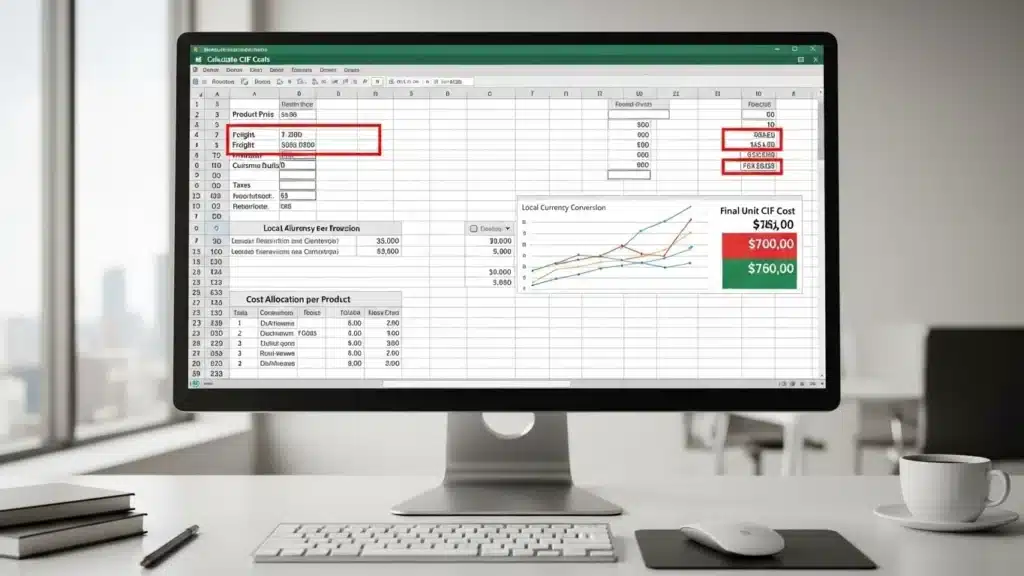
How to Input Your Data
Begin by entering the shipment’s Incoterm, such as EXW, FOB, CFR, or CIF. This defines who is responsible for costs at each stage of the shipment’s journey.
Set the buy currency, like USD, and your local currency, such as AUD. Apply a fixed exchange rate to convert all dollar-denominated freight and local charges into your currency for a consistent financial view.
Input the total seafreight cost and all local import charges—port handling, customs clearance, trucking, documentation, and marine insurance—into a pooled ‘Extra Costs’ section. The template will sum these into a ‘Total Extra Costs’ figure for allocation.
For each product SKU, enter the unit buy price, quantity, weight in kilograms, and cubic volume in cubic meters. The template uses the greater of the weight or volume for each item to allocate the shared extra costs, matching standard freight billing practices.
Specify the duty rate for each product based on its HS Code. Then, enter a global import tax percentage, like a 10% VAT or GST, which applies to the entire shipment’s landed cost value.
Understanding the Output and Calculations
The template combines seafreight and local charges into ‘Total Extra Costs’. It then allocates this cost pool to each SKU based on its proportional share of the total shipment’s weight or volume, whichever metric yields a higher charge for that item.
It calculates a ‘Landed Cost (Ex Tax)’ per unit. This figure adds the allocated extra costs and the applied duty amount to the product’s original buy price.
A separate ‘Per-Unit Tax’ is calculated by applying the global import tax rate to the landed cost excluding tax. This keeps the pre-tax cost and tax liability distinct for accounting clarity.
Final columns show the ‘Total Landed Amount’ for each SKU and a grand total for the shipment. This provides the complete financial picture, from individual unit cost to the shipment’s total value.
To add more products, you must drag the existing formulas into new rows. This ensures cost allocation and tax calculations extend correctly, mirroring the structured logic found in ERP systems like NetSuite, which uses separate GL accounts for different landed cost categories.
Final Thoughts
Calculating your landed cost is more than just adding a few numbers. It’s about seeing the full financial picture of your import. The base price from your supplier is just the beginning. Freight, duties, taxes, and a dozen other fees can easily add 40% or more to your total cost. Missing any of these pieces means your profit margin is based on a guess, not a fact.
Use the formula and the tools discussed here. Start with a clear HS code to get your duty rate. Factor in sea freight based on CBM or weight, whichever is higher. Don’t forget the port fees and agent commissions. A detailed Excel template or a dedicated calculator turns this complex process into a manageable, repeatable task. Knowing your true cost per unit is the first step to pricing competitively and protecting your business from unexpected losses.
Frequently Asked Questions
How do you calculate landed cost?
Landed cost is the total price to get a product from the factory floor to your warehouse door. It’s calculated by adding the product cost, shipping and freight, customs duties and taxes, insurance, and any handling or overhead fees. For a per-unit cost, you divide this total by the number of units. For example, a wooden serving board might have a landed cost of $6.41 per unit, broken down into a $4.95 product cost, $0.53 in combined duty and tariff, $0.30 for insurance, and $0.63 for its share of sea freight.
What is the import duty from China to the USA?
Import duty from China to the U.S. has two main layers. First, there’s the standard duty rate from the U.S. Harmonized Tariff Schedule, which for many goods is between 0% and 5%. On top of that, most Chinese-origin goods are subject to additional Section 301 tariffs, which add 7.5% to 25%. This means the effective total duty rate for many imported items from China often falls between 10% and 30%. Certain sensitive products like steel, aluminum, and solar panels can face total duties of 25% to over 50%.
How do I find the correct HS code for my product?
Finding the correct HS code is a critical step for customs. You start by identifying your product’s material, function, and finish. Then, you use the global Harmonized System’s structure—which has 21 sections and over 5,000 commodity groups—to find the correct 6-digit code. For U.S. imports, you extend this to a 10-digit number using the official U.S. Harmonized Tariff Schedule. You can verify the code using tools like the U.S. International Trade Commission’s HTS search or commercial classification services to ensure accuracy and avoid customs delays.
What are harbor maintenance fees (HMF)?
The Harbor Maintenance Fee (HMF) is a U.S. federal charge on commercial cargo arriving by ocean vessel. It’s calculated at a fixed rate of 0.125% (0.00125) of the cargo’s declared customs value. There is no minimum or maximum charge. This fee is paid to U.S. Customs and Border Protection at the time of entry and is deposited into a fund used for the maintenance and dredging of U.S. ports and harbors.
Is cargo insurance mandatory for international shipping?
Cargo insurance that protects the value of your goods is generally not legally required. However, carriers are mandated to have liability insurance for damage or loss they cause, though this coverage is often limited. For example, in U.S. trucking, a carrier must have at least $750,000 in liability insurance, but this doesn’t fully cover a high-value shipment. Therefore, while optional, purchasing separate cargo insurance is strongly recommended to protect your financial investment against risks like damage, theft, or loss during transit.