 Justin
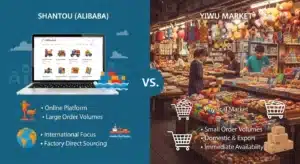
Relying solely on online platforms like Alibaba for sourcing leaves you exposed to hidden costs and quality risks, while depending only on offline agents can limit your market visibility and price discovery. The most resilient B2B procurement strategy isn’t a choice between one or the other—it’s a deliberate combination of both.

This article outlines a practical hybrid sourcing strategy, detailing how to use Alibaba for initial market research and price benchmarking, then leverage a Yiwu-based agent for on-site validation, quality control, and consolidated logistics. We’ll show how this approach can shorten sourcing cycles, secure direct factory pricing by bypassing traders, and manage risks, such as the 12.85% year-over-year decline in Alibaba trade volume for some categories, through structured payment protocols that tie 70% of the balance to final inspection approval.
Step 1: Market Research on Alibaba (Price/Trends)
Alibaba.com is the primary platform for B2B bulk sourcing, where prices are negotiable and structured around volume. Effective research here involves understanding tiered pricing models, verifying supplier credentials, and using the listed prices as a starting point for deeper negotiation, not as final costs.

Understanding Alibaba’s Pricing Hierarchy and Negotiation Levers
Bulk purchasing on Alibaba.com typically reduces Cost of Goods Sold (COGS) by 15-40% compared to smaller quantities, with discounts escalating at thresholds like 500, 1,000, and 2,500 units.
There is a clear pricing hierarchy: 1688.com (lowest factory prices), Alibaba.com (middle export prices), and AliExpress.com (highest retail prices), with AliExpress often 30-50% more expensive per unit.
Listed prices are starting points. The ‘bait-and-switch’ risk is real, where an initial quote of $1.00 can jump to $2.50 upon detailed inquiry, making verification critical.
Key negotiation levers include MOQ flexibility (prioritize suppliers with MOQs under 100 units for testing), payment terms (aim for 30-60 days), and tiered pricing for volume commits.
Validating Suppliers and Interpreting Market Signals
Prioritize suppliers with verifiable badges like ‘Lead Time Certified’ for ±2-day consistency and ‘Compliance Verified’ for standards such as REACH, UKCA, CPSC, or ISO 13485.
Check for recent (less than 6 months old) third-party test reports, such as from SGS. A supplier with SGS reports and ISO 13485 certification secured a 142,000-unit order despite a 29% higher bid.
Be aware of market contraction signals. Alibaba trade volume declined 12.85% year-over-year in 2025 for some categories, indicating a need for extra diligence.
Filter for suppliers offering DDP (Delivered Duty Paid) quotes to avoid hidden volumetric freight charges and ensure logistical cost predictability from the outset.
Step 2: Validation via Yiwu Agent (Real Cost Check)
A Yiwu agent validates suppliers through a 3-7 day process of on-site factory audits, documentation checks, and a structured 3-phase quality control protocol. This physical verification confirms operational scale, separates traders from manufacturers, and secures direct factory pricing, with payments tied to inspection milestones to mitigate risk.

The On-Site Factory Audit and Vetting Process
Agents conduct physical visits to the supplier’s listed address to confirm it is an active production facility. They assess the scale of operations, inspect machinery, and often request evidence like production videos or recent utility bills to prove consistent manufacturing activity.
A thorough documentation review is a core part of the audit. Agents verify the business license, tax registration, and crucially, the export license. They also examine the past six months of bank statements and tax returns to evaluate the supplier’s financial health and stability.
This process directly addresses a key risk on platforms like YiwuGo, where many listings are from traders acting as factories. By identifying and bypassing these middlemen, the agent secures pricing directly from the source manufacturer, eliminating reseller markups.
The agent’s own credibility is also verified. You should check their business license and ask for summaries of at least three recent client projects, complete with inspection photos, videos, or reports as evidence of their work.
The 3-Phase Quality Control and Payment Protocol
Quality assurance is structured into three distinct phases. First, a confirmation sample is approved for specifications, materials, and packaging. Next, a mid-production sample is checked to ensure the bulk order matches the approved sample. Finally, a pre-shipment inspection measures defect rates and checks carton conditions before goods leave the factory.
The pre-shipment inspection report is a critical document. It includes total item counts, the percentage of defects found, notes on carton condition, and serialized photographs of the goods. This report provides concrete evidence for approval before the goods are loaded for export.
Payments are strategically tied to these milestones. A typical 30% deposit is released only after the supplier verification is complete. The remaining 70% balance is paid only after the client reviews and approves the final quality control inspection report.
This protocol significantly reduces financial risk. If defects are found during the final inspection at the agent’s consolidation warehouse, those items can be returned to the factory for rework or replacement before the international shipment is arranged, preventing costly issues downstream.
Step 3: Purchasing via Agent (Consolidation)
Purchasing via an agent involves a structured four-phase process managed by a service partner. This includes obtaining competitive quotes, verifying samples, overseeing production with formal quality control, and handling all logistics for consolidated shipping. The agent acts as your on-the-ground manager to de-risk the procurement process.

The Four-Phase Agent Procurement Process
A professional sourcing agent manages your order through a defined, end-to-end workflow. This structured approach consolidates tasks and oversight that would otherwise fall to you.
In the first phase, the agent sources quotes from 3-5 verified suppliers to find the optimal price-to-quality ratio for your request. This competitive bidding ensures you don’t overpay.
Before bulk production starts, the agent coordinates the shipment of consolidated samples from potential suppliers to you for physical approval. This step prevents costly mistakes.
During production, the agent monitors factory progress. Once goods are finished, they are transferred to the agent’s warehouse for a formal AQL Level II inspection. Any defective items are immediately returned to the factory for correction.
Finally, the agent manages all export documentation, customs clearance, and freight (sea or air) for a consolidated delivery to your specified address. This service is often provided as DDP (Delivered Duty Paid), meaning the agent handles all costs and risks until the goods arrive at your door.
Key Agent Services and Operational Advantages
Full-service agents provide specific infrastructure and transparent practices that differentiate them from simple brokers or online directories. Their value lies in consolidation and risk management.
A primary advantage is the physical consolidation hub. Agents typically operate a warehouse (e.g., 3,000 sqm) where they can consolidate goods from over 20 different suppliers for free. This enables single, cost-effective shipments and often includes up to 30 days of storage.
Their financial model is transparent, operating on a clear commission basis rather than relying on hidden kickbacks from suppliers. Standard payment terms are a 30% deposit to initiate production, with the remaining 70% due only after quality control approval at their facility.
Agents handle specialized logistics, including complex requirements for channels like Amazon FBA. This can involve applying FNSKU labels, poly-bagging items, and shipping directly to Amazon fulfillment centers, which many suppliers are not equipped to do.
Their quality assurance infrastructure is a key differentiator. By conducting in-house AQL Level II inspections at their own warehouse, they can immediately reject and return sub-standard goods before international shipment. This prevents you from receiving and paying for defective products.

Step 4: Logistics via Specialized Forwarder
A specialized freight forwarder coordinates the entire shipping process for cargo with unique requirements, such as oversized, fragile, or hazardous goods. They manage export haulage, customs clearance, and multi-modal transport using specific equipment like flatbeds and reefers, ensuring compliance and real-time tracking to mitigate delays and damage.

What a Specialized Forwarder Manages
A specialized forwarder handles cargo that falls outside standard container shipping. This includes oversized items like construction machinery that exceed standard trailer limits, overweight shipments (where a gross weight over 50 kg mandates a forwarder), fragile goods such as glass or marble, hazardous materials across 9 distinct classes, and high-value items.
Moving this cargo requires specialized transport equipment. Flatbeds or lowboys are used for oversized and overweight cargo, especially when there is overhang. Refrigerated trucks, or reefers, maintain the cold chain for temperature-sensitive goods. Certified dry vans are essential for safely transporting hazardous materials.
Their role extends beyond transport to managing the full logistics chain. This includes arranging export haulage to the port for Full Container Load (FCL) shipments or consolidation for Less than Container Load (LCL), handling customs clearance, securing necessary export licenses, arranging cargo insurance, and leveraging their global network of carriers.
Technical Coordination and Documentation
Technical coordination for specialized shipments demands advanced scheduling. Applications for special transport must be coordinated with assigned local agents at least 5 days before delivery. For recurrent shipping lanes, proactive project planning is recommended at least 2 weeks in advance to ensure smooth operations.
Load carrier standards are strict. Shipments typically use standardized EPAL-quality pallets measuring 1200 x 800 x 800 mm. For non-standard geometry, approved disposable or special carriers are required, each with maximum load weights—for example, Schäfer Lagerfix containers have a maximum load of 15 kg.
Detailed documentation is mandatory. Delivery notes must include the purchase order (PO) number, item number, MAN-ES material number (if applicable), quantity, load carrier type, number of pallets, and gross/net weight. A scannable barcode combining a 10-digit order number and a 5-digit item number is critical for identifying the shipment throughout the supply chain.
When to “Go Direct” to the Factory
Direct sourcing is best for high-volume core products where cost control, quality oversight, and production agility are critical. It involves managing the factory relationship yourself to enforce specifications, conduct audits, and collaborate on design, but requires significant management effort and assumes full supply chain liability.
| Scenario | Direct Sourcing Fit | Key Consideration |
|---|---|---|
| High-volume “A” products | Optimal for per-unit cost reduction and maximum control. | Requires significant upfront vetting and ongoing management. |
| Complex custom or proprietary designs | Essential for co-development and protecting intellectual property. | Enables on-site inspections from raw materials to final testing. |
| Just-in-Time (JIT) production models | Critical for deep visibility into schedules and raw materials. | Demands full supply chain liability without an intermediary buffer. |
| Hybrid supply chain strategy | Applied to core items while agents handle diverse, low-volume lines. | Balances scalability; 78% of firms use hybrids for faster disruption recovery. |

The Core Scenarios for Direct Sourcing
Direct sourcing makes the most sense for your high-volume “A” products, where reducing per-unit cost and maintaining maximum control over the process are non-negotiable. This approach is essential for brands that rely on complex custom specifications, proprietary designs, or intellectual property that requires close co-development with the manufacturer.
It’s also critical for implementing just-in-time production models, which depend on deep visibility into factory production schedules and raw material sourcing to minimize inventory and lead times. This direct relationship enables on-site inspections at every stage of production, from checking raw materials to overseeing final quality testing, which is key for ensuring a differentiated, high-quality product.
Data-Driven Triggers and Hybrid Balance
Most modern supply chains use a hybrid model. You go direct for your core, stable product lines and use agents for sourcing diverse, low-volume “B” and “C” items. This balance is strategic; 78% of firms adopt hybrid strategies specifically to recover faster from disruptions. While direct control helps optimize costs against factors like rising tariffs—averaging 18.2%—leveraging agents for variety simplifies logistics.
The decision to go direct is often triggered by a need for rapid market response, faster innovation cycles, or building supply chain redundancy. Reflecting this, 80% of chief operating officers plan to expand nearshoring or onshoring elements within hybrid frameworks. Integrating AI into these hybrid strategies can further cut logistics costs by 5–20%. Choosing the direct path requires significant effort in factory vetting and ongoing relationship management, as your company assumes full liability without an intermediary to act as a buffer.
Managing a Diverse Supply Chain (Apps & Sheets)
Managing a diverse supply chain involves building redundancy with multiple suppliers across different regions to mitigate risks like disruptions. It relies on technology for real-time tracking and integrated software for data sharing, moving from basic contingency planning for novices to optimized just-in-time and KPI-driven processes for veterans.
| Strategy | Novice Approach | Veteran Optimization |
|---|---|---|
| Supplier Redundancy | Establish Plan B suppliers for critical items. | Maintain a geographically diverse, multi-tier network with structured contingency plans. |
| Technology & Tracking | Use basic spreadsheets for supplier lists and order tracking. | Implement IoT/RFID for real-time visibility and integrate SCM software with ERP systems for analytics. |
| Process & Performance | Focus on basic on-time delivery checks. | Apply JIT principles and track standardized KPIs (quality defects, responsiveness) across all tiers. |

Building a Resilient Multi-Supplier Network
The foundation of a risk-resistant supply chain is redundancy and diversification. This means establishing multiple suppliers for the same critical component. If one supplier faces a disruption, others can maintain your production flow, preventing a cascade failure across your supply tiers.
Geographic diversity is equally important. Sourcing and production capabilities spread across different regions ensure access to resources and provide flexibility. If a natural disaster, political issue, or logistics bottleneck affects one area, your operations in another can continue.
For new importers, the first practical step is implementing a structured contingency plan—a documented “Plan B”—for your most vital items. As operations mature, the framework evolves from simple backup plans to a system focused on continuous visibility into potential risks and maintaining the capability for rapid response to dynamic challenges.
Technology and Processes for Coordination & Control
Managing complexity requires technology for visibility and control. IoT sensors and RFID tags provide real-time data on inventory location, condition, and status across all tiers, moving beyond manual updates.
Supplier performance must be measured objectively. Standardized Key Performance Indicators (KPIs), such as on-time delivery rates, quality defect percentages, and responsiveness to issues, are essential for assessing and managing multi-tier partners.
Integration is key for coordination. Supply Chain Management (SCM) software should connect with Enterprise Resource Planning (ERP) systems. This creates a unified platform for analytics, forecasting, and reporting. Enabling supplier portals within these platforms facilitates two-way data sharing and streamlines communication.
Advanced operations can apply Just-In-Time (JIT) inventory principles to significantly reduce holding costs. However, JIT requires precise demand forecasting and a network of highly dependable, multi-tier suppliers to function without causing stockouts.
Final Thoughts
The hybrid sourcing strategy isn’t about choosing between online platforms and offline agents; it’s about using each tool for its specific strength. Alibaba excels as a research engine for discovering suppliers and understanding market pricing. A Yiwu agent provides the on-the-ground verification, quality control, and consolidation that turns that research into a reliable, low-risk order. A specialized forwarder then handles the complex logistics for non-standard shipments. This layered approach systematically de-risks the procurement process from discovery to delivery.
Your decision to go direct or use an agent depends on your product’s volume, complexity, and your own capacity for management. For core, high-volume items where cost and control are paramount, a direct factory relationship makes sense. For managing a diverse product range or when you lack local presence, an agent’s services are invaluable. Most successful importers operate a hybrid model, applying direct sourcing to their key products while leveraging agents for variety and flexibility. This balanced approach builds a supply chain that is both cost-effective and resilient to disruption.
Frequently Asked Questions
What is the best sourcing strategy for China?
There’s no single best strategy. Success requires a multi-step approach tailored to your product and risk tolerance. Key steps include defining clear product specifications, vetting multiple suppliers, implementing a three-stage quality control process (pre-production, in-line, and final inspection), negotiating beyond price for favorable terms and IP protection, and building relationships by starting with simpler products. For mixed-product procurement under the 2026 policy, suppliers need domestic products to account for at least 80% of total product cost to receive price advantages.
Should I combine Alibaba with a sourcing agent?
Yes, a hybrid approach is standard. Use Alibaba for initial supplier discovery and price comparisons, then engage a Yiwu-based agent for on-site verification, quality inspections, production monitoring, and logistics consolidation. This combination leverages the platform’s network and the agent’s local expertise, shortening sourcing cycles by weeks or months while ensuring compliance. Automation tools can handle up to 70% of the manual tasks traditionally done by agents.
How do I diversify my supplier base?
Aim for a balanced portfolio where no single supplier accounts for more than 30-40% of your total business volume to mitigate risk. Use multiple suppliers for mission-critical items, products with fluctuating demand, or when facing capacity constraints. It’s crucial to reassess your supplier portfolio at least annually to ensure it aligns with your business needs and risk profile.
Can I get Alibaba prices when sourcing in Yiwu?
Achieving exact price parity is generally not possible due to different cost structures. Yiwu often offers 15-40% lower unit prices for small-to-medium orders (under 5,000 units), but this advantage is offset by travel, logistics, and agent fees. For bulk orders (10,000+ units), Alibaba’s scale-driven discounts narrow the gap significantly. The decision should be based on the total landed cost per unit, not just the advertised price. A hybrid strategy—using Alibaba for research and a Yiwu agent for execution—is often optimal.
What are key tips for managing a hybrid supply chain?
Implement dual sourcing for critical components to build redundancy. Combine lean and agile models: use lean for predictable, high-volume production and agile for volatile demand segments. Target service levels of 95-99% and order cycle times under 5 days for your responsive, agile segments to maintain competitiveness and customer satisfaction.