 Justin
A single digit in your product’s HS code can be the difference between a 0% duty and a 25% tariff. For businesses sourcing from Yiwu, the world’s largest small commodities market, this isn’t a hypothetical risk—it’s a daily operational challenge that directly impacts your landed costs and supply chain reliability.
This guide breaks down the HS code system for Yiwu goods, from the global 6-digit standard used by over 200 countries to the critical country-specific digits that set your final duty rate. We’ll explain the legal rules that force you to use the most specific code, show you how to use official tools like the USITC database, and clarify how to handle complex shipments like gift sets. You’ll learn why the importer of record is ultimately liable for the code and how a structured partnership with your customs broker is essential for navigating these requirements.
What is an HS Code and Why It Matters
An HS Code is a standardized 6-digit number used globally to classify traded goods. Managed by the World Customs Organization, it’s the foundation for customs duties, trade statistics, and regulations in over 200 countries. Importers and exporters use it to determine tariffs and ensure smooth customs clearance.
The Global Standard for Product Classification
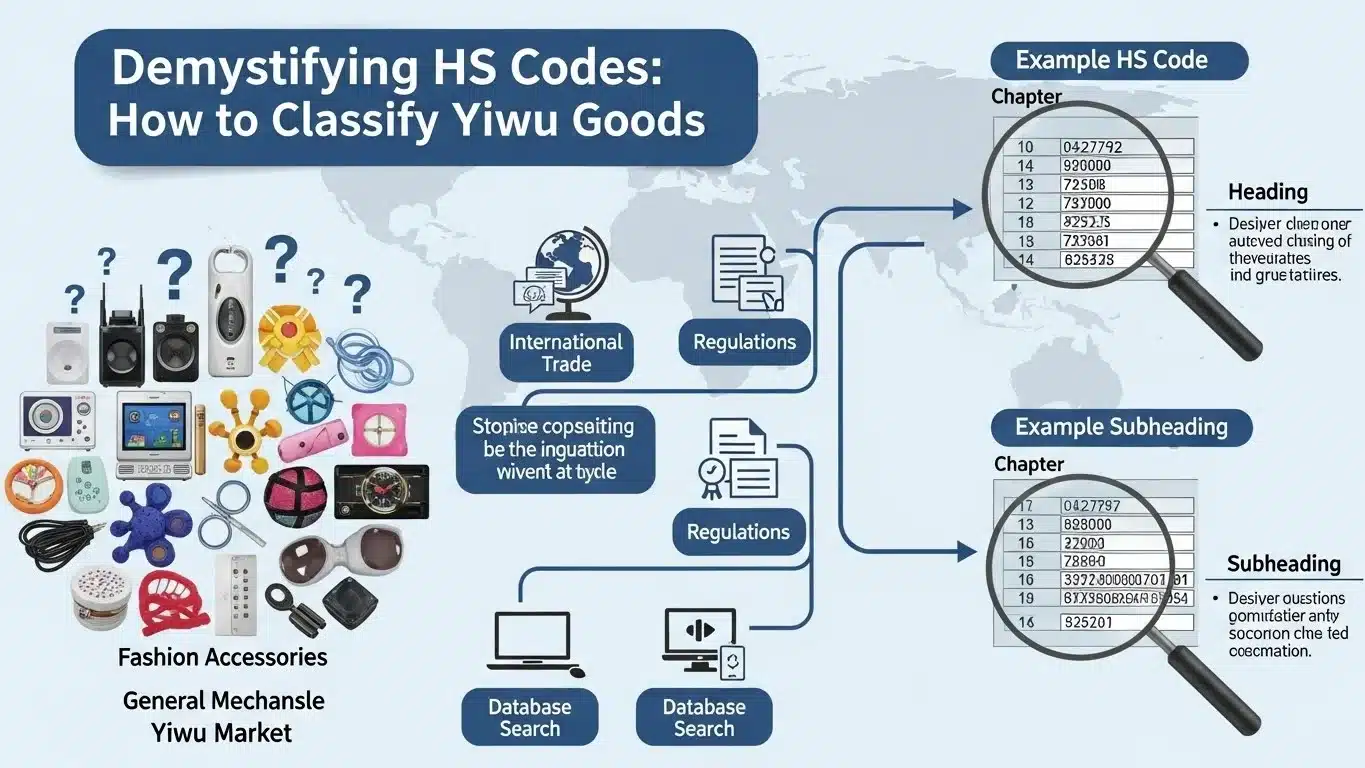
The Harmonized System (HS) Code is a 6-digit international standard format managed by the World Customs Organization (WCO). This structure is universal: the first two digits represent the Chapter (a broad product category like 62 for textiles), the next two are the Heading (a product group), and the final two are the Subheading (the specific item).
This system is used by more than 200 countries to create a uniform language for customs processing, applying tariffs, and compiling international trade statistics. To keep pace with new products and evolving trade patterns, the WCO updates the entire HS framework every five years.
From HS Code to Local Tariffs and Controls
While the first six digits are the global standard, individual countries add extra digits to create their own national tariff and regulatory systems. For example, the United States uses a 10-digit Harmonized Tariff Schedule (HTS) Code. The first six digits are the HS Code, followed by four US-specific digits that determine the exact import duty rate, issued by the US International Trade Commission (USITC).
Export controls operate under a different system. In the US, dual-use items (goods with both civilian and military applications) are classified with a 5-character alphanumeric Export Control Classification Number (ECCN), such as 3A001 for certain electronics. This code is issued by the US Bureau of Industry and Security (BIS). Other regions have their own extensions, like the 8-digit codes used in the Gulf Cooperation Council (GCC) or the 12-digit codes specific to Saudi Arabia.
The “General” vs. “Specific” Code Dilemma
The HS code system follows strict legal rules where the most specific product description must be used. Choosing a broad, general code over a more precise one is not allowed and can lead to incorrect duty payments, customs penalties, and shipment delays. This decision is guided by the General Rules of Interpretation (GRI).
| HS Code Level | Description | Role in Classification |
|---|---|---|
| First 2 Digits (Chapter) | Broad product category (e.g., Chapter 85 for electrical machinery). | Provides the initial, general category for the product. |
| 4 Digits (Heading) | More specific grouping within a chapter (e.g., 8501 for electric motors). | Where the “general vs. specific” choice often begins, guided by legal notes. |
| 6+ Digits (Subheading) | Precise product description, often with technical thresholds (e.g., 8501.10 for motors under 37.5W). | The most specific applicable code must be used; this is where national duty rates are applied. |
The Legal Rule: Why Specificity Wins
The General Rules for Interpretation (GRI 1, 3a, and 6) form the legal framework, requiring classification to follow the most precise product description available.
A specific heading or subheading (e.g., ‘electric motors under 37.5 W’) always takes precedence over a general one (e.g., ‘other electrical machinery’).
This rule is enforced globally by customs authorities under the World Customs Organization (WCO) framework to ensure uniform tariff application.
The structure itself forces specificity: the first 2 digits define the chapter, 4 digits the heading, and 6 digits the subheading, with each step narrowing the product description.
Where and Why the Dilemma Creates Risk
The critical ‘general vs. specific’ choice typically happens at the 4-digit heading or 6-to-10-digit subheading level, where national duty rates are assigned.
Misclassifying into a general code can trigger tariff underpayment or overpayment, customs audits, financial penalties, and holds on shipments.
Duty rates can swing dramatically based on specificity; one digit can change a duty from 0% to 25%.
To resolve dilemmas, professionals use technical authorities like the WCO Explanatory Notes and binding rulings from agencies like U.S. Customs and Border Protection (CBP).
Tools to Lookup HS Codes (USITC / TARIC)
The USITC HTS online search tool and the EU’s TARIC database are the primary lookup systems for importers. The U.S. Census Bureau’s Schedule B tool is for exports, while the CBP CROSS database provides binding classification rulings. These tools extend the global 6-digit HS code into country-specific 10-digit formats.

The USITC HTS Tool: The Engine for U.S. Import Classification
The official U.S. International Trade Commission (USITC) HTS search at hts.usitc.gov is the definitive source for 10-digit import codes. It allows full-text search across all 99 chapters, including critical special provisions in Chapters 98 and 99 for tariff engineering.
Users can download the entire Harmonized Tariff Schedule in Excel, JSON, or CSV formats for integration into cost models and ERP systems. The USITC DataWeb provides a commodity description lookup to cross-reference HTS codes with SIC and SITC classifications for trade analytics.
TARIC, Schedule B, and CROSS: Complementary Systems for Global Trade
For U.S. exports, the U.S. Census Bureau’s Schedule B search engine determines the mandatory 10-digit export code, sharing its first 6 digits with the HTS. The EU’s TARIC database layers EU-specific duties and regulations on top of the HS and Combined Nomenclature for goods entering the European Union.
U.S. Customs and Border Protection’s CROSS database holds legally binding rulings that show how specific products have been classified, providing precedent for challenging or defending a code. All national systems are built on the 6-digit HS code maintained by the World Customs Organization, which updates the core structure every five years.
Stop Overpaying & Overcomplicating Your Yiwu Sourcing

Handling “Sets” (e.g., Gift Basket) Classification
A ‘set’ for customs purposes is defined by WCO General Rule of Interpretation 3(b). It must contain at least two different items classifiable under different headings, be packaged together to meet a specific need, and be sold directly to users. The entire set is classified under the heading of the component that gives it its essential character, which is often determined by value, quantity, or function.
The Legal Definition of a “Set” and When It Applies
The World Customs Organization (WCO) defines a ‘set’ in General Rule of Interpretation 3(b) and its Explanatory Notes (HS 2022).
Three cumulative criteria must be met: 1) At least two different articles classifiable under different headings, 2) Put up together to meet a specific need or activity (e.g., a bath set, wine-and-cheese set), and 3) Packed for direct retail sale without repacking.
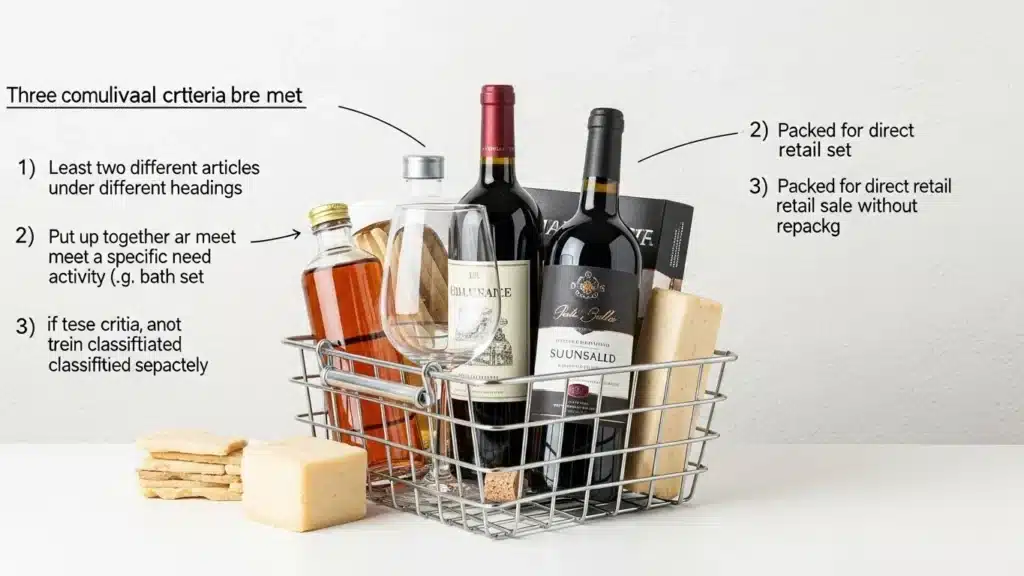
If these criteria are not met, customs requires each item to be classified separately. For example, in U.S. CBP ruling NY H85956, a gift basket was not considered a set, so the metal basket was classified under HTSUS 7323.99.9060 and its contents under their own headings.
Determining Essential Character and Practical Classification
Once a package qualifies as a set, it is classified under the heading of the component that provides its ‘essential character,’ based on factors like value, quantity, bulk, or role in use.
For a mixed food gift basket, the essential character often comes from preserved fruits (HS 2008) or bakery items (HS 1905). A wine gift basket is classified under HS 2204, with specific subheadings for container size (e.g., 2204.21 for wine in containers ≤2 liters in the EU).

A bath or toiletry gift set, as in CBP ruling N288167, is classified under heading 3307. If the packaging itself is the main commercial feature, the set may be classified under headings for the container, such as plastic articles (HS 3924.10.90) or metal household items (HS 7323).
How One Digit Can Change Duty from 0% to 25%
The duty rate for imported goods is legally set at the 8-digit level of the Harmonized Tariff Schedule. A change in the 7th or 8th digit moves a product into a different subheading, which can trigger a completely different tariff. For example, an electronic component might have a 0% duty under one 8-digit code but face a 25% or higher punitive tariff under another, based on its specific description and origin.
| HS Code Digits | Function | Impact on Duty Rate |
|---|---|---|
| First 6 Digits | International HS code for broad product category. | Does not set the legal duty rate. |
| 7th & 8th Digits | Form the internationally consistent subheading. | The legal duty rate is assigned at this 8-digit level. |
| 9th & 10th Digits | US-specific statistical suffixes. | Do not alter the duty rate; all 10-digit codes under the same 8-digit code share the same tariff. |
The Anatomy of a Tariff Code: Where Duty is Set
The structure of the 10-digit HS code is precise. The first six digits represent the international HS code, which provides a broad product category. The critical point for duty calculation is the 7th and 8th digits, which form the internationally consistent subheading. All products sharing the same first eight digits have the identical duty rate, regardless of the final two statistical suffix digits. Therefore, a single-digit change in the 7th or 8th position shifts the product to a new subheading with a potentially different tariff.
Real-World Impact: From 0% to Punitive Tariffs
A one-digit change in classification has tangible financial consequences. For instance, printed circuit boards (HS 8534.00) often have a 0% base Most Favored Nation (MFN) duty rate. However, if the same product is classified under a subheading subject to Section 301 tariffs on China-origin goods, a 25% penalty is added. For certain electronics, this can stack with other penalties, such as those under IEEPA or reciprocal tariffs, pushing total duties over 100%. A clear example is comparing codes 8509.40.1000 and 8509.40.2000; they share the first six digits but differ in the 7th and 8th, triggering duties from 0% to 25% or more.
Working with Your Customs Broker
A customs broker acts as your licensed agent to prepare and submit import/export declarations to customs authorities. The relationship is governed by formal contracts, strict reliance on your provided documents, and your final approval on all submissions. This structured process is critical for ensuring HS code accuracy, managing duty payments, and avoiding costly customs delays.
The Formal Framework of the Broker-Client Relationship
Your partnership with a customs broker operates under a formal, legally binding contract. This document clearly defines the scope of the broker’s engagement and the specific services they will provide, establishing clear accountability from the start.
The broker’s work is based entirely on the documents and information you supply. They are not permitted to alter, fabricate, or substitute any of your data. This rule ensures that the declaration, including the critical HS code classification, originates from you, the importer or exporter.
Before any declaration is finalized and filed with customs, it must receive your explicit approval and signature. This final check gives you direct control over the submission and confirms the accuracy of all details, including duties and taxes calculated.
Brokers are required to maintain current, orderly, and itemized records of every transaction. This meticulous recordkeeping provides full transparency, supports post-clearance audits, and creates a verifiable trail for all customs activities.
Operational Procedures and Broker Qualifications
Declarations are prepared in writing and submitted electronically. Brokers must operate systems that interface directly with customs platforms to lodge these documents, ensuring efficient and standardized processing.
To qualify and operate, brokers must demonstrate financial solvency, often through a surety bond or security deposit, and maintain a clean compliance record. These requirements protect the government and ensure the broker can meet financial obligations.
Licensed brokers undergo specific training and examinations. Their authorized scope of practice includes preparing and submitting declarations, paying duties and taxes on your behalf, and providing support during post-clearance audits and regulatory consultations.
While the electronic submission of a declaration can be delegated to authorized staff under the broker’s direct supervision, critical access credentials like passwords or PINs cannot be delegated. The licensed broker retains ultimate responsibility for the filing.
Final Thoughts
Classifying goods with the correct HS code is a precise, rule-based process, not a matter of choice. The system’s legal framework, from the global 6-digit standard to country-specific extensions, is designed for accuracy. Misclassification, whether accidental or intentional, carries real financial and operational risks, from unexpected duties to shipment delays and penalties.
Your success in international trade depends on treating HS code classification as a core business function. Use the official tools like the USITC HTS database, understand the rules for complex items like sets, and maintain a clear, documented partnership with your customs broker. Getting the code right from the start is the most effective way to ensure predictable costs and smooth movement of your goods across borders.
Frequently Asked Questions
How do I find the HS code for my product?
Start by gathering detailed product specifications from documents like the Technical Data Sheet and Bill of Materials. Then, search your country’s official classification database, such as the US Census Bureau Schedule B search for the first six digits. Apply the six General Rules of Interpretation to narrow down the correct heading and subheading. For legal certainty, you can apply for a Binding Tariff Information ruling from customs authorities.
What happens if I use the wrong HS code?
Using an incorrect HS code can lead to significant financial and operational problems. You may overpay or underpay duties, which can trigger audits and retroactive charges. Shipments can be delayed or held by customs, incurring storage fees. Penalties can include fines up to twice the lost revenue or $1 million per violation, and severe cases may result in seizure of goods or loss of import privileges.
Who is responsible for the HS code?
Legal responsibility is shared but distinct. The exporter or shipper is responsible for providing an HS code on export documents. However, the importer of record is ultimately legally liable for ensuring the correct Harmonized Tariff Schedule code is declared to their customs authority for duty assessment and clearance. Both parties must work together to ensure accuracy.
How do I classify ‘mixed goods’ or sets?
There is no single code for mixed goods. Classification follows the World Customs Organization’s General Rules of Interpretation, specifically Rule 3. This rule states you should first try to identify the most specific component heading. If that doesn’t work, classify by the component that gives the set its essential character. As a last resort, use the heading that appears last in numerical order.
Can I change the HS code to save on taxes or duties?
No. HS codes must accurately reflect a product’s composition, form, and function as defined by the official tariff schedule. Intentionally using an incorrect code to reduce duty liability is illegal and constitutes customs fraud. This can lead to severe penalties, shipment seizures, and legal action from authorities like U.S. Customs and Border Protection.