 Justin
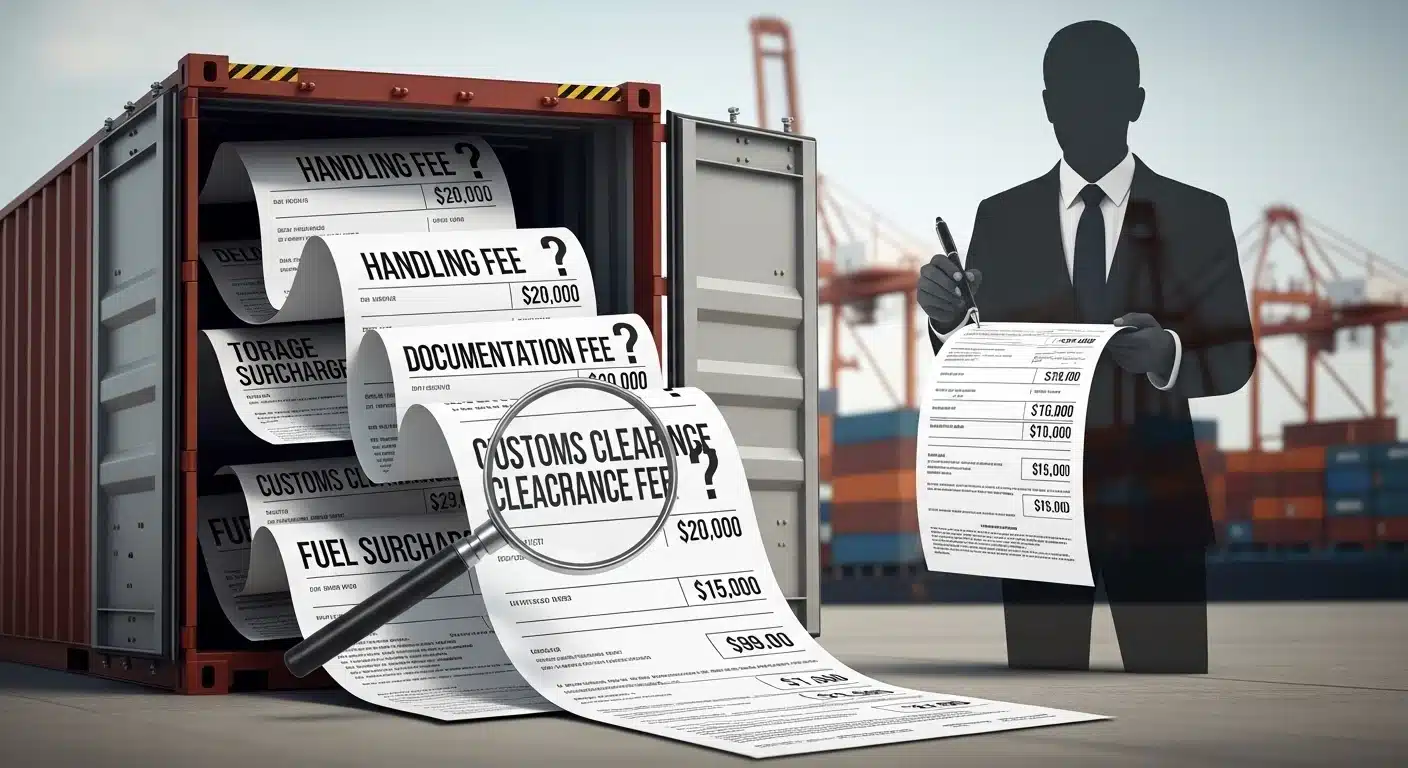
Your freight quote likely includes hidden fees and service markups that inflate your final cost. Understanding these charges is the first step to regaining control of your shipping budget.

This article breaks down how agents and forwarders structure their fees, from convenience charges and document processing to the bundled costs in a DDP quote. We’ll compare traditional and digital models—where platforms like Freightos can offer savings of 20-30%—and explain how Incoterms like EXW add pickup fees of $50 to $500 to your landed cost.
The “Convenience Fee” on Shipping
A convenience fee on shipping is a separate charge, often 2-4% of the transaction, added to cover payment processing or administrative handling costs for alternative channels like phone or mail orders. It is distinct from the base shipping cost, which must reflect actual or average costs per FTC rules. Card networks like Visa and Mastercard have specific rules governing how these fees are structured and disclosed.

What a Convenience Fee Covers (And What It Doesn’t)
This fee is designed to cover the costs associated with using alternative payment channels, such as phone or mail orders, or specific administrative handling tasks. It does not pay for the physical transport of the goods themselves.
Core shipping costs are governed by FTC Rule 16 CFR Part 464, which requires them to reasonably reflect actual costs or national averages. Handling charges, which are sometimes bundled into a ‘convenience’ add-on, must be included in the total advertised price and cannot be presented as a separate shipping cost.
This distinction can create pricing opacity, especially in ‘all-in’ Delivered Duty Paid (DDP) quotes. Newer importers may see a simple headline price, while experienced professionals can identify the specific markup for handling and payment processing.
Rules, Ranges, and How Fees Are Calculated
Card networks have strict but differing rules. Visa mandates a flat, fixed fee for all transactions within a specific payment channel. Mastercard and American Express allow for more flexible structures, including percentage-based or tiered fees.
Typical convenience fees range from 2% to 3% of the transaction value, with surcharges potentially reaching up to 4%. The fee can be calculated in several ways: as a fixed dollar amount, a percentage of the principal transaction value, or through tiered buckets based on card type or transaction amount.
A universal requirement across all networks is clear disclosure to the customer before the transaction is completed. The customer must also be given a clear option to cancel the transaction after being informed of the fee.
Comparing Agent Quote vs. Freightos/Forwarder
Traditional freight forwarders or agents provide bundled, all-in-one services with embedded expertise and custody, often resulting in higher, less transparent pricing. Digital platforms like Freightos aggregate and compare quotes from dozens of providers instantly, typically offering 20-30% lower costs by exposing markups and promoting competition, but with less hands-on cargo handling.
| Model | Key Characteristics | Typical Cost & Speed |
|---|---|---|
| Traditional Agent/Forwarder | Bundled, end-to-end service with custody, documentation, and risk management. Pricing includes embedded fees and commissions. | Higher, less transparent costs. Quotes can take around two days. |
| Digital Marketplace (e.g., Freightos) | Aggregates and compares real-time quotes from multiple vetted providers. Focuses on price transparency and instant access. | Often 20-30% lower costs. Quotes are provided instantly. |

The Traditional Agent Model: Bundled Service, Embedded Cost
Traditional forwarders offer end-to-end custody, documentation, and multimodal routing for a predictable, bundled price. This model is built on providing a full-service experience, handling everything from pickup to final delivery and customs clearance.
Their pricing includes handling, consolidation, storage, and customs services, with fees often embedded as a commission or margin on the carrier’s base rate. This bundling simplifies logistics for the shipper but can obscure the true breakdown of costs.
This approach provides significant expertise and reduces client risk by managing the entire supply chain. The trade-off is a potential lack of transparency, and receiving a finalized quote typically requires a process that takes around two days.
The Digital Marketplace: Instant Comparison and Cost Breakdown
Platforms like Freightos aggregate real-time quotes from 30+ vetted forwarders and 45+ carriers, providing instant, all-in pricing comparisons for air, ocean, and trucking. This creates a competitive marketplace where providers must justify their rates.
Its algorithm factors in weight, dimensions, and surcharges, often yielding costs 20-30% lower than single-provider quotes. For example, data shows a 20-foot container from Ningbo to LA costing $2432 on Freightos, compared to $3513 from a traditional forwarder—a savings of $1081.
Tools like AcceleRate provide instant quoting with historical cost data for accurate budgeting. This model splits sourcing opacity by exposing forwarder markups, giving shippers direct visibility into market rates and promoting competition over bundled service fees.
Incoterms Impact: EXW Pickup Fees
Under EXW terms, the buyer is responsible for all costs from the factory onward. This includes pickup and loading fees ranging from $50 to $500, which are just the first of many origin charges. These fees contribute to a total landed cost that can add 50-100% to the quoted EXW product price.

What EXW Pickup Fees Actually Cover
EXW means the seller makes goods available at their premises; the buyer bears all costs and risks from that point forward.
The quoted EXW price includes only product cost, factory profit, and packaging—no logistics.
Pickup and loading fees at the factory are the buyer’s first cost, typically $50 to $500 per shipment.
These are part of broader ‘origin charges’ that also include inland transport ($200–$2,000) and export clearance ($100–$800).
The Real Cost: From EXW Price to Landed Cost
Total origin charges for an EXW shipment typically range from $400 to $1,000, depending on logistics complexity.
A complete EXW shipping rate example: $400 (origin) + $540 (ocean freight) + $1,000 (destination) + $1,000 (duties) = $2,940 total.
The complete landed cost often adds a 50% to 100% markup to the initial EXW product price.
Buyers must calculate this total cost to avoid surprises, as the EXW price alone is an incomplete picture of final expenses.
Your Direct Line to the Yiwu Market. Zero Maze, All Goldmine.

Document Fees: ENS, Telex Release, Bill of Lading
Document fees are carrier or agent charges for processing key shipping paperwork. The main types are the Bill of Lading (B/L) fee for physical handling, the Telex Release fee for electronic cargo authorization, and the ENS fee for EU customs security filings. These fees, ranging from $30 to €35, impact both cost and delivery speed.

What Are Document Fees and Why Do They Exist?
A Bill of Lading (B/L) is the title document for cargo; its fee covers physical printing, handling, and courier costs to mail originals, typically $50-$100 per shipment.
A Telex Release is an electronic authorization replacing physical B/Ls; its fee ($30-$100) is for the administrative process of surrendering originals at the port of departure to enable faster release.
An ENS (Entry Summary Declaration) is a mandatory EU customs security filing submitted before arrival; carriers charge €25-€35 per B/L for this regulatory compliance service.
Cost, Time, and Strategic Implications
Using a Telex Release instead of physical B/Ls can save $50-$100 in courier fees and reduce cargo release time from up to 5 days to 1-2 days, or instantly.
An electronics trader saved $3,000 annually by switching to Telex Release, primarily from avoiding 48-hour clearance delays and related demurrage risks.
These fees are discretionary and set by carriers or agents, creating pricing opacity in all-inclusive DDP quotes; savvy importers request itemized breakdowns to identify them.
The “DDP All-in” Price: What are you actually paying?
A DDP price bundles all logistics costs, duties, taxes, and fees into one figure. You’re paying for freight, insurance, origin/destination handling, customs clearance, import duties based on your product’s HS code, and taxes like GST/VAT on the landed value. The total is often marked up with service fees, making a detailed breakdown essential to understand the true cost.
| Cost Component | What It Covers | Key Considerations |
|---|---|---|
| Freight & Logistics | Ocean/air freight, origin charges (pickup, export packaging, handling), destination charges, cargo insurance. | Often bundled; markups can be applied to inland transportation (15-30% coordination charge). |
| Duties & Taxes | Import duties based on the product’s HS code and CIF value; taxes like GST/VAT applied to the total landed value (CIF + duty). | Calculations are HS code-specific. For example, a 5% duty on a $10,000 CIF value equals $500. |
| Fees & Markups | Customs clearance, documentation processing, and various service fees. | Common markups include a 25-50% premium on clearance fees and a 20-40% processing fee on documentation. |

Breaking Down the DDP Bundle
A DDP quote consolidates several core cost pillars into a single price. The primary components are freight and logistics, which cover everything from ocean or air transport to origin charges like pickup, export packaging, and warehouse handling, as well as destination charges and cargo insurance.
It also includes all mandatory import duties. These are calculated as a percentage of the goods’ CIF (Cost, Insurance, and Freight) value, and the specific rate is determined by your product’s Harmonized System (HS) code. On top of the duty, taxes like Goods and Services Tax (GST) or Value-Added Tax (VAT) are applied to the total landed value, which is the CIF value plus the duty paid.
Under the Incoterms® 2020 rules for DDP, the seller’s obligation is comprehensive. They are responsible for all transport, insurance, and both export and import customs clearance, including paying all duties and taxes, up to the named destination. The buyer’s responsibility typically begins with unloading the goods at that point.
Calculating Your True Landed Cost
To move beyond the bundled quote and find your actual cost per unit, use the Total Landed Cost (TLC) formula: (Product Price + Freight + Insurance + Duties + Taxes + All Fees) ÷ Quantity. This calculation reveals the final cost of each item once it arrives at your door.
Service markups are frequently embedded within the DDP price. Sellers may add a 25-50% premium on top of actual clearance fees, a 15-30% coordination charge for inland transportation, and a 20-40% processing fee for documentation. The bundled nature of DDP creates opacity, hiding risks like exchange rate padding and the possibility that the seller retains volume discounts from carriers instead of passing the savings to you.
The most effective way to mitigate these risks is to request a line-item quote. This breakdown allows you to validate each component, such as verifying the duty calculation against the correct HS code and identifying any added service fees. This step is crucial for transforming a simple, opaque price into a transparent and accountable cost structure.
When to Let the Agent Handle Shipping (Small vs Large)
Use an agent for small, infrequent, or lightweight shipments where their consolidation services and paperwork handling provide value. For large, high-volume shipments, direct shipping with a freight forwarder is often more cost-effective due to bulk rate savings and greater control, bypassing agent fees.

The Case for Using an Agent: Small & Infrequent Shipments
Agents provide essential services like carrier network access, rate negotiation, and export paperwork handling, which are valuable for low-volume shippers.
They enable consolidation, repacking, and quality inspections, which can mitigate costs from volumetric weight penalties on bulky, lightweight items. For air and express shipping, carriers charge based on whichever is greater: the actual weight or the volumetric weight (calculated as L × W × H ÷ 6000). This system penalizes lightweight but bulky items, making an agent’s ability to repack and consolidate multiple orders into one shipment a key cost-saving strategy.
For a single, small purchase—like a 2kg pair of shoes—an agent’s total cost, including their service fees, may still be competitive with direct shipping options. This approach offers significant convenience and risk management, handling everything from domestic pickup in China to final delivery, though extra fees can make agents less ideal for tiny, single-item purchases.
When to Go Direct: Large Volume & Bulk Shipments
For high-volume, frequent, or heavy shipments—typically those over 10kg—direct negotiation with carriers secures better bulk rates. The savings from these rates usually outweigh an agent’s service fees, making direct shipping the more economical choice.
Sea freight becomes the dominant mode for large shipments due to its cost-per-cubic-meter (CBM) pricing structure. Taking control of the carrier and route directly increases transparency and can reduce the opacity often associated with Delivered Duty Paid (DDP) services when using an agent.
A veteran sourcing strategy is to split the logistics chain. You can use an agent for their expertise in China domestic consolidation and initial export paperwork, which often comes with low fixed fees. Then, for the international leg of the shipment, switch to a direct freight forwarder. This hybrid approach leverages the agent’s local efficiency while exposing and avoiding potential markups on the main ocean or air freight charges.
Final Thoughts
Understanding the various fees in freight forwarding is the first step toward controlling your shipping costs. From convenience fees and EXW pickup charges to document fees and bundled DDP prices, each component represents a potential area where costs can be marked up or obscured. The key difference often lies in the service model: traditional agents bundle expertise and custody into a single, less transparent price, while digital platforms use competition to drive down costs and expose the underlying rates.
Your shipping strategy should match your business needs. For small, infrequent shipments, an agent’s consolidation and handling services can justify their fees. For larger, regular shipments, the savings from direct negotiation or using a transparent digital marketplace become significant. Regardless of the method, always request a detailed, line-item breakdown of any quote. This simple practice transforms an opaque bundled price into a clear cost structure, allowing you to verify fees, challenge markups, and make informed decisions that protect your bottom line.
Frequently Asked Questions
Do sourcing agents charge for shipping?
Yes, sourcing agents typically charge for shipping separately from their base commission. Shipping costs are quoted on a case-by-case basis, determined by factors like weight, distance, and logistics complexity. The standard sourcing commission (often 5–10%) does not include these fees. Agents may manage logistics through their own operations or coordinate with freight forwarders, handling tasks like customs clearance and delivery.
Is it cheaper to use an agent’s freight forwarder?
Using a freight forwarder through your agent can be more cost-effective, especially for smaller shipments. Forwarders leverage aggregated volume to secure rates 20-40% below standard published tariffs from carriers. They also bundle services like origin handling and customs clearance into flat fees, which helps avoid the numerous hidden charges (like terminal fees and fuel surcharges) that can inflate direct shipping costs by 30-50%.
Common hidden fees include broker fees, Merchandise Processing Fees (MPF) charged at 0.21% of the entered value (with a minimum of $25 and a maximum of $485), fuel surcharges (BAF), and Terminal Handling Charges (THC). These fees are often inflated under DDP terms where suppliers use undisclosed brokers. Errors in HS code classification can also lead to a 12% duty variance, and customs values based on CIF terms are typically higher than FOB.
What is the average shipping agent markup?
Shipping agents and freight brokers typically operate with a markup ranging from 10% to 20%. Within this structure, individual agents often receive 50–70% of the profit from each successfully brokered load, with the remainder going to their brokerage firm. This differs from freight forwarders, who operate on much tighter average margins of around 3.5% due to their different business model and cost structures.
How can I check freight rates?
You can check freight rates using online freight calculators or load boards. Key details to input include origin and destination ZIP codes, shipment weight, dimensions (to calculate dimensional weight), freight class (based on NMFC standards), and distance. For example, a benchmark trucking rate might be $4.74 per mile. Industry tools like DAT iQ RateView analyze billions in transactions to provide these benchmarks, helping you verify quotes.