Justin
If you’re sourcing products from overseas, you’ve likely faced a frustrating reality: the factory you found online often ignores small orders, while trading companies seem to add an extra layer of cost. This isn’t just poor service—it’s a fundamental difference in business models. Factories are built for high-volume efficiency, making small orders unprofitable due to setup costs. Meanwhile, traders consolidate demand to offer flexibility, but at a higher price.
This article breaks down the trader vs. factory decision. We’ll explain why factories typically ignore orders below 500-1000 units, how traders can reduce sourcing cycle times by up to 50% by acting as a one-stop shop, and the specific volume thresholds where switching from a trader to a factory makes financial sense. You’ll learn to identify a supplier’s true nature, evaluate the hybrid model, and make a data-driven choice for your next order.
The “Factory Myth”: Why Real Factories Ignore Small Buyers
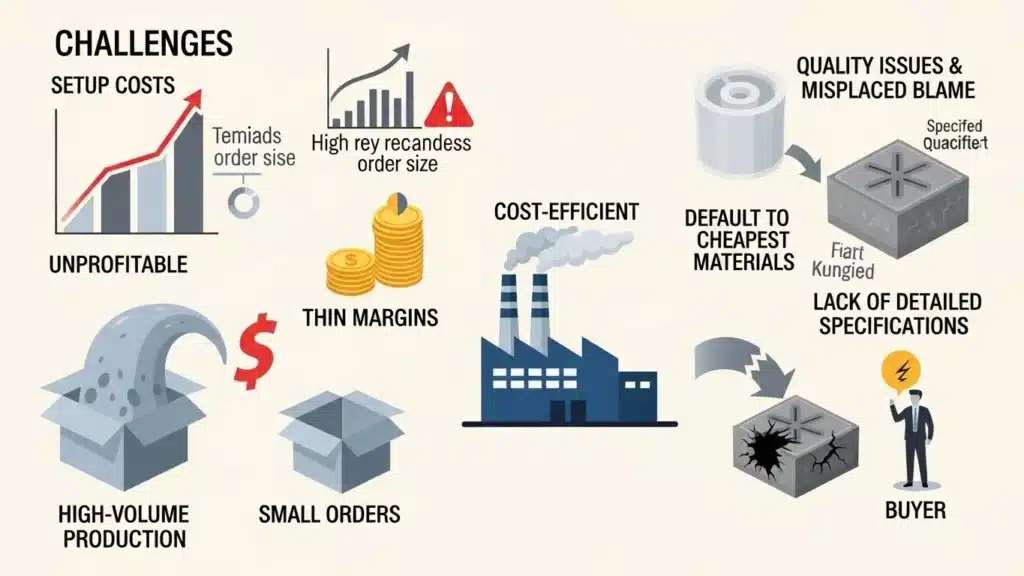
Factories operate on thin margins and prioritize cost-efficient, high-volume production runs. Small orders are unprofitable due to high setup costs relative to the low volume. Without detailed specifications, factories default to the cheapest materials, often leading to quality issues that buyers mistakenly blame on the factory.
The Profitability Equation: Why Small Orders Lose Money
Factories prioritize maximum profits and cost-efficient materials, making low-volume orders unprofitable due to high setup costs.
There is no universal MOQ standard; factories ignore small buyers because the revenue from a small run does not justify the fixed costs of production setup and communication.
The business model is built on scalable, spec-defined runs where thin margins are offset by large volumes, a dynamic small orders cannot fulfill.
The Specification Void: How Lack of Detail Creates Risk
Factories produce strictly to a buyer’s provided design and specs. Quality issues often stem from poor buyer communication or insistence on low-cost materials.
Without explicit details on materials, dimensions, color, finish, or product function, factories will default to the cheapest viable option to protect their margin.
This creates significant risk for the factory, as vague instructions can lead to rework, misproduction, and disputes, which are disproportionately costly on small orders.
Trading Company Advantages: Variety & Low MOQ
Trading companies consolidate products from multiple suppliers, offering buyers a wide variety under one roof and simplifying procurement. They leverage bulk relationships with factories to negotiate lower minimum order quantities, allowing clients to order smaller volumes, test products, and bundle items without the high thresholds factories require.

| Advantage | Mechanism | Key Benefit |
|---|---|---|
| Product Variety | Aggregating products from multiple suppliers into a single point of contact. | Reduces sourcing cycle times by up to 50% and simplifies procurement logistics. |
| Low MOQ & Flexibility | Negotiating lower minimums through pooled orders and long-term factory relationships. | Enables order quantities as low as 100 pieces for market testing and kitting projects. |
| Risk Mitigation | Maintaining pre-vetted supplier networks, quality inspections, and inventory buffers. | Provides contingency planning and rapid fulfillment, especially valuable for new importers. |
The One-Stop-Shop Model for Product Variety
Trading companies act as a consolidated sourcing channel by aggregating products from multiple suppliers across diverse categories like electronics, industrial components, and healthcare. This model creates a single point of contact for buyers.
This consolidation can reduce sourcing cycle times by up to 50% compared to the process of searching for and managing relationships with individual factories directly. Buyers save significant time and administrative effort.
To ensure reliability, trading companies maintain pre-negotiated contracts and inventory buffers with their network. This practice guarantees consistent stock availability and enables rapid fulfillment, which is critical in fast-moving or regulated sectors such as pharmaceuticals.
From a logistics standpoint, this model simplifies procurement and inventory management. It eliminates the need for buyers to coordinate with, negotiate with, and make separate payments to multiple vendors, streamlining the entire supply chain process.
How Trading Companies Enable Flexible, Low-Volume Orders
The primary mechanism for lower MOQs is the trading company’s established, long-term relationships with factories. By pooling orders from multiple clients, they can meet or exceed a factory’s production minimums, then distribute smaller quantities to individual buyers. This allows access to order quantities as low as 100 pieces.
This low-volume capability is ideal for testing market demand, launching new products, or fulfilling kitting projects that require mixed bundling of different items. Factories often cannot accommodate these small, customized orders due to their own production constraints and cost structures.
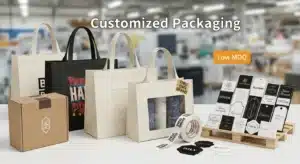
Beyond volume, trading companies provide added flexibility through value-added services. These include custom packaging, private labeling, and financing options—services that smaller factories frequently lack the resources or expertise to support in-house.
This sourcing model offers significant risk mitigation, especially for novice importers. It provides access to a pre-vetted supplier network, along with services like quality inspections and contingency planning for supply chain disruptions. For experienced buyers, it offers a scalable sourcing solution without the complexity of managing numerous factory relationships directly.
Factory Advantages: Price & Customization Control
Direct factory sourcing offers lower per-unit prices by cutting out trader markups and provides complete control over the production process, from material selection to final assembly. This enables deep customization but requires larger order commitments and upfront capital investment from the buyer.

| Aspect | Factory Advantage | Key Consideration |
|---|---|---|
| Pricing | Lower per-unit cost by eliminating trader markups. | Requires larger Minimum Order Quantities (MOQs) and upfront investment. |
| Customization | Full control over materials, design, and production process. | Buyer must manage production oversight and quality assurance directly. |
| Flexibility | Precise execution of tailored specifications. | Less flexibility on order size changes and product diversification compared to traders. |
The Direct Price Advantage: Cutting Out the Middleman
Factories can offer significantly lower product prices because they sell directly to the buyer, removing the additional costs added by trading companies. This price advantage stems from the factory’s role as the manufacturer.
Achieving these lower prices requires the factory to make substantial capital investments in its production infrastructure, machinery, and skilled workforce. These costs are absorbed into their operational model.
For the buyer, the trade-off for a lower price point is often adherence to the factory’s terms. This typically includes rigid minimum order quantities and specific payment terms, which are less flexible than those a trader might negotiate.
Full-Spectrum Customization and Production Control
Working directly with a factory grants control over the entire manufacturing chain. You can specify raw materials, influence design details at every stage, and dictate the final finish, enabling a level of product tailoring that is not possible through an intermediary.
This hands-on oversight allows for precise customization that traders cannot facilitate, as they are not involved in the actual production process and act primarily as communicators and distributors.
The factory model also reduces reliance on third-party quality checks. The buyer or their appointed agent can conduct in-line inspections and monitor production quality directly at the source, leading to more consistent outcomes.
How to Spot a Trader (Product Range Clues)
A trader’s catalog is broad and diverse, covering unrelated product categories like plastics, textiles, and electronics, sourced from multiple factories. A factory’s catalog is narrow, focusing on a specific material or process, such as only steel fabrication or plastic injection molding, reflecting their in-house production capabilities.

The Trader’s Catalog: Broad, Diverse, and Aggregated
Traders maintain diverse catalogs with unrelated items (e.g., plastics, steels, electronics) sourced from multiple specialized factories.
This model enables low minimum order quantities (MOQs) and product variety, ideal for kitting projects that require 50+ different items from a single supplier.
They act as supply chain orchestrators, providing flexibility and consolidation but lack in-house production assets like CNC machines or assembly lines.
The Factory’s Catalog: Narrow, Deep, and Specialized
Factories specialize in a limited selection, often 1-5 related SKUs, focused on a core competency like a specific material (steel) or process (injection molding).
Their high MOQs justify the setup of specialized machinery, and their catalog depth reflects direct control over production assets like robotics and CAD systems.
A narrow catalog is a strong indicator of genuine manufacturing, contrasting with a trader’s role as an intermediary managing logistics and quality checks.
The “Hybrid” Model: Industry & Trade Integrated
A hybrid model combines the direct production control and pricing of a factory with the product variety, low MOQs, and logistical flexibility of a trading company. It uses integrated technical platforms to manage data flows between industrial systems and trading partners, enabling a seamless supply chain.

What a Hybrid Model Is and Why It Works
A hybrid entity acts as both a production facility and a trading partner. It manages its own manufacturing while also sourcing and consolidating goods from other verified factories.
This approach gives buyers direct access to factory-level pricing and customization for core products. At the same time, it offers the trader benefits of lower minimum order quantities, a wider product variety, and consolidated shipping from multiple sources.
This model solves the classic buyer’s dilemma by providing a single point of contact. It delivers cost control from the factory side and supply chain agility from the trader side.
The operational viability of this model is technically enabled by hybrid integration platforms (HIPs). These platforms connect industrial ERP systems with cloud-based trade and logistics networks.
The Technical Backbone: Integration Platforms and Data Flows
Core integration relies on platforms that support both traditional EDI standards, like UN/EDIFACT and ANSI X12 for factory systems, and modern APIs (REST/JSON) for e-commerce and trader networks.
Key transport protocols include AS2, SFTP, and OFTP2. These are used for secure B2B document exchange—such as orders, invoices, and shipping notices—between different partners.
Platforms like IBM Cloud Pak for Integration or Cleo Integration Cloud provide unified API management, enterprise messaging, and high-speed file transfer in a single technical stack.
Security is managed through transport encryption (TLS), token-based authentication like OAuth, and role-based access control. These measures protect sensitive data as it moves across the supply chain.
This technical architecture supports modern business models like drop-shipping and omnichannel retail. It synchronizes data between a brand’s systems, multiple factories, and fulfillment partners seamlessly.
When to Switch from Trader to Factory
Switching from a trader to a factory becomes strategically sound when your per-SKU order volume consistently meets factory MOQs (typically 500–1,000+ units), you require deep customization or technical control, and the 5–15% cost savings justify tighter payment terms. For low-volume, multi-component projects, traders remain the more flexible and efficient option.

The Volume and Customization Threshold
The primary trigger for switching is consistently ordering 500–1,000+ units per SKU, which meets the typical factory minimum order quantity (MOQ) for custom or OEM work. This volume threshold is a clear operational milestone.
Direct sourcing becomes critical when your product requires engineering support. This includes modifying CAD files, obtaining PPAP-like production documentation, or securing material traceability reports (MTRs) that factories can provide directly.
Protecting intellectual property is another key factor. Sending CAD files and bills of materials (BOMs) directly to the factory reduces the number of entities handling your proprietary data, lowering the risk of leakage.
This move is also justified for products tied to formal material or process standards, such as ASTM A36 steel or ISO 1461 hot-dip galvanizing. Factory-level validation and documentation are essential for compliance and traceability in these cases.
Evaluating Cost, Control, and Complexity
Ordering directly from a factory typically reduces your unit cost by 5–15%. This saving comes with a trade-off: factories usually require tighter payment terms, like a 30–50% deposit, compared to the more flexible credit traders often offer.
Factories provide superior control over the production process and quality assurance, especially those with certifications like ISO 9001. This direct oversight is valuable for managing technical risk and ensuring process capability.
Traders add significant value for complex, low-volume projects. They excel at “kitting,” which involves combining 5–10 different components from multiple specialized factories into a single coordinated shipment and invoice, handling the logistics and supplier management for you.

Sticking with a trader is often the better choice if your order volume is fragmented across many SKUs, you need flexible credit terms (30–90 days), or you rely on their multilingual teams to manage quality inspections and logistics across a diverse supplier network.
Final Thoughts
The choice between a factory and a trading company isn’t about finding the “best” option, but the right partner for your specific stage and needs. For new importers, small businesses, or projects requiring a mix of products, a trading company provides essential flexibility, lower risk, and streamlined logistics. As your order volume grows and your requirements become more specialized, the direct cost savings and control offered by a factory become increasingly valuable.
Your sourcing strategy should evolve with your business. Start with the support and variety a trader offers to validate your market and manage complexity. When you consistently hit volume thresholds and need deep technical control, transitioning to a factory can unlock the next level of efficiency and customization. The most effective supply chains often leverage both models, using each for what it does best.
Frequently Asked Questions
How can I tell if a supplier is a factory or a trading company?
Professionals use a combination of checks rather than a single test. Verify the business scope on official government databases and request factory certificates like ISO/BSCI that show a physical plant address. Ask for production-line videos or a live video tour. Assess the technical depth of their answers to product questions. Compare their product range and MOQ behavior: a genuine factory typically focuses on 1-3 closely related product types and has higher MOQs tied to production capacity, while a trading company’s catalog often includes dozens to hundreds of disparate SKUs across multiple categories with more flexible MOQs and pricing.
Is a trading company always more expensive than a factory?
In most cases, yes. Trading companies typically add a commercial margin, making their unit prices roughly 10-30% higher than buying directly from a factory. A common benchmark in B2B sourcing is a 15-25% markup. While a large trading company with significant volume leverage might occasionally match factory prices, the standard procurement assumption is that a factory provides the baseline cost, and a trading company adds its service fee on top.
Do factories automatically have export licenses?
No, factories do not automatically hold a general export license. Export licenses are transaction-specific, issued to the exporter of record (which can be a factory or a trader) based on the product’s classification, destination, end-user, and end-use. For most standard consumer goods, no specific license is required, and shipments proceed under a ‘No License Required’ (NLR) status. The key for buyers is to verify that their supplier, whether factory or trader, can correctly act as the exporter of record, classify items (using codes like ECCNs for electronics), and obtain necessary licenses for controlled goods.
What are the main reasons to use a trading company?
Trading companies streamline the sourcing process, potentially cutting cycle times by up to 50%. They manage the complexity of dealing with multiple factories, which is ideal for projects requiring diverse components or kitting. They handle pre-vetted supplier networks, conduct on-site inspections, and consolidate procurement and logistics. This reduces the administrative burden and risk for the buyer, especially for those new to sourcing or managing complex, multi-supplier orders.
Can trading companies handle custom packaging and kitting?
Yes, many trading companies offer comprehensive custom packaging and kitting as a value-added service. They coordinate with outsourced manufacturing partners to provide services like private labeling, poly-bagging, and applying FNSKU labels for Amazon FBA. They manage logistics for consolidating components from different factories into a single kit. Some partners operate facilities capable of processing hundreds of thousands of cases per month, adhering to quality standards like ISO 9001.