Justin
Clearance from customs is the point where a government decides whether your goods may legally enter the country, and it is decided on the data you declared rather than on the goods sitting in the container. That distinction is not pedantry. A container of party supplies that is perfectly safe, correctly made and exactly what you ordered will still sit at a terminal for weeks if the declared classification, value or certificate data does not hold up. The cargo is never the problem in those cases. The filing is.

Key Takeaways
- Clearance is a decision about your declared data, not an inspection of your goods. Most shipments are never physically opened at all.
- In the United States, entry must be filed within 15 calendar days after landing, and the entry summary with estimated duties within 10 working days after the time of entry.
- CBP has five business days from presentation to release or detain. Anything not released in that window is legally detained, and a notice must follow within another five business days.
- That five-day clock does not apply when CBP is holding goods for another agency such as the FDA. This is the single biggest reason a “customs hold” runs long, and almost no guide says so.
- Duty liability is a personal debt of the importer. Paying your broker does not discharge it if the broker never pays CBP, and a customs bond does not relieve you either.
- The $800 de minimis exemption is indefinitely suspended for everything outside the international postal network, effective 24 June 2026. Low-value parcels now need real formal or informal entry.
- Since 8 July 2026, CPSC certificates for regulated consumer products must be filed electronically with CBP at entry — squarely relevant to the toy, houseware and party-goods mix Yiwu ships.

What Customs Clearance Actually Is
Strip away the jargon and clearance is an administrative decision with three components: you tell the government what is arriving, the government decides whether to believe you, and money changes hands. Everything else — the terminology, the forms, the status codes your forwarder pastes into an email — is machinery built around those three moves.
The part importers consistently get wrong is the second move. People picture an officer walking a container, opening cartons, judging whether the goods look acceptable. That is not the default path and never has been. The overwhelming majority of shipments are assessed entirely on electronic data: what you called the product, what tariff code you assigned it, what you said it was worth, where you said it was made, and whether any other agency has a stake in that product category.
A physical examination is an exception the system escalates to, not the routine it starts with.
This is why “but the goods are fine” is never an argument that works. It answers a question nobody asked. If the tariff code on your entry describes a different article than what is in the box, the goods being high quality is irrelevant — the declaration is wrong, and the declaration is the thing under review.
Equally, if your product falls under an agency like the FDA or the Consumer Product Safety Commission and the required certificate data was not transmitted, the merchandise can be flawless and still inadmissible. You did not fail an inspection. You failed to file.
Entry, release, and liquidation are three different events
These get used interchangeably in forwarder emails and they should not be. Entry is the act of making a legal declaration to customs. Release is permission to move the goods out of the terminal — that is the moment most people mean when they say “cleared.” Liquidation is the final calculation of what you owed, which happens later and can reopen a duty bill you thought was settled. A shipment can be released and still generate a demand for more money months afterwards, because release is a decision about admissibility while liquidation is a decision about arithmetic.
There is a further wrinkle in US law worth knowing. Under 19 CFR 141.68, when entry documentation is filed without an entry summary, the “time of entry” can be the moment a CBP officer authorises release — meaning release and entry can be simultaneous.
And under 19 CFR 141.68(e), goods will not be authorised for release, and an entry is not even considered filed, until the merchandise has physically arrived within port limits with intent to unlade. You cannot clear a shipment that has not turned up, no matter how early the paperwork went in.
The Two Clocks That Govern a Clean Entry
A US import runs on two deadlines that most buyers never see because a broker absorbs them. Knowing them anyway is useful, because they tell you how much slack actually exists when something goes sideways.
The first is the entry deadline. Under 19 CFR 142.2(a), merchandise for which entry is required “will be entered within 15 calendar days after landing from a vessel, aircraft or vehicle, or after arrival at the port of destination in the case of merchandise transported in bond.” Fifteen calendar days sounds generous until you remember it includes weekends and that a missing certificate on the China side can burn a week by itself.
The second is the entry summary deadline. Where the importer does not file the summary at the time of entry, 19 CFR 142.12(b) requires that the entry summary documentation “shall be filed, with estimated duties attached, within 10 working days after the time of entry.” That is the point at which the money is actually due.
Note the different units — 15 calendar days for one, 10 working days for the other. Mixing them up is a common way to be late while believing you are early.
There is a third clock that runs before the vessel even sails, and it is the one Yiwu buyers trip over most. The Importer Security Filing requires core data — seller, buyer, importer of record number, consignee — to be transmitted “no later than 24 hours before the cargo is laden aboard the vessel at the foreign port” under 19 CFR 149.2(b).
Two of the ten elements get more room: container stuffing location and consolidator are due “in no event later than 24 hours prior to arrival in a United States port.” That carve-out exists precisely for consolidated freight, where the stuffing location genuinely is not known when the booking is made. The regulation also permits an initial filing on best-available data for four elements, provided it is updated as better information arrives.
In practice a correctly filed entry on a product with no partner-agency interest is often released around the time the vessel arrives rather than days afterwards — but treat that as a typical pattern, not a promise. CBP publishes no guaranteed release time, and any specific “clears in 24 to 48 hours” figure you see quoted is a carrier’s service observation, not a regulatory commitment. The numbers you can actually rely on are the outer limits above.
Who Is Actually On the Hook When the Entry Is Wrong
This is the question buyers ask last and should ask first. The answer in US law is blunt, and it is not the answer most people assume.

Under 19 CFR 141.1(b)(1), duty liability “constitutes a personal debt due from the importer to the United States which can be discharged only by payment in full of all duties legally accruing.” The same provision then closes the two escape hatches importers reach for.
On brokers: “Payment to a broker covering duties does not relieve the importer of liability if the duties are not paid by the broker.” On bonds: “Delivery of a Customs bond with an entry is solely to protect the revenue of the United States and does not relieve the importer of liabilities incurred from the importation of merchandise.”
Read those two sentences again if you buy DDP. If you wired duty money to an intermediary who then did not pay CBP, the debt is still yours, and the government can come to you for it. The bond does not absorb it either — a bond protects the revenue, not the importer. This is the structural reason experienced importers insist on being the named importer of record even when it is more work: the liability attaches to that party regardless of who handled the filing, so you would rather control the filing you are already responsible for.
The practical consequence for a Yiwu buyer is about who supplies the data. Your consolidator or agent can prepare and transmit accurate information, and a good one materially reduces your risk of a wrong classification or a missing certificate. What no agent can do is take the liability off you.
Anyone in China promising that “we handle customs, you have no risk” is describing a commercial arrangement, not a legal one — and if the entry is wrong, the demand letter has your company name on it. Confirm your own position with a licensed customs broker in the destination country before you agree to any DDP structure.
The Fork in the Road: Released, Held, or Examined
Once an entry is filed, a shipment goes one of three ways, and the difference between them is the difference between a normal week and a very expensive month.
The first path is release. The data holds up, no agency has flagged the commodity, duties are secured, and the goods are free to move. Nothing happens that you will notice.
The second path is a document or data hold. Customs is not questioning the physical goods; it wants something clarified — a value that looks inconsistent with the commodity, a classification that does not match the description, a certificate that should have been transmitted and was not. These resolve at the speed your side supplies the answer. A buyer whose supplier can produce the underlying commercial documents the same day resolves this in days; a buyer chasing a market booth that has already moved on to the next order does not.
The third path is examination, where the goods themselves get looked at. Exams escalate in intensity — a non-intrusive scan of the sealed container is the mildest and the most common, opening the doors to look inside is the middle rung, and a full physical devanning at a bonded facility is the severe end.
The escalation logic matters more than the terminology: each rung exists because the previous one did not resolve the question, so the way to stay on the mild rungs is to make sure the declared data matches what a scan would suggest is inside.
| Outcome | What is being questioned | Who resolves it | Governing clock |
|---|---|---|---|
| Release | Nothing; data held up | No action needed | Ninguno |
| Document or data hold | Value, classification or missing certificate data | You, via your broker and supplier | Your own response speed |
| CBP examination | Whether contents match the declaration | CBP, at importer’s cost | 5 business days to release or detain (19 CFR 151.16) |
| Partner-agency detention | Admissibility under that agency’s law | The agency, e.g. FDA or CPSC | 151.16 does not apply; FDA allows 10 business days to respond |
The five-business-day rule, and the notice you are entitled to
Here US law gives importers a genuine, under-used lever. Under 19 CFR 151.16(b), “within five business days from the date on which merchandise is presented for CBP examination, CBP will decide whether to release or detain merchandise. Merchandise that is not released within the five business day period will be considered to be detained merchandise.” Silence is not limbo. After five business days the goods are legally detained, and that status carries obligations.
Specifically, 19 CFR 151.16(c) requires CBP to issue a notice within five business days of that decision or failure to release, and the notice must state the specific reason for the detention, the anticipated length, the nature of the tests or inquiries to be conducted, and — the clause worth memorising — “the nature of any information which, if supplied to CBP, may accelerate the disposition of the detention.” That last item is effectively a written instruction on how to get your freight back. If your broker has not obtained it, ask.
There is a second entitlement in the same section. Under 19 CFR 151.16(d), on written request CBP will provide copies of any testing results together with a description of the testing procedures and methodologies used.
If a detention rests on a lab finding you think is wrong, you can ask for the method, not just the verdict. Also budget for the fact that under 19 CFR 151.16(b) the importer pays the costs of preparing and transporting merchandise for examination — an exam is not free even when it ends in release, which is why the goal is to avoid the escalation, not to price it.
Why a Partner-Agency Hold Behaves Nothing Like a Customs Hold
This is the section that explains why two importers can both say “we got a customs hold” and have wildly different experiences. They did not get the same thing.
The five-business-day decision clock has an exemption written into its very first line. 19 CFR 151.16(a): “The provisions of this section are not applicable to detentions effected by CBP on behalf of other agencies of the U.S. Government in whom the determination of admissibility is vested.” When CBP holds your goods because the FDA, the CPSC, USDA or another partner agency owns the admissibility call, the customs timetable simply switches off. CBP is holding the box; it is not the one deciding.
That single sentence explains most horror stories. The importer keeps pressing the broker for the five-day notice, and the broker cannot produce one, because the detention is not governed by the section that requires it. The relevant clock belongs to the other agency, and it runs on different arithmetic.
What the FDA timetable actually looks like
Take the FDA as the worked case, since food-contact items, cosmetics, and some electronics accessories out of Yiwu land in its scope. When the FDA detains, it issues a Notice of FDA Action serving as the Notice of Detention and Hearing, and the response window is defined in the agency’s own procedures. Per the FDA’s guidance on detention and hearing, “FDA’s Regulatory Procedures Manual allows 10 business days from the date of detention” to provide testimony, and “to allow for weekends, holidays, and mailing time the Notice of FDA Action generally specifies a timeframe of 20 calendar days.” Miss it and “the compliance officer can issue a refusal of admission.”
Note the shape of that: you are not waiting on a decision, you are on a deadline to argue. The burden has flipped.
An importer who treats an FDA detention like a customs hold — sit tight, let the broker chase it — can lose the shipment by doing nothing while the response window expires. Extensions are possible on request within the stated timeframe if you give a reasonable basis, but they are requests, not rights.
One more trap sits in the same guidance. Detained goods are expected to stay in the declared port of entry area, and if product has been moved out and the FDA then wants to examine or sample it, the agency “may ask Customs and Border Protection (CBP) to issue a demand for redelivery.”
If you have already trucked the pallets to a fulfilment centre and broken them into inventory, complying with a redelivery demand is a logistics problem of an entirely different order. Requirements vary by product type, agency and the importer’s role, so confirm your specific exposure with a customs broker or the relevant agency rather than assuming your category is out of scope.
What Changed in 2026, and Why Old Advice Is Now Wrong
Two changes landed recently enough that a large share of the customs advice currently online is describing a system that no longer exists. Both hit small importers hardest, and both are directly relevant to Yiwu’s product mix.
De minimis is suspended, not merely narrowed
For years the working assumption was that a shipment under 800 US dollars entered duty-free with minimal formality under Section 321. That assumption is dead. A CBP interim final rule published on 24 June 2026 implements “an indefinite suspension of the de minimis administrative exemption for imports valued at $800 or less arriving via all modes other than through the international postal network,” and states that such entries “must utilize formal or informal entry procedures.” The rule took effect the day it published.
This followed Executive Order 14324 of 30 July 2025, which suspended duty-free de minimis for all countries and required covered shipments to be entered in the Automated Commercial Environment by a party qualified to make entry, effective 29 August 2025. The regulatory text is worth reading directly if low-value parcels are your model — the Federal Register notice of the suspension sets out the scope precisely.
The operational consequence is that low-value air parcels now behave like real imports. They need entry, they need a qualified filer, and they attract duty.
For context on where the thresholds now sit, the same rule restates that formal entry procedures generally apply above 2,500 US dollars while informal entry is authorised at 2,500 or less — but it also notes CBP “may require formal entry for any merchandise if deemed necessary for purposes of admissibility, revenue protection, or the efficient conduct of customs business.” A small parcel is no longer a way around the system; it is just a smaller entry.
CPSC certificates must now be filed electronically at entry
The second change is more specific to what Yiwu actually sells. The CPSC’s Certificates of Compliance final rule became effective on 8 July 2026 — three weeks before this article was written. It “implements, for importation of products and substances regulated by CPSC, electronic filing of certificates (eFiling) with CBP.” Certificates that used to be documents you kept and produced on request are now data you transmit at entry.
If you import toys, children’s articles, party goods, or general-use consumer products in CPSC-regulated categories, this changes the failure mode.
Previously a certificate problem surfaced when someone asked for the certificate. Now the absence of transmitted certificate data can surface at the entry itself. Worth knowing too: a technical correction published in September 2025 restructured the rule into a single effective date plus two applicability dates depending on how products are manufactured or imported, and the correction states it “has no substantive effect on the dates by which products subject to the final rule must be in compliance.” Several summaries still circulating quote the withdrawn dual-effective-date structure, so check the CPSC certificates final rule itself rather than a secondary summary, and confirm with your broker which applicability date governs your goods.
A Worked Example: One Yiwu Consolidation, Two Different Outcomes
The following is illustrative rather than a specific customer file, but the mechanics are the ones that decide real containers. Picture a buyer consolidating fourteen SKUs from nine Yiwu booths into one 40-foot container: plastic housewares, a few hundred cartons of party decorations, some stainless kitchen tools, and one SKU of children’s plastic toys.

In version one, the consolidator builds the packing data SKU by SKU. Each line carries its own description and tariff code. The toy SKU is identified early as CPSC-regulated, its certificate data is prepared for electronic filing at entry, and the ISF goes out with the core elements more than 24 hours before lading, with the stuffing location and consolidator details supplied against the later arrival-based deadline that exists for exactly this kind of freight. The entry is filed against arrival, the data is internally consistent, and the container is released without anyone opening a door.
In version two, the same physical goods ship under a tidier-looking declaration: nine invoices collapsed into one line reading “plastic goods,” a single tariff code applied across categories because it was simpler, and the toy SKU folded in with everything else. Nothing here is exotic fraud — it is the ordinary corner-cutting that happens when nobody owns the paperwork. But the value now looks wrong for the stated commodity, the code does not describe most of what is inside, and the CPSC-regulated SKU has no certificate data associated with it.
The container gets scanned. The scan shows a mixed load that does not resemble a uniform consignment of plastic goods, which is the inconsistency that pushes it up the escalation ladder.
The importer now needs invoices from nine booths retroactively, at least one of which has no interest in reconstructing paperwork for an order it already shipped and was paid for. Meanwhile the toy SKU has drawn separate attention, and if a partner agency picks it up, the five-business-day customs clock stops applying to that portion entirely. One clean consolidation and one careless one, same cargo, and the difference was decided in an office in Yiwu weeks before the vessel sailed.
The transferable lesson is that clearance risk is created upstream and merely discovered downstream. By the time a container is at a terminal, every input that determines its fate is already fixed. This is also why the cheapest-quote instinct misfires here: an agent who saves you a modest amount on the consolidation but hands your broker inconsistent data can cost you an order of magnitude more in demurrage and exam charges. The same principle applies to calculating your true landed cost, where clearance friction is the line item people forget to budget.
Is This Your Problem to Solve, or Someone Else’s?
Not every importer needs to understand clearance at the same depth, and pretending otherwise wastes people’s time. The honest split depends on who carries the liability and how much control you have over the declared data.
| You need to understand this yourself | You can reasonably delegate it |
|---|---|
| You are the named importer of record | You buy DDP from a party that is genuinely the importer of record |
| Mixed-category consolidations from several suppliers | Single-SKU repeat orders from one factory, stable classification |
| Any CPSC, FDA or other agency-regulated category | Unregulated goods with a settled tariff code history |
| Low-value air parcels, now that de minimis is suspended | Postal-network shipments, which the suspension does not cover |
| Margins thin enough that a detention would hurt | Established programmes with a broker relationship and history |
The right-hand column comes with a caveat that is easy to miss. Delegating the work is not delegating the debt. As the liability rule above makes plain, if you are the importer of record you remain personally liable for duties even when someone else does every keystroke —
so “I can delegate this” means you can delegate the labour, never the exposure. If you are unsure which column you are in, that uncertainty is itself the answer: find out who is named as importer of record on your last entry before the next container ships.
What to Get Right on the China Side Before the Box Ships
Clearance is won or lost on the origin side, so this is the checkpoint list that matters before a container leaves. It is deliberately about data consistency rather than about which documents exist — the document set itself is a separate topic with its own guide.
- One description per SKU, carried through every document. The description on the invoice, the packing list and the entry should be the same words. Divergence between documents is the single most common trigger for a data hold, because it is the easiest inconsistency to detect automatically.
- Classification decided before shipping, not at the port. A tariff code assigned under time pressure by someone who has not seen the goods is a guess. Settle it while the product is still in front of you.
- Regulated SKUs identified and flagged separately. Anything plausibly within CPSC, FDA or other agency scope should be known as such before consolidation, because certificate data now needs to be transmitted at entry rather than produced later.
- Declared value that matches the commercial reality. A value inconsistent with the commodity invites scrutiny; a value that cannot be substantiated by underlying documents from the actual supplier turns that scrutiny into a problem.
- Supplier documents retained at the point of purchase. Reconstructing invoices from a market booth weeks after the fact is materially harder than collecting them at the time, and detention responses run on deadlines that do not accommodate that delay.
- ISF data assembled against the right deadline. Core elements go 24 hours before lading; stuffing location and consolidator have until 24 hours before arrival. Knowing which is which prevents both late filings and unnecessary panic.
None of this requires customs expertise on your part. It requires that somebody on the origin side treats the paperwork as a deliverable with a quality standard rather than as an afterthought produced on the day of loading. Where a consolidator adds real value is exactly here — in the discipline of building consistent data across many small suppliers.
Where a consolidator’s authority stops is at the border: an agent in Yiwu supplies accurate inputs, and cannot make an admissibility decision or shorten a partner-agency detention. Whether it can be the importer of record on your entry is a separate question with a real answer either way — the next section sets out the conditions under which it can, and what that does and does not transfer.
What We Check on a Consolidated Load, and Where We Stop
Because the previous section describes what should happen rather than who does it, here is the division of labour stated plainly. The figures below are our own published service terms rather than industry averages — read them as the specification you would be contracting to, and compare them against whichever agent you actually use. They are deliberately paired with the limits, because the limits are the part buyers are usually not told.
The physical starting point is a 3,000 sqm warehouse in Yiwu where goods from separate booths are received, counted and staged, with storage free for the first 30 days. That free window is not a discount — it is what makes accurate paperwork possible on a mixed load. A fifteen-booth consolidation does not arrive in one afternoon; cartons land across days or weeks as each vendor finishes.
If storage were metered from day one, the commercial pressure would be to seal and ship before the last booth’s invoice and carton count are in hand, which is exactly how a packing list ends up describing goods that are not in the container. A month of free storage turns waiting for booth eleven into a scheduling decision rather than a financial one, and the entry data gets built from documents that exist rather than from estimates.
Bulky retail packaging is removed at that stage to cut cubic volume. Worth being precise about what that does and does not change: it lowers your freight bill, and it alters the carton count and dimensions that have to appear consistently on the packing list, the bill of lading and the ISF. It does not change your liability position at all. Buyers routinely read repacking as a risk service; it is a cost lever with a documentation consequence, and the two get confused often enough to be worth separating.
Where a SKU’s condition is the open question rather than its paperwork, inspection is a separate commissioned service with published tolerances: sampling follows ANSI/ASQ Z1.4 (ISO 2859-1), with critical defects at 0 allowed, major at AQL 2.5 and minor at AQL 4.0 by default, run at 100% produced and 80% packed, reported as a PDF within 24 hours with photos and measurement data, and charged standalone at a flat $199 per man-day. That 24-hour turnaround is the number that interacts with clearance, and it is worth saying why rather than leaving it as a specification.
A discrepancy found the day after inspection can still be corrected on the invoice and packing list before the documents are finalised and the ISF is transmitted. The same discrepancy found a week later is no longer a paperwork correction — the data has already been filed, and amending a filed entry is a different and more expensive conversation than getting it right the first time.
Each of those checks is timed against a specific deadline rather than against a general sense of urgency. The seller, buyer, importer of record and consignee elements have to be transmittable at least 24 hours before lading under 19 CFR 149.2(b); stuffing location and consolidator have until 24 hours before US arrival, which is the one piece of slack a consolidation genuinely gets.
Certificate data for a CPSC-regulated SKU has to exist in filable form before the entry, not before an auditor asks, because the eFiling rule took effect on 8 July 2026. And supplier invoices need to be collected at purchase, because if a detention lands, the FDA response window is 10 business days — generally expressed as 20 calendar days on the notice — and that is not enough time to re-open a conversation with a booth that shipped weeks ago.
Now the limits, which matter more. No origin-side party — ours included — can make an admissibility decision, accelerate or appeal a partner-agency detention, or certify that a product meets a destination standard; that last one is what an accredited laboratory and a certificate are for. If a sourcing agent tells you clearance is fully handled and no risk reaches you, they are describing a commercial promise that the regulation does not support, and the regulation is what applies when something goes wrong.
One limit deserves stating precisely rather than loosely, because we sell the service it concerns. Our DDP offer does involve acting as importer of record on our own import bond, and that is a real arrangement rather than a marketing phrase: a nonresident consignee has the right to make entry, and under 19 CFR 141.18 a nonresident corporation may enter merchandise for consumption provided it has a resident agent in the state of the port of entry authorised to accept service of process, and files a CBP Form 301 bond with a resident corporate surety. Those two conditions are the substance of the arrangement, and they are a fair thing to ask any DDP seller to evidence.
What the arrangement does not do is make your exposure disappear, and the distinction is the one from the liability section above. Where we are genuinely the named importer of record, the duty debt under 19 CFR 141.1 attaches to us. Where you are named — which is the case on most non-DDP entries and on anything shipping to your own Amazon account under your own EIN — the debt is yours, and it stays yours whether we, a broker, or nobody at all prepared the filing. So the question to settle before a container moves is not whether someone is handling clearance, but which name is on the entry, because that is the field that decides who CBP bills.
The honest framing is that origin-side work changes the probability of a smooth entry, and only the choice of importer of record changes the legal allocation of risk. Good data makes a hold less likely and makes any hold that does occur far cheaper to resolve, because the documents that answer the question already exist. Repacking, free storage and a 24-hour inspection report all buy accuracy, not immunity. Ask any agent — including us — to tell you in writing which party is named as importer of record on your entry, and treat vagueness on that point as the answer.
Where to Go Deeper
This page is the overview: what clearance is, who carries the risk, and what happens when a shipment is held rather than released. The mechanics each have their own guide, because trying to cover them here would produce a worse version of all four.
- Classification: how tariff codes are chosen and what happens when one is wrong — see the HS code guide for Yiwu imports.
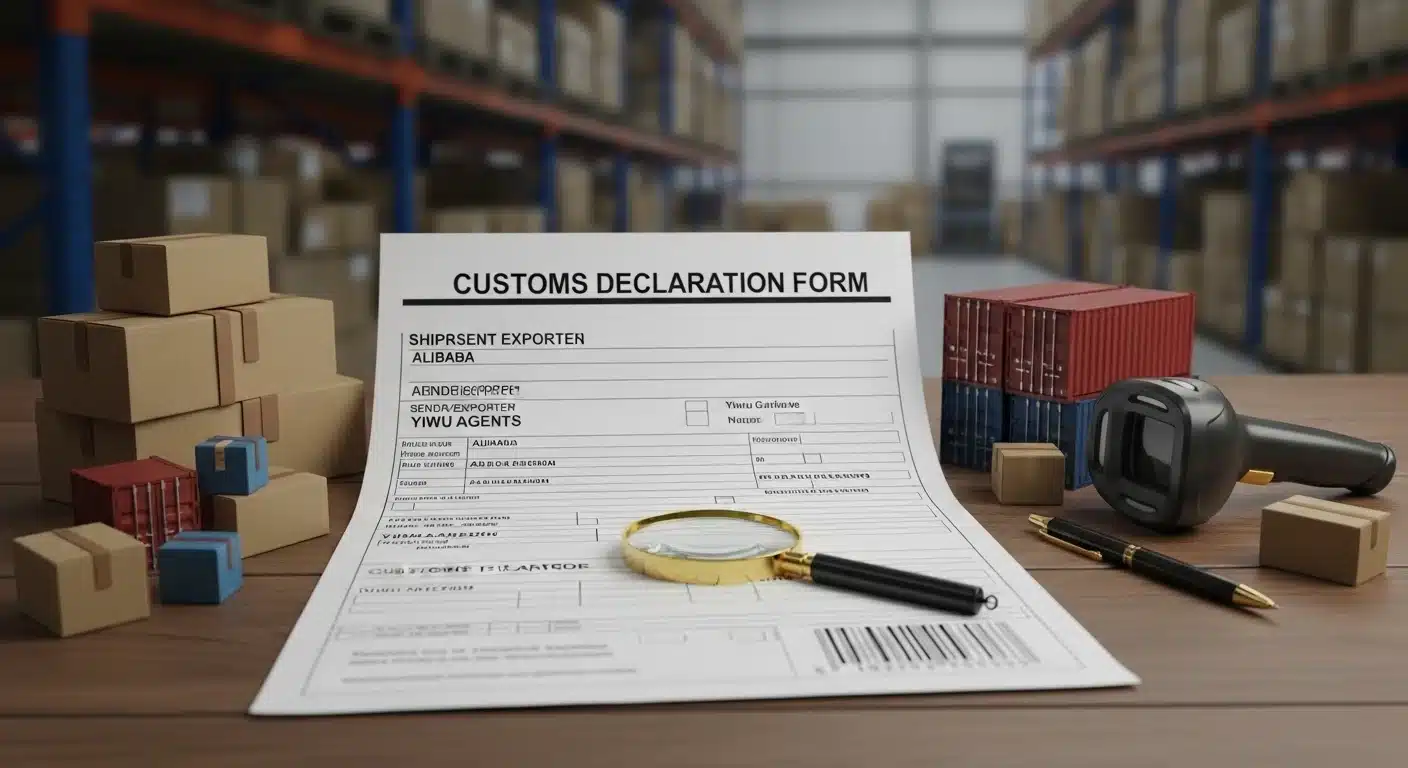
- Declaration integrity: why the invoice behind your entry matters, in customs declarations and the Alibaba versus agent invoice difference.
- Transport documents: the bill of lading explained, since release at destination depends on it.
- Who bears which risk: EXW, FOB and DDP compared for Yiwu buyers — the term you agree decides who is exposed to a clearance problem.
- Regulated consumer goods: importing baby products and CPC compliance, the category where certificate filing bites hardest.
- Marketplace sellers: Amazon customs compliance basics, where a detention also threatens your inventory position.
Conclusión
Clearance from customs rewards preparation and punishes improvisation, because it is a judgment about information you supplied weeks earlier and can no longer change. The deadlines are knowable, the entitlements during a detention are written down, and the two rules that changed this year — the de minimis suspension and mandatory electronic filing of CPSC certificates — have already invalidated a lot of advice still circulating. Knowing that duty liability stays personally with the importer of record is what turns all of this from trivia into something you act on.
If you are consolidating mixed goods out of Yiwu, the useful next step is to look at how your declared data gets built before the container is sealed, rather than at what to do once it is stuck. Where your own product category is concerned, confirm the current requirements with a licensed customs broker in your destination market.
Preguntas frecuentes
What does “cleared by customs” actually mean on a tracking page?
It normally means release was authorised, so the goods may leave the terminal. It does not mean your duty bill is final — liquidation happens later and can still adjust what you owe.
Can my shipment be cleared before the vessel arrives?
Documentation can be submitted in advance, but no. Under 19 CFR 141.68(e) goods are not authorised for release until they have arrived within port limits with intent to unlade.
Does the $800 de minimis rule still help small importers?
Not outside the postal network. Since 24 June 2026 the exemption is indefinitely suspended for all other modes, so sub-$800 shipments require formal or informal entry and attract duty.
My broker says there is no detention notice. Is that possible?
Yes, if another agency owns the admissibility decision. The notice requirement in 19 CFR 151.16 does not apply to detentions CBP makes on behalf of agencies such as the FDA.
Can I get the lab results behind a detention?
Yes. Under 19 CFR 151.16(d), on written request CBP will supply copies of testing results plus a description of the procedures and methodologies used, subject to limited proprietary exceptions.
If I buy DDP, am I still exposed to a duty bill?
If you are the importer of record, yes. Duty liability is a personal debt, and paying a broker does not discharge it where the broker fails to pay customs.