Justin
In wholesale and liquidation markets, the standard ‘no return, no refund’ policy means your leverage to reject defective goods evaporates the moment you release final payment. With processing a single return costing 17–30% of an item’s value, the system is designed to shift that risk and cost onto you, the buyer.

This guide explains how to protect yourself. We’ll detail why your final inspection report is your primary contractual tool, how to negotiate a practical defect allowance like a 2% spare parts clause, and the critical difference between a credit note and a cash refund. You’ll learn the process for quarantining defective stock and see how objective standards, like those used in a real case of broken ceramics, turn subjective disputes into enforceable resolutions.
The “No Return” Culture of Wholesale Markets
In wholesale and liquidation markets, goods are typically sold ‘as-is’ with explicit ‘no return, no refund’ clauses. This culture exists because processing returns costs 17–30% of an item’s value, and high retail return rates (around 16.9%) push problematic stock into B2B channels. Buyers trade the option to return for significantly lower prices, accepting the risk that a portion of goods may be defective or unsellable.

The Economic Engine Behind ‘Final Sale’
The ‘no return’ policy is a direct response to the immense cost of reverse logistics in retail. Processing a single return costs an estimated 17–30% of the item’s original purchase price, covering transport, handling, and markdowns. This cost is magnified by the sheer volume of returns. In 2022, U.S. retailers recorded $743 billion in returns from $4.9 trillion in sales, a rate of about 15.2%.
The problem is even more acute for ecommerce, where return rates average 16.9–18.1%—nearly double the 8–10% rate for in-store purchases. To protect their margins from this major cost driver, retailers offload slow-moving or high-return-risk inventory into wholesale and liquidation channels. These channels are designed from the outset as ‘final sale’ ecosystems, where the cost of returns is eliminated by removing the option entirely.
How the System Manages Risk Without Returns
Without the safety net of returns, the wholesale system relies on contractual tools and upfront diligence to manage risk. Contracts use Incoterms like ‘FOB’ to transfer the risk of loss or damage to the buyer the moment goods are loaded for shipment. This is paired with mandatory inspection-at-receipt clauses, placing the onus on the buyer to identify issues immediately. This shift is logical, given that industry data shows 80.2% of ecommerce returns are due to damage or breakage—a risk explicitly pushed downstream in B2B deals.
Quality management happens before payment, not after a sale. Buyers and sellers use tools like manifest audits, sample inspections, and standardized product grading schemes (e.g., A, B, C salvage grades) to set clear expectations. Payment terms act as the primary leverage. A common model is a 30% deposit to start an order, with the remaining 70% balance due only after the buyer approves a final inspection report. This structure aligns interests and replaces the need for post-purchase returns.
Why You MUST Inspect Before Payment (Leverage)
Your main contractual leverage to reject defective goods is tied to a passed final inspection report based on standards like ANSI/ASQ Z1.4. Releasing payment before this inspection is complete effectively waives your right to use these objective, statistical criteria to demand rework or a refund. The inspection acts as the final gate before money and goods change hands.
| Inspection Stage | Core Standard / Method | Role in Payment Leverage |
|---|---|---|
| Final Pre-Shipment Inspection | ANSI/ASQ Z1.4, ISO 2859-1 (AQL Sampling) | Provides the objective, documented proof required to accept a lot and release the final payment balance. Paying before this report forfeits your right to reject based on statistical defect rates. |
| In-Process Inspection | Statistical Process Control (SPC), ISO 9001 | Monitors production to reduce defects before the final gate, but does not replace the final acceptance decision that triggers payment. |
| High-Risk / Critical Feature Inspection | Regulatory Mandates (e.g., for Medical Devices) | Often requires 100% inspection and documented conformity before any shipment or payment can proceed, illustrating the absolute link between inspection proof and commercial release. |

The Standards-Based Gate: How Inspection Creates Leverage
Acceptance sampling standards like ANSI/ASQ Z1.4-2008 and ISO 2859-1 provide a statistically valid method to accept or reject an entire production lot without checking every single item. They define the inspection level, sample size, and Acceptable Quality Limit (AQL) to determine if defect rates are within agreed-upon limits.
A passed final inspection report executed under these standards is the documented proof a lot is acceptable. It is explicitly the ‘last line of defense before products are shipped.’ Paying the supplier’s final balance before receiving and approving this report removes your primary, objective basis for rejecting the shipment based on defect rates.
The Inspection-to-Payment Workflow in Practice
A robust quality system integrates pre-production, in-process, and final inspections, often aligned with ISO 9001:2015 requirements. In-process inspection uses Statistical Process Control (SPC) to monitor parameters like temperature and pressure, aiming to reduce defects before the final gate.
The decisive commercial action happens at the final pre-shipment inspection. Here, random sampling per the AQL plan determines lot acceptance or rejection. High-risk industries like medical devices may mandate 100% inspection of critical features, underscoring the principle: no conformity documentation, no shipment, and no final payment.
Standard payment terms, such as a 30% deposit to start production with a 70% balance due after QC approval, are designed to align money release with this final quality gate.
Negotiating a “Defect Allowance” (e.g., 2% Spare Parts)
A defect allowance is a pre-agreed tolerance for faulty goods, often formalized as a percentage of spare parts (like 2%) included in your order. It’s based on statistical quality standards like AQL, which permit a certain defect rate before rejecting an entire batch. Negotiating this clause upfront protects your payment leverage and provides a buffer against expected manufacturing variances without halting the entire shipment.
| Industry Standard | Benchmark / Acceptable Rate | Practical Implication for a 2% Allowance |
|---|---|---|
| AQL (General Consumer Goods) | Up to 2.5% major defects (e.g., 10 in 1,000 units) | A 2% spare parts clause directly covers defects within this common inspection limit. |
| DPPM by Sector | Automotive: <50 (0.005%) Consumer Goods: <200 (0.02%) Medical Devices: <10 | Your negotiated allowance should reflect your product’s complexity, from precision parts to general merchandise. |
| Six Sigma (Process Capability) | Level 3 (General): ~66,807 PPM (6.68%) Level 6 (Critical): 3.4 PPM (0.00034%) | The allowance accounts for realistic yield loss in mass production, where zero defects is statistically improbable. |
| Industry Failure Rates | Packaging/Lubricants: ~1% (10,000 PPM) Modern Target: ~75 PPM (0.0075%) | A 2% buffer is realistic for many consumer goods without being overly generous or punitive. |
What a Defect Allowance Is and Why You Need One
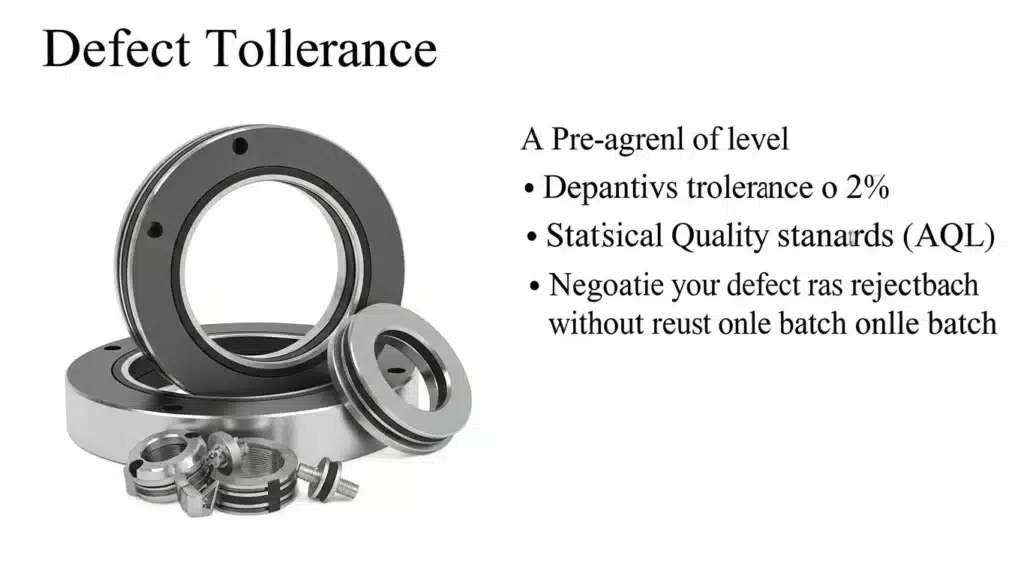
A defect allowance is a contractual buffer, such as agreeing to receive 2% extra units to cover anticipated faulty items, preventing disputes over minor quality variances.
It shifts the risk of inherent manufacturing yield loss from the buyer to the supplier, as producing with zero defects is statistically improbable in mass production.
This clause protects your final payment leverage; you can approve shipment and release funds if defects are within the agreed tolerance, avoiding costly delays.
For novice importers, it prevents returns for minor defects; for veterans, it’s a tool to secure free spare parts, improving overall unit economics.
The practice is grounded in the “no return” wholesale culture, where sending goods back to China is often impractical, making a pre-negotiated buffer essential.
Industry Benchmarks and How to Set Your Allowance
The AQL (Acceptable Quality Limit) standard is key: for general consumer goods, an AQL of 2.5 for major defects is common, allowing up to 10 defective units in a sample of 1,000.
Compare DPPM (Defective Parts Per Million) benchmarks: Automotive targets <50 DPPM (0.005%), while consumer goods may tolerate up to 200 DPPM (0.02%).
Use the defect rate formula: (Defective Units / Total Units) x 100. A 1% rate means 10 defectives in 1,000 units, a typical starting point for negotiation.
Sector standards vary: Packaging may accept ~1% (10,000 PPM), while precision industries like medical devices target under 10 DPPM. Your allowance should reflect product complexity.
A practical clause: ‘Supplier will provide a 2% quantity of spare parts at no extra cost to cover defects within the AQL Level II inspection limits.’ This aligns statistical targets with tangible buffer stock.

Getting a Refund: Credit Note vs. Cash Back
A credit note is an accounting adjustment that reduces your payable balance with a supplier for future orders, ideal for credit sales or offsetting final payments. A cash refund is a direct return of funds, typically used for fully paid cash transactions. The choice depends on your payment terms and the need for an immediate cash return versus maintaining a business relationship.

How a Credit Note Works as a Future Credit
A credit note formally adjusts the Accounts Receivable balance, linking directly to the original sales invoice without an immediate cash transfer. This is a mandatory step for tax compliance; issuing a refund without a corresponding credit note leaves the original invoice valid, creating a significant audit risk.
This tool is commonly used for partial returns, such as for 2 out of 10 defective units, or to document credits against a final payment balance, like the 30% often held until quality control approval. By referencing the specific original invoice, it creates a verifiable audit trail for product returns, damaged goods, or pricing errors. The credit generated can then be applied to your oldest unpaid invoices, effectively managing your account balance.
When to Demand Cash Back Instead
A cash refund directly credits your Cash or Accounts Receivable account (if the original payment was made by card), providing immediate liquidity. This method is best suited for transactions that were fully settled in cash upfront, where no ongoing credit relationship with the supplier exists.
In a B2B accounting context, processing a cash refund typically involves debiting the supplier’s Sales Returns and Allowances account, which is a separate step from simply issuing a credit note. This approach becomes crucial when a supplier relationship has broken down or for one-off purchases where future business is not anticipated, as it ensures you recover your capital directly and conclusively.
What to Do with Defective Goods in Your Country
When defective goods arrive, the first step is a formal quarantine process. Suspect materials are physically segregated, tagged, and blocked in your inventory system. Quality control then logs the incident and assesses the lot against agreed standards like AQL. Once liability is confirmed, you work with the supplier for a credit or replacement, and the goods are disposed of according to local safety and environmental rules.

The Formal Quarantine and Non-Conformance Process
The immediate response to defective goods is a standardized quarantine. Defective or suspect materials must be moved to a physically segregated ‘hold’ or ‘quarantine’ area. A formal ‘Hold’ or ‘Blocked’ tag is attached, listing the supplier name, quantity, and full lot or mill identification for traceability.
This physical action is mirrored in your inventory system. The stock status is updated in the ERP/MRP system to ‘blocked,’ which prevents it from being issued to production. Quality control then assigns a unique Quality Incident number and logs the event in a ‘Non-Conformance – Defective Incoming Raw Material Ledger.’
This documented process, often aligned with ISO 9001 requirements, creates the essential audit trail needed for supplier claims and regulatory compliance. It ensures the goods are contained and cannot enter your production flow until a formal disposition is decided.
Evaluating Defects and Managing Supplier Claims
After quarantine, the lot is evaluated against the Acceptable Quality Limit (AQL) plan defined in the purchase agreement. Common thresholds are 0.0% for critical defects, 2.5% for major defects, and 4.0% for minor defects. A single critical defect—anything posing a safety risk or violating regulations—typically justifies complete lot rejection and can block market entry.
For consumer products in markets like the U.S., CPSC best practices require robust lot/batch controls to identify and isolate defective units for potential recalls. This traceability is critical for managing goods already in the distribution chain.
Once supplier liability is confirmed through this evaluation, the commercial process begins. Purchasing issues a formal credit note request to the supplier to recover costs. The defective lot is then either returned, scrapped, or reworked under controlled conditions, following local environmental and safety rules.
Local consumer protection laws also define final remedies for defective goods that have already reached the market. These laws typically grant consumers rights to a refund, replacement, or repair, placing the responsibility on the manufacturer or importer as the liable party.
Case Study: The Broken Ceramics Dispute
This case study shows how a buyer, facing a shipment of broken ceramic tiles, used ISO and ASTM standards to prove the goods were substandard. By commissioning independent tests for water absorption and flexural strength, they provided evidence to withhold final payment and negotiate a replacement, turning a he-said-she-said argument into a data-driven resolution.

ute: Subjective Claims vs. Objective Standards
A buyer receives a container where 8% of ceramic tiles are cracked or chipped, far exceeding the agreed 2% defect allowance.
The supplier blames rough handling during shipping, while the buyer suspects inherently weak or porous material from the factory.
Without agreed-upon standards, the negotiation stalls over blame, blocking the release of the final 30% payment and any resolution.
The Resolution: Leveraging Testing and Contractual Holds
The buyer commissions a third-party lab to test random samples per ISO 10545-1, focusing on water absorption (ASTM C373) and breaking strength.
Test results show water absorption at 0.8%, failing the ≤0.5% requirement for certified porcelain tile per ANSI A137.1:2022, proving a material defect.
Armed with the lab report, the buyer formally places the final payment on ‘quality hold’ as per their contract, demanding the supplier re-manufacture the non-conforming batch at their own cost.
Key Standards and Data for Ceramic Disputes
Technical disputes over broken ceramics can be anchored in formal materials and product standards, rather than subjective claims. For structural integrity and breakage, buyers and suppliers can reference ASTM C1161 for flexural strength and ASTM C1421 for fracture toughness of the relevant ceramic body, while ASTM C1368 addresses slow crack growth that may lead to cracking during shipping or early field use. These tests provide quantified strength data (MPa for flexural strength, MPa·m1/2 for KIC) that can be compared against purchase order specifications.
For tiles and decorative ceramics, ISO 13006, the ISO 10545 series, ANSI A137.1:2022, and ASTM C373 give clear numeric acceptance ranges for water absorption (%), breaking strength (N or MPa), dimensional tolerances (mm), surface quality (visible defects per m²), chemical resistance classes, and frost resistance. These standards allow for independent testing and sampling according to ISO 10545-1 batching rules to demonstrate non-conformity against defined product grades, such as the ≤0.5% water absorption threshold for certified porcelain.
Food-contact and decorative ceramics introduce another pathway for rejection: regulatory non-compliance. ASTM C738-94(2020) defines an acetic-acid extraction method to determine leachable lead (Pb) and cadmium (Cd) from glazes. If shipment samples exceed allowable levels, the batch may be legally unsellable, providing a strong contractual basis for rejection even if items are physically intact.
From a process-control perspective, ceramic manufacturers operating under ISO 9001 and Six Sigma frameworks document each process step and its associated test data. Third-party QC firms provide checklists that translate these into field-level controls: defined AQLs, sampling plans, defect categories, and pass/fail criteria at pre-shipment inspection. For a buyer, attaching the release of the final payment to passing such an inspection—referencing concrete standards—turns a generic “quality hold” into a standards-driven gate for evidence-based negotiation.
Final Thoughts

In wholesale and liquidation, the “no return” policy isn’t a loophole—it’s the fundamental rule of the game. You trade the right to send goods back for a significantly lower price. This means your protection against defects must shift from post-purchase returns to pre-payment actions. Your primary leverage is the final inspection report and the payment you hold until it’s approved. Negotiating tools like a defect allowance and understanding the difference between a credit note and a cash refund are not optional extras; they are the essential mechanisms that replace the consumer-style return policy in this high-volume, low-margin environment.
The core takeaway is that managing defects in B2B trade is a proactive, contractual process, not a reactive customer service issue. Success depends on setting clear standards upfront, using inspection as a financial gate, and having a documented plan for when things go wrong. By anchoring disputes in objective data—like the ceramic case study showed—you move from subjective arguments to enforceable resolutions. Ultimately, your goal isn’t to eliminate all risk, but to control it through structure and evidence, ensuring that when defective goods arrive, you have a clear, agreed-upon path to a solution without halting your business.
Frequently Asked Questions
Can I return defective goods to China?
Yes, you can return goods to China if they are re-exported in the same condition within one year from the original import date due to quality or specification issues. This process is typically duty-free.
How do I get a refund from a Chinese supplier?
Direct cash refunds are uncommon. The most reliable method is to file a claim through Alibaba Trade Assurance within 30 days of delivery for quality or shipping issues. Alternatively, use documented defects and contract terms like AQL standards to negotiate replacements or a partial refund, often by withholding the final 30% payment as leverage.
What is considered a standard defect rate in manufacturing?
Defect rates are often benchmarked against Six Sigma levels. A common industrial benchmark is 3 Sigma, which allows for about 66,807 defects per million opportunities, or 6.68%. The gold standard is 6 Sigma, which aims for just 3.4 defects per million, or 0.00034%.
Does Alibaba Trade Assurance cover defective products?
Yes, Alibaba Trade Assurance covers product-related issues, including defective, damaged, or incorrect items that fail to meet the agreed contract or quality standards. Buyers must typically act before the 15-day auto-confirmation of shipment to initiate a dispute.
Who is responsible for return shipping costs?
The party responsible for return shipping depends on the reason. For defective, mis-shipped, or incorrectly described goods, the seller usually pays. For returns due to a change of mind or items that simply didn’t sell, the buyer typically covers the cost. Industry trends show a 20-25% increase in merchants charging for non-defective returns, making buyer-paid shipping more common.