
 Justin
Effective communication with Chinese suppliers is a critical skill, yet the tools you rely on can create as many problems as they solve. Alibaba’s chat filters might block your legitimate sourcing inquiries, while WeChat’s social ecosystem exposes you to scams and surveillance. Even face-to-face meetings in Yiwu hinge on interpreting unspoken cultural cues that can make or break a deal.

This article breaks down the practical realities of each channel. You’ll learn how Alibaba’s bot management can incorrectly flag new buyers, why a supplier’s WeChat account must be at least six months old to be verified, and how strategic silence during negotiations can compel better terms. We compare translation tools like DeepL and Google Translate for accuracy, and provide actionable steps to verify identities and read body language to secure your business interests.
The Limitations of Alibaba Messenger (Filters/Bots)
Alibaba Messenger’s bot management system can inadvertently hinder legitimate business communication. Its reliance on predefined detection rules, dependency on paid security services, and restrictive throttling can block serious sourcing inquiries, add costs for suppliers, and create friction for high-volume buyers.

How Bot Filters Restrict Communication
Alibaba’s system uses predefined fingerprints and whitelists to manage bots, offering limited options for custom detection logic.
This standard approach can block or challenge sophisticated, legitimate communication attempts, not just malicious scrapers.
For buyers, this means messages from new or complex sourcing inquiries might be incorrectly flagged, delaying contact with suppliers.
The Hidden Costs and Setup Hurdles
Full bot mitigation features are not standalone; they require enabling additional paid services like Web Application Firewall (WAF).
This creates configuration overhead and extra costs for suppliers, which can be a barrier for smaller vendors on the platform.
The dependency on these services means robust communication filtering isn’t universally accessible to all Alibaba suppliers.
Impact on Legitimate Buyer Activity
Throttling rules based on simple metrics like IP address can limit high-volume, legitimate research by serious buyers.
Actions like forced CAPTCHAs or blocks can create friction, interrupting the flow of negotiation and sample requests.
The system’s focus on security can inadvertently treat a buyer’s intensive sourcing activity as suspicious, hampering efficiency.
Face-to-Face in Yiwu: Reading Body Language
Success in Yiwu negotiations depends on understanding unspoken cultural cues. Mastering body language helps you interpret true intentions, avoid causing offense, and build the trust necessary to secure favorable terms.

The Unspoken Rules of Chinese Business Etiquette
Chinese communication prioritizes indirectness and harmony, making body language a critical supplement to spoken words.
Maintaining ‘face’ (mianzi) is paramount; avoid direct confrontation or public criticism that could cause embarrassment.
A formal posture and reserved demeanor are expected, especially in initial meetings, to show respect and seriousness.
Key Gestures and Signals to Interpret
Eye Contact: Sustained, direct eye contact can be perceived as aggressive or challenging. Use moderate, respectful glances.
Handshakes: Offer a light, not firm, handshake. Let your Chinese counterpart initiate or guide the physical greeting.
Nodding and Smiling: These often signal polite listening, not necessarily agreement. Do not assume a ‘yes’ from a nod alone.
Personal Space: Maintain a greater distance than in Western cultures. Avoid backslapping or other familiar touches.
Applying Insights for Effective Yiwu Negotiations
Use silence strategically. Pauses allow your counterpart to consider offers and save face, often leading to better terms.
Observe the supplier’s team dynamics. Who defers to whom? Identifying the real decision-maker is crucial.
Pair your verbal requests with respectful body language—a slight bow, presenting a business card with two hands—to build trust and rapport.
Translation Tools: DeepL vs. Google Translate
DeepL excels in linguistic accuracy for European languages, producing more natural-sounding sentences, while Google Translate offers broader language support and better accessibility for casual use.

Choosing the Right Tool for the Job
DeepL is the specialist for European languages, producing more natural-sounding sentences and better understanding context for formal documents.
Google Translate is the generalist with support for over 130 languages, making it the go-to for casual translation and less common language pairs.
For sourcing in Yiwu, DeepL is often better for precise communication on product specs and contracts, while Google Translate is useful for quick chats and broad supplier outreach.
A Detailed Feature Comparison
DeepL supports 28-30+ languages and excels in accuracy, topping 65% of language pairs in professional benchmarks, particularly for European languages.
Google Translate supports 130+ languages and offers moderate to high accuracy, with stronger performance for Asian languages.
DeepL offers high privacy claims and paid enterprise features like glossaries and tone control. Google Translate provides limited offline use and integrates into post-editing workflows.
Practical Application in Sourcing
Use DeepL to translate technical specifications, quality control reports, and formal supplier agreements to avoid costly misunderstandings.
Use Google Translate for initial supplier contact on platforms like WeChat, translating product listings, or understanding basic market signage in Yiwu.
Always have a human review critical translations. For high-value negotiations or complex contracts, consider professional translation services to complement these tools.

Negotiating in Real-Time: The Power of Silence
Strategic silence is a powerful tool in real-time negotiations with Chinese suppliers. A deliberate pause after making an offer or receiving a counteroffer can compel the other party to respond with better terms, reveal hidden information, and project a confident, data-backed stance that builds trust.

Using Silence to Build Tension and Secure Concessions
In real-time negotiations, a strategic pause of 5-10 seconds after making an offer compels the supplier to respond, often with better terms.
This technique leverages a cultural norm where prolonged silence creates discomfort, prompting the other party to fill the gap, making it effective for price discussions or pushing for quality improvements.
How Silence Reveals Hidden Information and Leverage
Remaining silent after a supplier’s counteroffer encourages them to elaborate, potentially disclosing production constraints, cost breakdowns, or unmentioned flexibility.
This real-time data mining helps uncover leverage points without direct questioning, allowing veteran negotiators to verify claims during WeChat or call discussions by listening for unsolicited details.
Projecting Confidence and Building Trust Through Patience
Employing silence projects authority and patience, contrasting with the novice eagerness to fill voids which can weaken a negotiating position.
Maintaining composure during 10-20 second pauses signals preparation and a data-backed stance to suppliers, which encourages trust and cooperation, especially when combined with written confirmations for accountability.
Avoiding Scams: Verifying Identity on WeChat
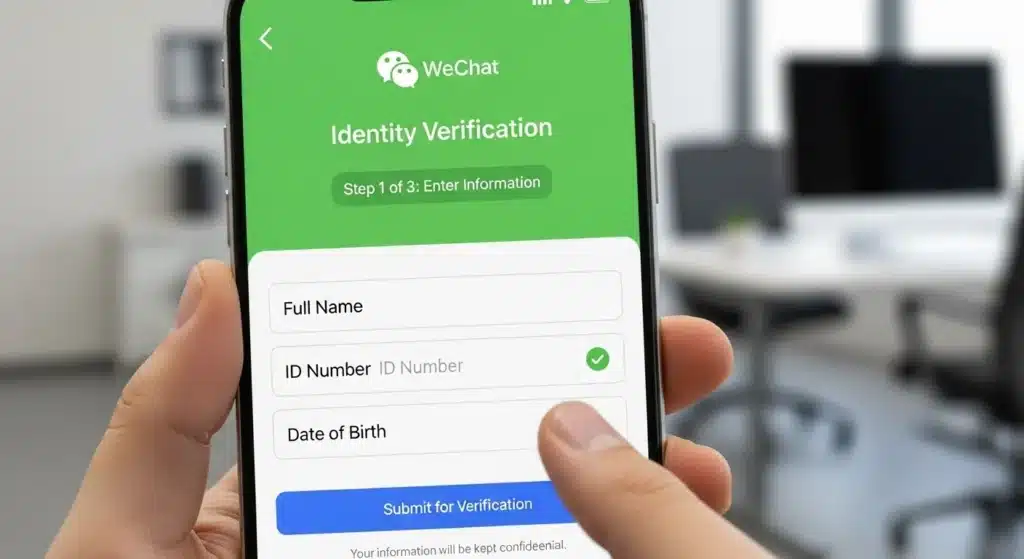
Verifying a WeChat user’s identity is a critical step to avoid scams when sourcing from Chinese suppliers. The process involves specific methods, eligibility requirements, and accepted documentation to confirm an account is legitimate and not a recently created fake profile.
The Core Verification Methods
QR Code Scanning is the primary method, where an existing user with an account at least 6 months old scans your code.
The ‘Help a Friend’ registration is an alternative, where an eligible user can register you via the WeChat Team account.
Paid third-party verification services are a last resort, typically costing around $15.
Eligibility and Documentation Requirements
The verifying user must have a Chinese account held for at least 6 months and cannot have verified someone else in the past month.
WeChat accepts passports and Mainland Travel Permits for identity verification.
For business use with WeChat Pay, Mainland China ID cards are the only currently supported form of ID.
Applying Verification to Supplier Sourcing
Use these methods to confirm a supplier’s WeChat account is legitimate and not a recently created fake profile.
Verifying a supplier’s identity helps establish a baseline of trust before sharing sensitive business information or payments.
This step is a critical part of due diligence, complementing on-site factory visits and quality inspections.
Frequently Asked Questions
Is WeChat safe for business?
WeChat is not considered safe for most business communications, particularly those involving sensitive data. It lacks end-to-end encryption by default, allowing Tencent or authorities to access messages stored on servers. China’s Cybersecurity Law and National Intelligence Law require companies like Tencent to provide user data to authorities upon request. The platform also monitors and censors content, including business discussions. For sensitive negotiations or data sharing, it’s advised to use dedicated enterprise versions like WeChat Work or secure alternatives, and keep transactions on platforms like Alibaba for their structured protections.
How do I talk to Chinese suppliers?
Initiate direct contact and assess their responsiveness; reliable sellers answer promptly with detailed, professional replies. Formalize all agreements on-platform, such as Alibaba, by requesting itemized quotes and written production schedules. Use video verification to request live factory or warehouse tours to verify legitimacy. Be cautious about moving communication off-platform, as it can lead to misunderstandings and reduced buyer protection. Avoid any payment requests made outside the secure e-commerce system, such as via Western Union or cryptocurrency, as these are common scam tactics.
Should I move from Alibaba to WeChat for supplier chats?
Moving from Alibaba to WeChat carries notable risks, especially for novices. Alibaba provides robust e-commerce safeguards like AES-256 encryption, two-factor authentication, and streamlined IP violation reporting. WeChat, while useful for relational networking and viewing a supplier’s ‘real factory life’ via Moments, offers weaker brand protection tools and has a higher scam exposure in its social ecosystem. For secure transactions and verification, stick to Alibaba’s verified channels initially. Experienced buyers can use WeChat cautiously for ongoing relationship-building but should keep deal finalization on Alibaba.
What is the best translation app for business?
For business use, Microsoft Translator and DeepL are the top choices. Microsoft Translator excels in collaborative environments, supporting real-time group conversation translation for over 100 participants and integrating seamlessly with Microsoft Office and Teams. DeepL is superior for translation quality and document work, delivering highly accurate, natural-sounding translations, particularly for European languages. Google Translate remains a strong free alternative with support for over 130 languages. Your choice depends on whether you prioritize collaboration features (Microsoft Translator) or translation quality and document support (DeepL).
Is negotiating via WeChat safe?
WeChat is not recommended for sensitive business negotiations. Key risks include the lack of end-to-end encryption, potential government surveillance under Chinese law, content censorship, and a history of data breaches and scams. Messages can be accessed by Tencent or authorities, exposing deal terms or intellectual property. For novices, it’s safer to stick to platform messaging on Alibaba or use verified enterprise tools. If using WeChat, limit discussions to non-sensitive topics and consider switching to encrypted apps for final deal negotiations. Implement third-party tools for archiving and monitoring if necessary.
Final Thoughts
Choosing the right communication channel is more than a technical decision; it’s a strategic one that directly impacts your sourcing success. Alibaba Chat provides a structured, secure environment for transactions but can create friction with its automated filters. WeChat offers immediacy and relationship-building potential but requires careful identity verification and carries security risks. Face-to-face meetings in places like Yiwu unlock a deeper level of trust and understanding through cultural cues that digital platforms cannot replicate.
The most effective approach is a hybrid one. Use Alibaba’s platform for initial contact and to formalize agreements with its built-in protections. Leverage WeChat cautiously for ongoing rapport and quick updates, always verifying identities first. Whenever possible, complement digital communication with in-person visits to read body language, build genuine trust, and master negotiation tactics like strategic silence. Supported by the right translation tools for clarity, this multi-channel strategy balances efficiency, security, and the human connection essential for successful, long-term supplier relationships.