

 Justin
Choosing the right fee model for your China sourcing agent is more than a budgeting exercise—it directly impacts your total landed cost and supply chain transparency. A 5% commission on a $40,000 order might seem straightforward, but a ‘free’ agent could hide a 5% factory kickback, costing you the same amount without the clarity.

This article breaks down the three primary fee structures—commission, flat, and hourly—and provides the 2026 cost benchmarks for each. You’ll see a detailed comparison of how a standard 5-10% commission stacks up against a $100-$1,000 flat fee, learn the real math behind hidden kickbacks in places like Yiwu, and get practical guidance on structuring payments and contracts to protect your interests.
The 3 Common Fee Models (Commission/Flat/Hourly)
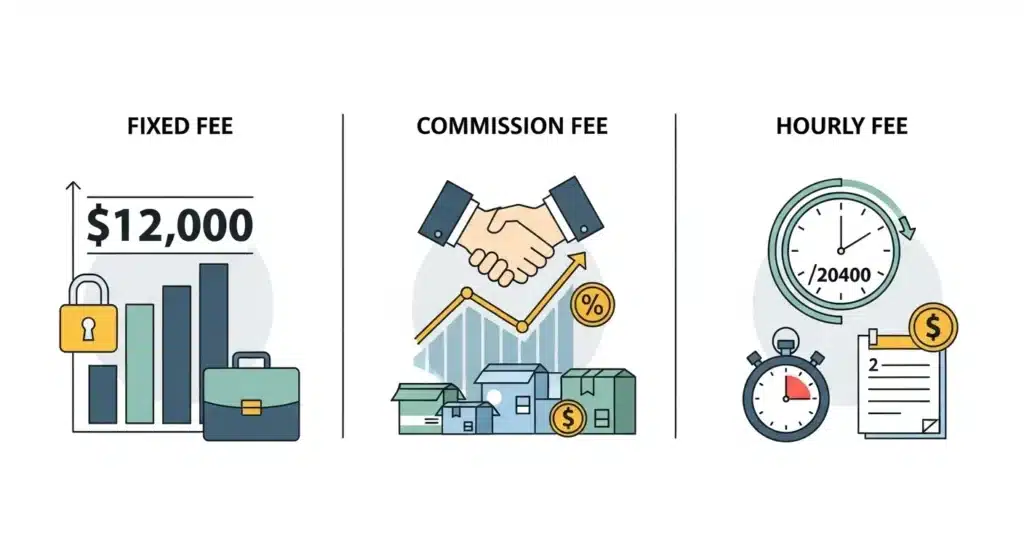
Sourcing agents typically charge using one of three models: a commission (3-10% of order value), a flat project fee ($100-$1,000+), or an hourly rate (often wrapped in a retainer). The commission model is most common for standard orders, while flat fees suit defined projects, and hourly rates apply to ongoing advisory work. Hybrid models combining these elements are also prevalent.
| Fee Model | Typical Cost Range | Best For |
|---|---|---|
| Commission | 3-10% of order value (5-10% standard) | Standard procurement of consumer goods |
| Flat / Fixed Fee | $100 – $1,000+ per project | Defined, one-off projects or specific tasks |
| Hourly / Retainer | Embedded in monthly retainer agreements | Ongoing advisory or variable management needs |
How Commission, Flat, and Hourly Models Work
The commission model charges a percentage of the total order value. For sourcing consumer goods from China, this typically falls between 3-10%, with 5-10% being the standard band. This structure directly ties the agent’s payment to the size of your order.
A flat or fixed-fee model involves a set dollar amount for a defined scope of work. Common examples include a fee of $300 for supplier sourcing and qualification, or around $800 for end-to-end project management from initial sourcing through to shipment. This offers predictable costs for scoped projects.
The hourly model bills for time spent. It is rarely quoted as a simple hourly rate in public; instead, it’s usually embedded within monthly retainer agreements for ongoing advisory or management services. This model charges for direct labor and agent availability.
Comparing Costs, Data, and Hybrid Structures
When accounting for all service overhead, the total cost of a commission-based engagement can represent 5-11% of the order value. This is a useful benchmark for evaluating a quoted rate against industry norms.
Flat fees for sourcing tasks commonly range from $100 to $1,000. The final cost scales with the project’s complexity, the depth of quality assurance required, and the scope of ongoing management.
Hybrid models are common optimizations in practice. These combine elements of the core structures to balance incentives and cost predictability. Examples include a $1,000 flat fee plus a 10% share of any cost savings negotiated, or a 60% fixed retainer combined with a 40% variable commission on order value.
Your choice of model depends on order predictability. Use a commission for standard, repeatable procurement. A flat fee works best for one-off, well-defined projects. An hourly or retainer model is suited for ongoing, variable advisory needs where the workload fluctuates.
The Hidden Cost of “Free” Agents
Agents who claim to work for free are not providing a charitable service. Their income comes from hidden markups on your product prices or undisclosed rebates (kickbacks) from the factory. This model lacks transparency, often leads to higher overall costs, and can compromise the agent’s incentive to negotiate the best price for you.
How the ‘No-Fee’ Model Actually Works
The agent’s income is embedded in your product’s unit price through a factory markup, which you pay indirectly.
Alternatively, the agent receives a rebate or kickback from the supplier after your order is placed, a payment you never see on any invoice.
This creates a fundamental conflict of interest, as the agent’s profit is tied to a higher factory price, not to saving you money.
The lack of a transparent service fee agreement makes it impossible to audit the agent’s true compensation or align their incentives with yours.
The Real Price of Hidden Commissions
Your final landed cost becomes inflated, often by 3% to 10% or more, mirroring standard commission rates but without your knowledge.
You lose negotiation leverage, as the agent may not push the factory for the lowest possible price to protect their hidden margin.
It complicates price benchmarking; you cannot accurately compare quotes from different agents or assess true factory costs.
This model fosters distrust and can lead to supply chain issues if quality is compromised to preserve the agent’s hidden profit.
What Does the Service Fee Actually Cover?
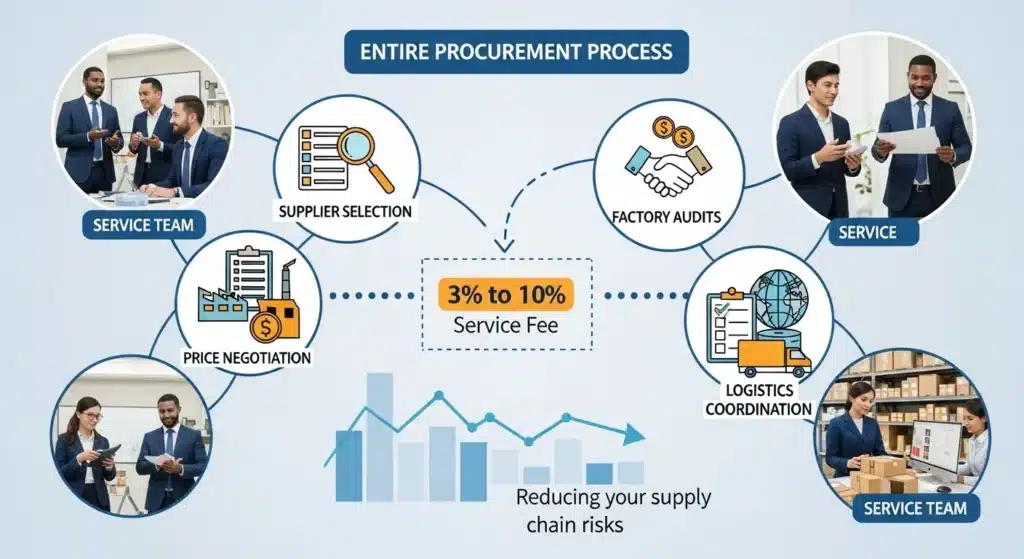
A sourcing agent’s service fee, typically 3–10% of your order value, pays for a complete procurement workflow. This bundle acts as your on-the-ground team, covering supplier vetting, factory audits, price negotiation, quality control inspections, and logistics coordination to de-risk your supply chain.
The Core Service Bundle: Your Procurement Team
The fee funds a defined project scope, not a vague introduction. It covers the full sourcing lifecycle from market scanning to shipment. This includes supplier shortlisting, factory due diligence like license checks and on-site audits, and cost and term negotiation.
The bundle also explicitly covers quality assurance. Your agent creates AQL plans and conducts in-process and pre-shipment inspections. Logistics coordination, such as goods consolidation and basic export documentation, is typically part of the standard 5–10% commission.
How Fee Structures Adapt to Your Business
Commission rates adjust based on risk and scale. Complex or small orders often see 8–10% or more, while large repeat orders over $100,000 can qualify for 3–5%. For continuous procurement, hybrid models with a monthly retainer ($500–$5,000+) fund ongoing supplier management, paired with a lower per-order commission.
A critical risk is undisclosed factory kickbacks, which can be 20–300% of the agent’s stated fee. This severely misaligns incentives if not contractually forbidden. Transparent agents provide fee breakdowns, forbid rebates in contracts, and may offer performance-based discounts, like a 0.5–1 percentage point reduction tied to quality and delivery metrics.
Your Direct Line to the Yiwu Market. Zero Maze, All Goldmine.

Kickbacks: The Dirty Secret of Yiwu
A kickback is a secret commission a sourcing agent receives from a factory, inflating your purchase price. In Yiwu, agents advertising ‘free’ or 1–2% commissions often rely on these hidden rebates of 3–10% to make their business viable, meaning your total agent cost can still reach the standard 5–10% industry rate.
| Agent’s Advertised Commission | Typical Hidden Factory Kickback | Your Total Agent Cost |
|---|---|---|
| “Free” or 1-2% | 3-10% of order value | ~4-11% (aligns with standard 5-10% range) |
| Transparent 5-8% | 0% (disclosed model) | 5-8% (clear, upfront cost) |

How Factory Kickbacks Inflate Your Costs
A kickback is an undisclosed rebate paid by the factory to the agent, typically 3–10% of your total order value. This practice is common when agents advertise ‘free’ or very low commissions (1–2%), as the visible fee doesn’t cover their operational costs.
The agent’s incentive shifts from finding you the best price to steering you toward factories that offer them the highest rebate, often at your expense. Your final product cost becomes opaque, as the factory’s quoted price to you includes this hidden commission.
The Real Math Behind a ‘1% Commission’
A typical 40 ft container from Yiwu holds about $40,000 in goods. A 1% ‘visible’ commission pays the agent only $400. Basic operational costs in Yiwu, like one staff salary, start at around $1,200 per month, not including overhead.
To bridge this gap, the agent must secure a factory kickback. A 5% rebate on the same $40,000 order adds $2,000 in hidden costs. Combined, the agent’s total take becomes $2,400, or 6% of your order value—aligning with the standard 5–10% transparent commission range.
Calculating Your Landed Cost (Case Study)
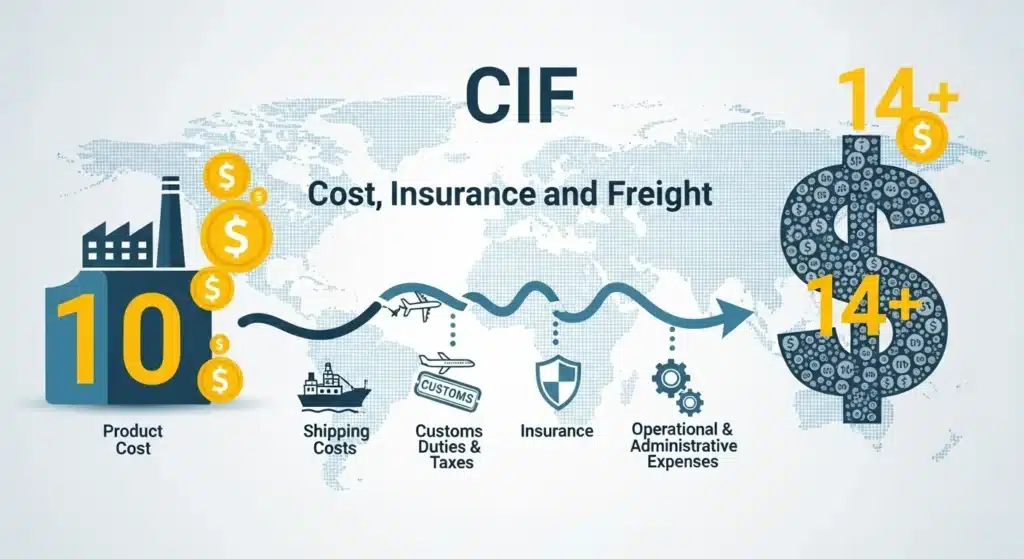
Landed cost is the total price to get goods from the factory floor to your warehouse. It includes the product cost, all freight and shipping, customs duties and taxes, insurance, and your operational overhead. For a $10 item, the final landed cost can easily reach $14 or more.
The Landed Cost Formula: Breaking Down the Five Cost Buckets
The standard formula for landed cost is: Landed Cost = Product Cost + Freight/Shipping + Customs Duties & Taxes + Insurance/Risk + Overhead/Operating Costs. This formula is used by major logistics and finance providers to model the true cost of imported goods.
The freight component includes ocean or air freight, trucking (drayage), terminal handling charges, and container fees. Customs costs are determined by the product’s specific HS code and the destination country’s tax laws. Insurance for marine cargo typically ranges from 0.25% to 2% of the cargo’s total value. Overhead covers expenses like warehousing, port charges, and administrative costs.
Case Study Analysis: From $10 FOB to $14.05 Landed
Consider importing 1,000 units at a $10 FOB price from China to the United States. Ocean freight, drayage, and handling total $3,300, or $3.30 per unit. Customs duty is calculated at 5% on the customs value, adding $500. Insurance for the shipment adds another $250.
The total landed cost for the shipment is $14,050, which breaks down to $14.05 per unit. This represents a 40.5% increase over the original $10 factory price. This case shows how logistics and border fees significantly inflate the final cost.
The impact can be even more dramatic for lower-value goods. In another scenario with a $4 unit cost, high allocations for risk and overhead can drive the landed cost to $11.54 per unit—a 188.5% increase over the factory price. For higher-value goods with efficient shipping, the uplift can be as low as 10%.
When to Pay: Upfront vs. Upon Delivery
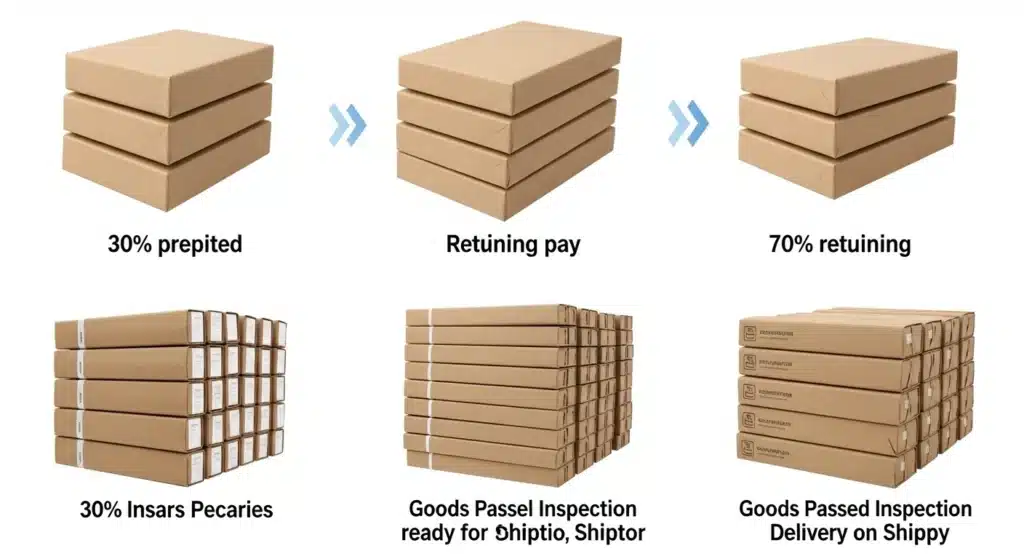
In China sourcing, standard payment to factories is a split: typically 30% upfront to secure production and 70% after goods pass inspection and are ready to ship. For sourcing agents, commission is often tied to a milestone like a successful inspection, with payment due shortly after, ensuring their fee aligns with delivery readiness.
The Standard Factory Payment Schedule
The de-facto technical benchmark is a split payment: about 30% payable on order confirmation to secure raw materials and production line time.
The remaining 70% is payable only after the goods pass a formal pre-shipment inspection and are confirmed ready for shipment.
This structure, often expressed as ‘30% T/T deposit, 70% T/T after inspection,’ protects the buyer from paying 100% upfront while meeting the supplier’s cash-flow needs.
Variants like a 20/80 split or payment ‘against copy of Bill of Lading’ are minor calibrations of the same core principle: partial upfront, majority upon delivery readiness.
Structuring Agent Commission Payments
Agent commission is typically 3–10% of the factory’s FOB invoice value, but the critical clause specifies when it is due.
Well-drafted agreements tie the agent’s invoice to a technical event, such as ‘within 7 days of the client confirming successful pre-shipment inspection,’ with payment due in 15 days.
This aligns the agent’s payment with the factory’s final 70% payment, occurring between successful QC and final shipment.
Some agents use a hybrid model: a fixed retainer or upfront fee paid before project start to cover initial work, plus a reduced commission on the shipped order value later.
Contract Terms You Must Check
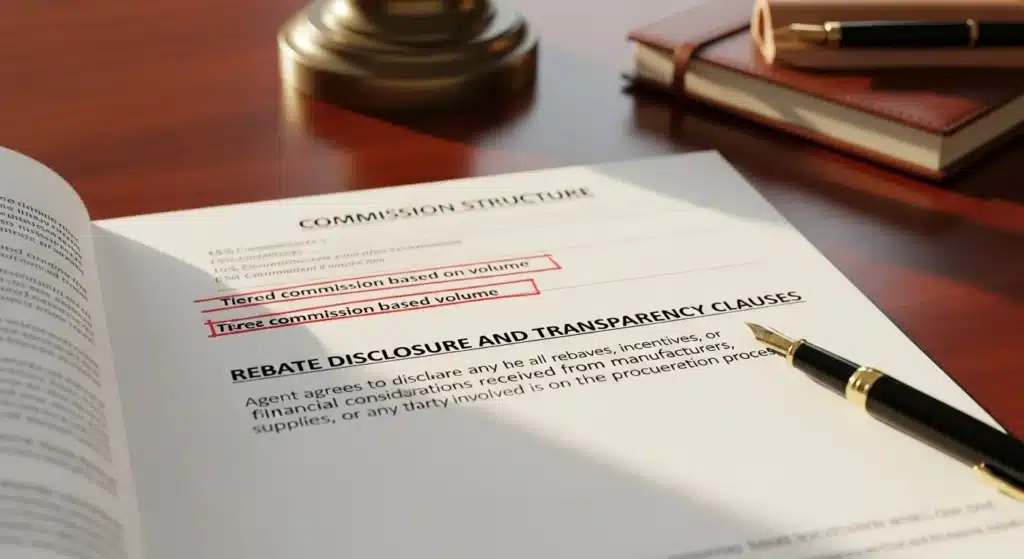
The most important terms in a sourcing agent contract are the commission structure and clauses addressing hidden factory rebates. A standard commission is 3-10% of the total purchase order value, with rates often lower for high-volume orders. Crucially, the contract must define how any ‘kickbacks’ or rebates from the factory are handled, as these are common but rarely disclosed without a specific agreement.
Defining the Commission Structure and Scope
The agent’s fee is typically a percentage of the total purchase order value. This rate usually falls between 3% and 10%. The exact percentage depends on the order’s scale and complexity.
Larger orders often justify a lower commission rate, sometimes as low as 3%, because the agent’s revenue scales with the total value. For smaller or more complex projects that require significant upfront work, rates can be higher, up to 10%. The contract should specify whether this is a flat percentage or if it changes based on order size.
Your agreement must also detail what services are covered by this fee. Common inclusions are supplier identification, price negotiation, and quality control coordination. A clear scope prevents disputes over additional charges later.
Mandating Transparency on Factory Rebates and Kickbacks
A critical, often overlooked clause involves factory rebates. It’s common for agents to receive additional payments or “kickbacks” from suppliers, which are not automatically passed on to you. This hidden income can inflate your effective cost.
Your contract should explicitly require the agent to disclose any such rebates, commissions, or financial incentives received from the factory. The strongest agreements go further, stipulating that these rebates must be either deducted from your final invoice or shared with you according to a pre-agreed formula.
There is no industry standard or certification that governs this practice. The contract itself is your only tool for creating transparency and ensuring your agent’s incentives are aligned with getting you the best possible price, not just the highest factory commission.
Final Thoughts
Choosing between a flat rate and a percentage commission for your China sourcing agent comes down to your project’s nature. A percentage model (3-10%) aligns the agent’s fee with your order value, making it predictable for standard, repeatable procurement. A flat fee ($100-$1,000+) offers cost certainty for one-off, well-defined projects. The most critical factor isn’t the model itself, but its transparency. Avoid agents who advertise ‘free’ services, as their income typically comes from hidden factory markups or kickbacks that inflate your final cost without your knowledge.
Your contract is the key tool for ensuring a fair partnership. It should clearly define the fee structure, the scope of services covered, and—most importantly—mandate full disclosure of any factory rebates or kickbacks. A transparent 5-8% commission is almost always better than a seemingly low 1-2% fee that hides additional costs. By understanding the true landed cost, which includes product, freight, duties, and agent fees, you can make an informed decision that protects your margins and builds a sustainable supply chain.
Frequently Asked Questions
What is a standard commission rate in Yiwu?
The standard commission for a full-service Yiwu sourcing agent typically ranges from 5% to 10% of the total order value. This fee covers supplier verification, negotiation, quality control, and shipping coordination.
Do agents get kickbacks from suppliers?
Yes, this is a common practice. Agents who advertise ‘free’ sourcing often rely on undisclosed kickbacks from factories, which are hidden in the product price. Transparent agents avoid this by charging you a clear, agreed-upon commission instead.
Should I pay the supplier directly or the agent?
You should pay the supplier directly. This is the standard risk-control practice. The agent’s commission, typically 3-10% of the FOB value, is paid separately. This keeps the commercial invoice clean and ties product liability directly to the factory.
What is the difference between a sourcing agent and a trading company?
A sourcing agent works for you, charging a service fee (5-10% commission) to find and manage suppliers without taking ownership of the goods. A trading company buys products from factories and resells them to you with a markup (often 15-30%), acting as the seller and taking legal title to the inventory.
Are there extra fees for warehousing?
Yes, warehousing is a separate service and is not included in the standard sourcing commission. Storage fees in China are typically billed per cubic meter (CBM) per month, often ranging from $5 to $15. Handling and value-added services like labeling also incur additional charges.
Is the service fee refundable?
Typically, no. The sourcing agent’s commission is considered earned once the agreed work is completed or an order is placed. It is generally non-refundable unless a specific performance or money-back guarantee is explicitly stated in your contract.