Justin
If you sell Christmas decorations, you are almost certainly buying them from China already — you just may be doing it through two or three middlemen. Roughly two-thirds to 80% of the world’s Christmas decorations are made in and around one Chinese city, Yiwu, and nearly every “USA supplier” that ranks for wholesale Christmas decorations is a domestic distributor reselling that same container at a 40–120% markup. This guide is about buying the tier below them: sourcing baubles, lights, trees, wreaths and figurines direct from the factories and the Yiwu holiday market, what it really costs once duty and compliance are counted, and — the part that catches most first-timers — why the order you place in July is the one that actually arrives before Christmas.
Key Takeaways
- Yiwu is the source, not a middle step. The city produces an estimated 60–80% of the world’s Christmas decorations across 500+ factories and a dedicated holiday zone inside a 60,000-vendor market — the layer your domestic wholesaler buys from.
- Ornaments are duty-free; lights are not. Glass, wood and other Christmas ornaments enter the US at a Free HTS rate (heading 9505.10); LED light strings carry an 8% base duty (9405.31). Both then take the China-specific Section 301 surcharge.
- The real China surcharge in 2026 is 7.5%. After the Supreme Court struck down the IEEPA “reciprocal” tariffs in February 2026, the duty that still applies to most Christmas décor is Section 301 List 4A at 7.5% — stacked on top of the base HTS rate. Confirm the live rate with your broker; policy has moved repeatedly.
- Christmas lights need UL 588. It is not a federal law, but the safety standard for seasonal lighting is the de-facto gate for US retail, Amazon and clean customs release. Un-listed lights are the #1 rejection risk.
- Order now or miss the season. Between 30–60 day production, the October 1 Golden Week factory shutdown, and 30–40 day ocean transit, cargo must be ready to sail by late September. For reliable pre-Christmas retail stock, place orders in June–August.
Why buy Christmas decorations wholesale direct from China
Search “wholesale Christmas decorations” and every result on page one is a US-based distributor — Christmas Place, Jamali Garden, Burton & Burton, Wintergreen, Oriental Trading. They are good businesses, but they are all doing the same thing: importing containers from Chinese factories, warehousing them in the US, and reselling to you at a markup that has to cover their real estate, staff and risk. That markup is typically 40–120% over the landed China price. For a shop or e-commerce seller doing meaningful volume, that spread is the difference between a healthy holiday margin and a thin one.
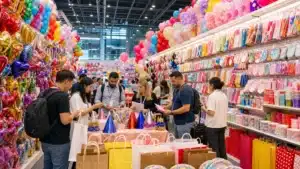
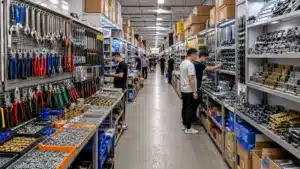
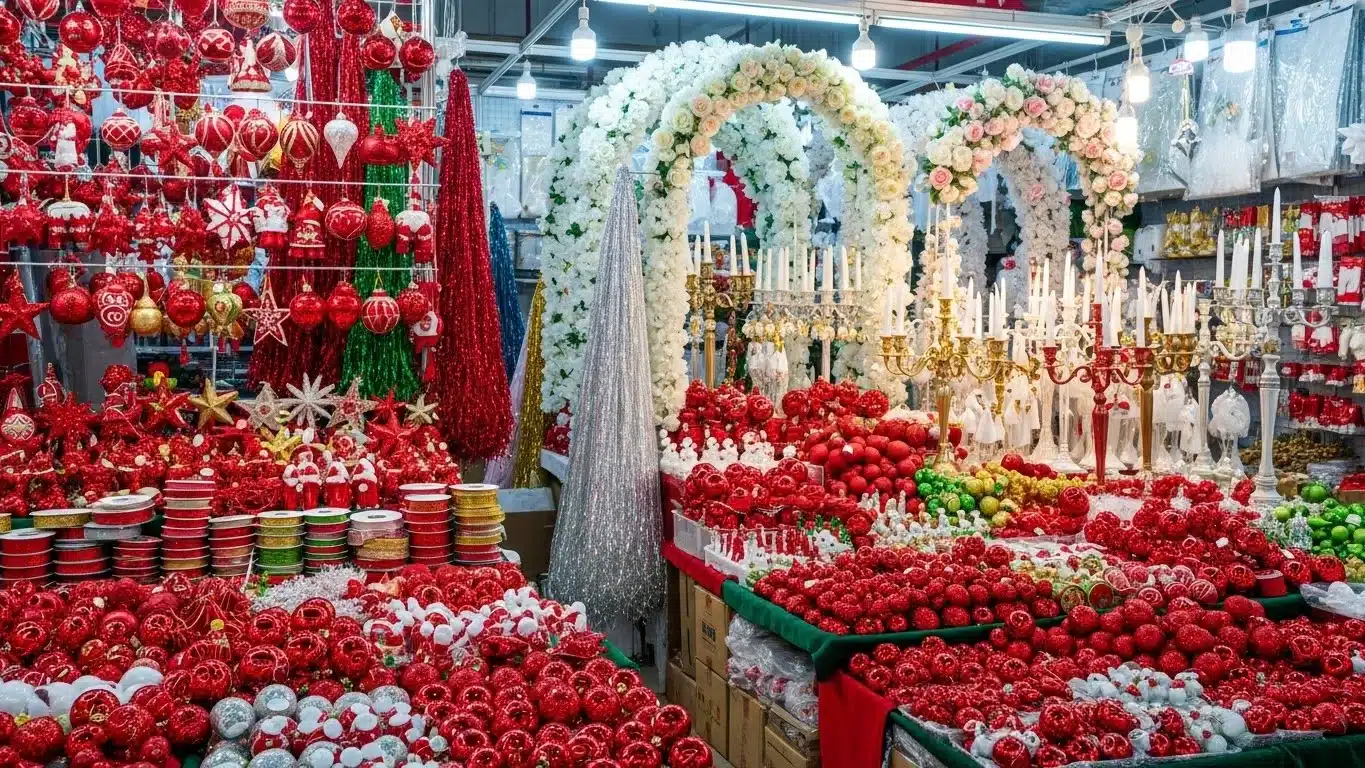
The reason the concentration is so extreme is geography. The bulk of the world’s Christmas output flows through Yiwu in Zhejiang province — a city of about 1.9 million that industry and press estimates credit with 60–80% of global Christmas decoration production. Inside Yiwu International Trade City, the largest small-commodity market on earth with more than 60,000 vendors, an entire district is given over to holiday goods: aisle after aisle of baubles, tinsel, light strings, artificial trees, inflatables and nativity sets. Buying here — directly or through an agent standing in the market — removes the importer, the domestic wholesaler, and their two margins from your cost base.
Direct sourcing is not automatically the right move for everyone, and this guide is honest about that trade-off later. But if you are ordering by the carton rather than the piece, the economics are hard to argue with: you take on a longer lead time and the compliance work the distributor used to absorb, and in exchange you capture the margin they were keeping.
What “wholesale Christmas decorations” actually covers: categories, MOQs and price bands
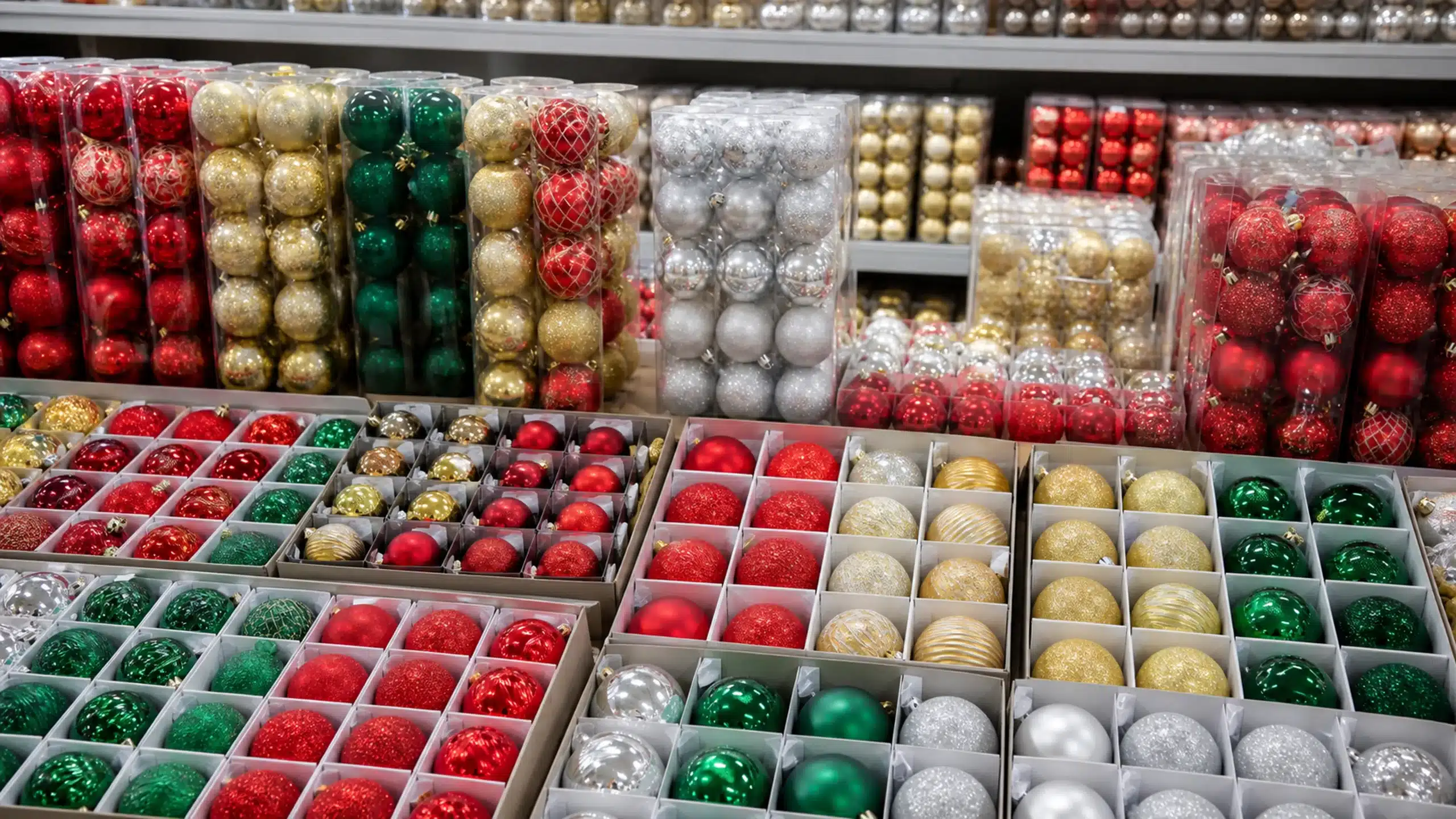
“Christmas decorations” is not one product with one supplier — it is five or six distinct manufacturing categories, each with its own factories, minimum order quantities (MOQ) and compliance profile. Treating them as one line item is how buyers end up with a supplier who is excellent at baubles and mediocre at electrical lights. The table below is a planning reference; the price bands are market estimates for standard (non-licensed, non-custom) goods and will move with materials, order size and season — treat them as directional, not a quote.
| Categoría | Typical MOQ (per design) | Est. FOB price band | US HTS heading |
|---|---|---|---|
| Glass & plastic baubles / ornaments | 300–1,000 pcs | $0.10–$0.60 / pc | 9505.10.10 / .25 |
| LED light strings & net lights | 500–2,000 sets | $0.50–$3.00 / set | 9405.31.00 |
| Artificial trees | 100–500 pcs | $4–$40 / pc | 9505.10.25 |
| Wreaths, garlands & picks | 200–1,000 pcs | $0.80–$6 / pc | 9505.10 / 6702* |
| Figurines, nativity, inflatables | 300–1,000 pcs | $0.50–$8 / pc | 9505.10.30 / .25 |
Two practical notes hide inside that table. First, MOQs are per design and colourway, not per category — a 1,000-piece bauble minimum split across five colours is really 200 of each, which is why buyers consolidate designs. Second, the tariff classification is not cosmetic: whether a wreath is treated as a festive article under 9505 or as artificial foliage under 6702 changes its duty, and that is decided by how it is described and constructed, not by what you call it on the invoice. Get the classification confirmed before you commit to a category — the next section explains why it matters to your landed cost.
The 2026 duty and tariff map: what Christmas décor really costs at the border
This is where the direct-import maths is won or lost, and where most “how to source from China” articles go quiet because the numbers are specific and they change. Here is the current, verifiable picture for goods of Chinese origin arriving in the United States.
Base HTS duty. Navidad ornaments are among the few consumer goods that enter the US duty-free under the regular tariff schedule. The US International Trade Commission’s Harmonized Tariff Schedule lists ornaments of glass (9505.10.10), of wood (9505.10.15) and of other materials (9505.10.25) all at a Column 1 general rate of Free. LED Christmas light strings are the exception: heading 9405.31.00 carries an 8% general duty (non-LED sets fall under 9405.39). Non-ornament festive articles — some wreaths and garlands classified as artificial foliage — can attract a general rate around 8.4%.
The China surcharge. On top of that base rate, Chinese-origin goods carry the Section 301 tariff. Christmas decorations and lighting sit on List 4A, whose rate is 7.5% and has been in force since February 2020. Critically, this survived 2026’s tariff upheaval: after the Supreme Court ruled in February 2026 that the IEEPA “reciprocal” and fentanyl tariffs were not authorised — invalidating those surcharges — the Section 301 duties were untouched and remain fully in effect. The current List 4A exclusions were extended through November 10, 2026 under the October–November 2025 US–China agreement. Because this landscape has shifted several times in eighteen months, treat the numbers below as the mid-2026 baseline and have your customs broker confirm the live stacked rate before you wire a deposit.
| Product | Base HTS duty | + Section 301 (List 4A) | = Effective China duty |
|---|---|---|---|
| Glass / plastic ornaments | Free | 7.5% | ~7.5% |
| LED light strings | 8% | 7.5% | ~15.5% |
| Artificial trees | Free | 7.5% | ~7.5% |
Worked example. Say you split a container between $10,000 (FOB value) of glass baubles and $10,000 of LED light strings. The baubles are duty-free at base but take the 7.5% Section 301 duty — $750. The lights take 8% base plus 7.5% Section 301 — $1,550. On $20,000 of goods, that is $2,300 in duty, plus the merchandise processing fee (roughly 0.35% ad valorem) and, for ocean freight, the 0.125% harbor maintenance fee. The lesson is not that lights are a bad category — it is that a mixed order’s real landed cost is category-weighted, so you calculate duty line by line before you decide your retail price, never on a single blended guess. If you want the full method, our landed-cost formula for import buying decisions walks through every component, and the HS code guide for Yiwu imports covers getting the classification right.
Safety and compliance you cannot skip — especially on lights
The compliance gap is where direct importers get hurt, because it is exactly the work your old distributor was silently handling. For decorative goods it clusters around three risks.
Electrical safety (UL 588). The recognised US safety standard for seasonal and holiday decorative lighting is UL 588, covering decorative light strands, wreaths and motorised displays rated for temporary use (90 days or less) at up to 120 V. It is not, strictly, a federal legal requirement — but in practice it is the gate. Major retailers, Amazon and many customs brokers will not accept seasonal lighting without UL 588 listing, and the standard’s rain, water-immersion, strain-relief and overcurrent tests are precisely the failure points of a cheap, un-listed string. If a supplier cannot produce a current UL 588 test report, treat the quote as incomplete, not cheap. This is the single most common reason a first China lighting order gets rejected or stranded.
Lead, phthalates and Prop 65. Painted ornaments, PVC light cords and soft figurines are the classic carriers of restricted substances. Any decoration designed or marketed for children becomes a children’s product and falls under the federal 100 ppm lead limit and CPSC testing rules. Even for adult décor, PVC cords and coatings routinely trigger California’s Proposition 65 warning obligations for lead and phthalates — and a Prop 65 notice can reach you as a lawsuit, not a customs hold. Specify unleaded coatings and phthalate-free PVC in writing, and ask for the test report rather than the reassurance.
Flammability. Artificial trees and textile garlands should meet recognised flammability expectations; reputable factories test to it, budget ones assume you won’t ask. Building compliance into the specification and the pre-shipment inspection — not discovering it at the port — is the whole game. Our guide to AQL inspection stages and costs covers how to fold these checks into a pre-shipment inspection.
The Christmas sourcing timeline: why the order you place in July is the one that arrives in time
This is the part that separates people who source Christmas décor once from people who do it every year. Christmas is a hard deadline working backwards through a supply chain that has its own hard deadline in the middle — Golden Week. China’s National Day holiday begins October 1, and for roughly a week most mainland factories close completely or run on skeleton crews. It does not just pause production; the run-up triggers an export surge that causes port congestion, container shortages and rolled ocean bookings, and factories need one to two weeks after the holiday to clear the backlog and return to full staffing.
Now stack the lead times on top. Christmas goods typically need 30–60 days of production, and ocean transit from China to the US runs another 30–40 days port to port. Freight forwarders advise booking ocean space three to four weeks before Golden Week and confirming your cargo-ready date before the final week of September — because an order that isn’t ready to sail by late September may not move until factories reopen and the queue clears in mid-October, which for a Christmas retailer is effectively too late. Work the calendar backwards and the deadline is uncomfortably early:
| When | What must happen |
|---|---|
| Jun – Aug | Finalise designs, approve samples, place orders and pay deposits. This is the safe window. |
| Aug – mid-Sep | Production runs; schedule the pre-shipment inspection for late in this window. |
| By late Sep | Cargo ready and booked to sail antes de Golden Week. Miss this and you risk the October backlog. |
| Oct – early Nov | Ocean transit + US customs clearance. |
| Mid-Nov | Goods at your warehouse for the selling season. |
If you are reading this in July, you are in the sweet spot — early enough to approve samples properly rather than rushing them, and to build in the inspection. If it’s already September, the honest move is to switch part of the order to air freight for the fast-selling lines and accept the cost, or plan the bulk of the buy for next year. For the shipping side specifically, our guide to cutting container shipping rates covers booking around the peak-season squeeze.
How to source without getting burned — and who should not go direct
Direct China sourcing rewards volume and planning and punishes improvisation. Being clear-eyed about which side of that line you’re on will save you a bad season.
Best for
- Retailers and e-commerce sellers ordering by the carton or container
- Brands wanting custom colours, packaging or private-label ornaments
- Buyers who can commit by mid-summer and plan a season ahead
- Anyone whose volume makes the distributor markup material
Not for
- Small shops needing a few dozen pieces per design (buy domestic)
- Last-minute buyers after the late-September sailing cutoff
- Sellers who can’t handle UL/compliance documentation
- Anyone unwilling to pay for a pre-shipment inspection
If you are on the “best for” side, the workflow that prevents most disasters is short and non-negotiable: (1) vet the supplier — a market booth is not always the factory, so confirm who actually makes the goods; (2) order and approve physical samples before mass production, because a photo hides colour drift, glass thickness and cord quality; (3) put every compliance point (UL 588, unleaded, phthalate-free, flammability) in the written specification, not the conversation; and (4) pay for a pre-shipment inspection on the finished lot before the balance payment leaves your account. A defect found in the factory is a reprint; the same defect found in your US warehouse in December is a write-off. If you would rather have someone standing in the Yiwu market doing the vetting, sampling and inspection for you, that is exactly what a sourcing agent is for — see when it’s worth it in our guide on when to use a Yiwu sourcing agent, and the broader Yiwu Christmas & holiday products sourcing guide for the market walkthrough.
Sourcing Christmas décor direct this year?
If you’re ordering by the carton and want the factory price without the distributor markup, our team walks the Yiwu holiday market, vets suppliers, manages samples and runs pre-shipment inspection — so your container is right and on time. Best for volume buyers planning a season ahead.
Frequently asked questions
What is the MOQ for wholesale Christmas decorations from China?
It varies by category and is set per design, not per order. Baubles and figurines commonly start around 300–1,000 pieces per design, artificial trees around 100–500, and LED light sets around 500–2,000. Consolidating fewer designs, or buying stock (non-custom) items through an agent, is how smaller buyers meet minimums.
Are Christmas decorations duty-free to import into the US?
The base HTS rate on Christmas ornaments (heading 9505.10) is Free, and artificial trees are also duty-free at base. But Chinese-origin goods still carry the Section 301 List 4A surcharge of 7.5%, and LED light strings (9405.31) add an 8% base duty on top of that. So “duty-free” applies to the base tariff on ornaments only — not to the China surcharge. Confirm the current stacked rate with a customs broker.
Do imported Christmas lights need UL certification?
UL 588 is not a federal legal mandate, but it is the recognised safety standard for seasonal lighting and functions as the de-facto requirement for US retail shelves, Amazon listings and smooth customs clearance. In practice, sell or ship un-listed lights and you risk rejection. Always require a current UL 588 test report from the supplier.
When should I place my Christmas decoration order from China?
June to August is the safe window. Between 30–60 day production, the October 1 Golden Week factory shutdown, and 30–40 day ocean transit, your cargo needs to be ready to sail before late September. Order later than that and you risk the post-holiday port backlog pushing arrival past the selling season.
Why is Yiwu the center of Christmas decoration sourcing?
Yiwu, in Zhejiang province, is credited with producing an estimated 60–80% of the world’s Christmas decorations across 500+ factories, and its International Trade City has a dedicated holiday district among its 60,000+ vendors. That concentration means lower prices and one-stop sourcing across every décor category — which is why most Western distributors buy there and resell at a markup.
Can I get custom or private-label Christmas ornaments?
Yes — custom colours, printed designs, branded packaging and private-label ornaments are standard in Yiwu, though they carry their own MOQs and a longer sample-approval cycle. Build extra weeks into the timeline for custom work, and lock samples early so revisions don’t push you past the Golden Week cutoff.