Justin.
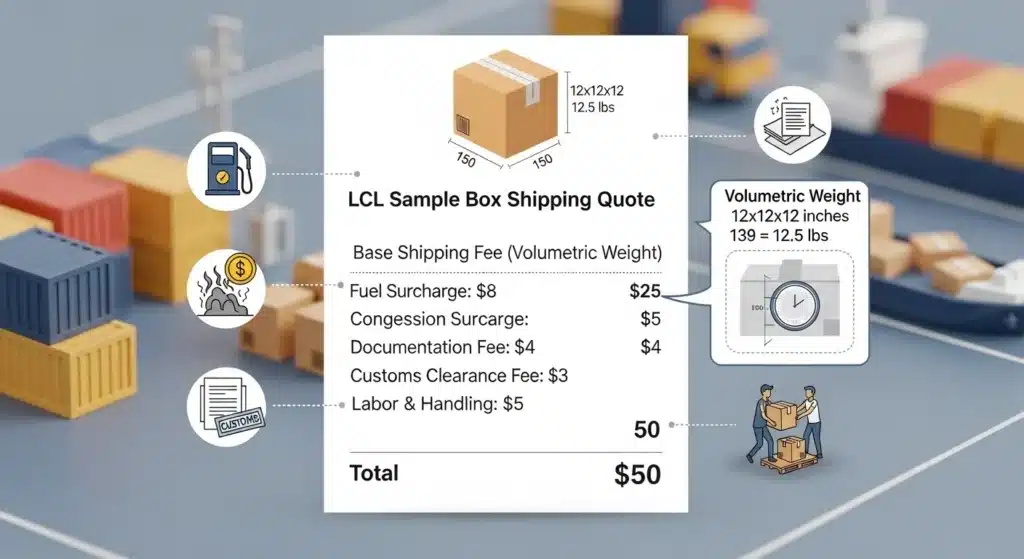
That $50 shipping quote for a small sample box isn’t just a logistics fee—it’s a complex breakdown of dimensional weight calculations, accessorial surcharges, and the labor required to consolidate shipments. For B2B buyers sourcing from markets like Yiwu, understanding these sample fees is critical to managing your upfront costs and making informed purchasing decisions.
This article breaks down the true cost of sample consolidation, explaining why a 1-pound item can incur a $40–$60 charge and how repacking multiple samples into a single shipment can cut costs by over 50%. We’ll cover the mechanics of domestic and international shipping, the reality of “free” samples, and how strategic services like detailed sample reports and cost deduction from bulk orders can turn sampling from an expense into an investment.
The Logistics of Sample Collection (Domestic Shipping)
Domestic shipping costs for samples are determined by package weight, dimensions, distance, and service speed. Carriers bill based on the higher of actual or dimensional weight, with additional fees for fuel, residential delivery, and handling often leading to surprisingly high costs for small packages.

How Domestic Sample Shipping Costs Are Calculated
The final price is calculated using a combination of factors. Carriers start by determining the billable weight, which is either the actual weight of the package or its dimensional weight—calculated as (Length x Width x Height in inches) / 166 for major carriers like UPS and FedEx—whichever value is higher. This ensures carriers are paid for the space a package occupies, not just its mass.
The shipping distance, expressed as a “zone” (e.g., Zone 2 for nearby destinations, Zone 8 for cross-country), then multiplies the base rate. Finally, a series of accessorial fees are added. These can include fuel surcharges, fees for residential delivery or signature confirmation, and insurance. Each of these adds to the base cost, which explains why a simple quote can quickly escalate.
Why a Small Sample Box Can Cost $50
A common point of confusion is why a lightweight sample in a small box incurs such a high fee. For example, a 1-pound item in a 12x12x6 inch box may have a dimensional weight of 5.2 pounds ( (12x12x6)/166 ). The carrier will charge based on this higher 5-pound weight bracket.
On top of that weight-based rate, standard surcharges apply. A residential delivery fee might add $4, a current fuel surcharge could be $5, and requesting signature confirmation may cost another $3. Insurance, if declared, adds more. When these are layered onto a ground shipping base rate of $15-$30, the total easily reaches $40 to $60. The cost reflects the handling, space utilization, and service guarantees, not merely the physical transport of a light object.
Strategies to Reduce Your Sample Shipping Costs
Several practical steps can lower your expenses. First, consolidate multiple samples into a single shipment whenever possible. This reduces the per-unit impact of dimensional weight calculations and eliminates duplicate handling fees. Always default to ground shipping for domestic routes under 1,000 miles unless expedited service is absolutely necessary.
Optimize your packaging by using vacuum-sealing or minimizing excess padding to shrink the box dimensions, which directly lowers the dimensional weight. Investigate if your package qualifies for a carrier’s flat-rate box option, which can be cost-effective if the dimensional weight is high. Finally, shipping from or to a commercial address instead of a residential one avoids a common surcharge, and for regular volume, negotiating rates through a third-party logistics provider (3PL) can secure better discounts.
“Free” Samples vs. Paid Samples in Yiwu
Most suppliers in Yiwu offer the product sample itself for free, but the buyer pays for international shipping, typically $30–50 USD. For custom or high-value items, a refundable sample fee is common, which is often credited against a future bulk order.

The Most Common Model: Free Product, Paid Shipping
Most Yiwu suppliers provide the product sample itself at no cost. The buyer is responsible for the courier fees to ship the sample internationally. Typical shipping costs for small samples range from $30 to $50 USD. This model is standard for common, off-the-shelf products.
When and Why Suppliers Charge a Sample Fee
A refundable sample fee is common for higher-value items or custom/OEM products. The fee can range from the product’s production cost to 2-3 times the bulk unit price. This fee is often credited against the buyer’s first bulk order, effectively making it a deposit. Custom designs may incur additional, non-refundable design or mold fees on top of the sample cost.
Understanding the True Cost: Shipping Markups and Transparency
When a supplier arranges and invoices shipping, they often charge the standard public courier rate. Suppliers typically pay discounted commercial rates, creating a potential markup. For example, a $50 shipment may be billed at $100. Using a service partner like Chineseyiwu.com can provide more transparent cost breakdowns and leverage consolidated shipping to reduce these fees.
Consolidation Fee: Labor for Repacking
This fee covers the manual labor of sorting and repacking multiple smaller shipments into a single, consolidated load. It’s a separate charge from base shipping rates that enables significant overall savings by accessing lower volume discounts and eliminating per-package surcharges.
| Scenario | Individual Shipments Cost | Consolidated Cost (incl. Repacking Fee) |
|---|---|---|
| 4 packages (4 lb total) | $78.00 (4 × $19.50) | $33.60 ($19.50 + 3 × $4.70 repack/handling) |
| Average per eliminated shipment | N/A | ~$5.50 savings (packaging/labor offset) |
| LTL to FTL shift | Higher per-touchpoint costs | 25–35% lower via repacking to full loads |

What the Repacking Labor Fee Covers
This fee is charged by logistics providers for the manual work of handling, sorting, and repacking multiple smaller shipments into one consolidated load.
It specifically includes opening packages, reorganizing contents, palletizing goods, and preparing them for combined transport, often as part of LCL (Less than Container Load) or LTL (Less than Truckload) services.
The process aligns shipments by destination and compatibility to minimize wasted space and carrier surcharges, which is why it’s distinct from base shipping rates.
Cost Breakdown and Real-World Savings
Exact rates vary by provider, weight, and volume, but the fee enables significant overall savings by eliminating multiple per-package charges.
For example, shipping four individual 1-lb packages might cost $78, while consolidating them into one box with a repacking fee could reduce the total to $33.60—a savings of over 50%.
Consolidating shipments to move from LTL to Full Truckload (FTL) can lower costs by 25-35%. The labor fee is the upfront cost that makes these volume discounts possible.
Why This Fee Matters for Sample Shipments
For small sample orders or ‘tiny boxes,’ carriers often apply high per-package surcharges. Repacking into a single shipment avoids these, but the manual labor to do so is billed separately.
This is the ‘hidden’ cost component behind what might seem like a high $50 shipping quote for a small item. The fee is an investment to access lower consolidated rates.
For experienced buyers, the repacking process creates a window for more thorough quality checks. The coordination time allows for detailed video reviews of samples before they are shipped out, reducing the need for additional rushed shipments.

Courier Costs: DHL vs. FedEx vs. EMS discounts
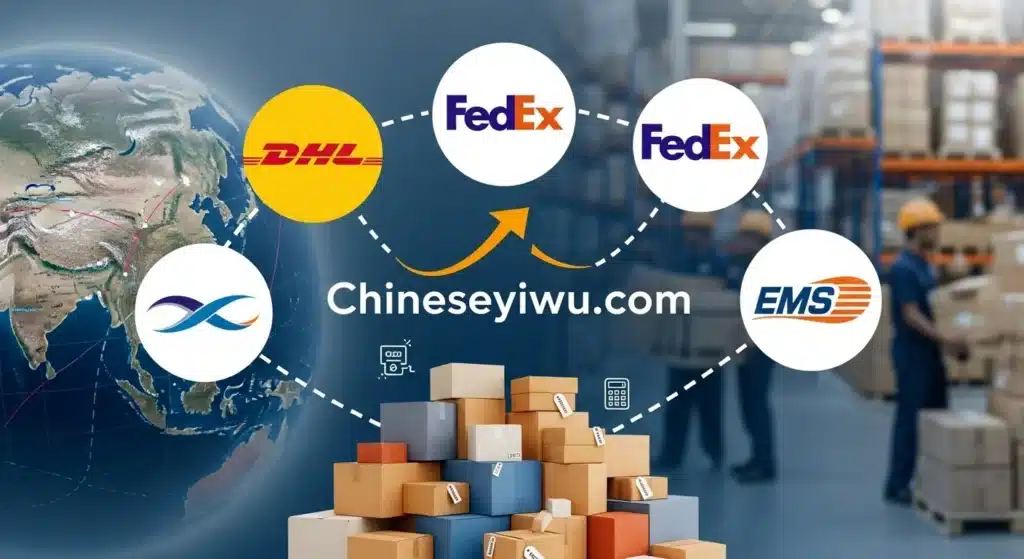
Chineseyiwu.com negotiates discounted rates with major couriers like DHL, FedEx, and EMS due to its high shipping volume, passing these savings directly to clients. The final cost is based on the shipment’s volumetric weight, destination, and service level.
Understanding the Courier Options and Their Roles
Chineseyiwu.com manages all export documentation, customs clearance, and freight for global shipping, offering DDP service directly to the client’s door. This comprehensive service includes product consolidation in its 3,000 sqm warehouse, a critical step before arranging the final courier shipment. Courier costs are part of the final logistics phase, which only proceeds after the client has approved the QC inspection report.
How Discounts Are Applied and Costs Structured
As a high-volume partner shipping to over 100 countries, Chineseyiwu.com negotiates discounted rates with major couriers like DHL, FedEx, and EMS. These negotiated discounts are passed on to clients, making international shipping more cost-effective than arranging it independently. The final courier costs are calculated based on the consolidated shipment’s volumetric weight, destination, and the chosen service level, such as express versus economy.
Choosing the Right Service for Your Shipment
DHL and FedEx are typically used for time-sensitive, high-value shipments that require full tracking and faster delivery. EMS (Express Mail Service) is often a more economical choice for less urgent shipments or deliveries to certain regions, balancing cost and speed effectively. The company’s logistics team advises on the optimal carrier based on the client’s budget, delivery timeline, and the specific requirements of the destination country.
Deducting Sample Costs from Bulk Orders
Deducting sample costs from bulk orders is a standard practice where suppliers credit initial sample fees against a client’s first large purchase. This turns an upfront business expense into a recoverable cost, making the sampling phase less of a financial barrier.

How Sample Cost Deduction Works in Sourcing
Deducting sample costs from bulk orders is a standard practice where suppliers credit initial sample fees against a client’s first large purchase.
This addresses a key buyer concern: high upfront costs for samples, which can include $50+ for shipping and handling of small boxes.
For a sourcing partner like Chineseyiwu.com, this means negotiating with factories to have sample shipping or subscription fees applied as a discount on the final bulk order invoice.
The process turns an initial business expense into a recoverable cost, making the sampling phase less of a financial barrier.
Practical Application and Financial Tracking
In practice, sample costs such as materials, DHL/FedEx shipping, and even fees for detailed video reviews can be bundled and deducted.
Proper categorization is key: these costs should be tracked separately and can often be classified as Cost of Goods Sold (COGS) or marketing expenses for full financial deductibility.
While specific metrics on fee waivers are not publicly listed, the principle is common in supplier negotiations. A $200 to $600 sample shipping cost, for example, could be directly subtracted from a $10,000 order.
Clients should request that any sample cost credit is clearly itemized on the bulk order commercial invoice from the supplier for clear financial records.
The “Sample Report” Service Fee
This is a fee-for-service charge for professional analysis and reporting, distinct from commissions or physical sample handling. It compensates for expertise and time spent on detailed reviews, such as video analysis or sourcing strategy documents, and is billed based on time, a fixed project scope, or the value delivered.

What a Sample Report Fee Covers
This fee is for professional analysis and reporting, not for physical sample handling or shipping.
It compensates for the expertise and time spent on detailed reviews, such as video analysis of product quality or comprehensive sourcing strategy documents.
The model is a fee-for-service, distinct from commissions, and is billed based on time, a fixed project scope, or the value delivered.
Common Fee Structures and Examples
Fees can be structured as hourly rates (e.g., a financial planner charging per hour for a full plan), fixed project fees, or annual retainers.
Examples from other industries show a wide range, from a $500 upfront fee for a detailed plan to fixed annual fees of $125,000 for ongoing brokerage services.
These agreements specify scope and payment terms upfront to ensure transparency and prevent disputes, with fixed fees offering budgeting certainty for clients.
Value for Sourcing Clients
For new importers, this fee explains costs that go beyond simple logistics, covering the expert analysis needed to avoid costly mistakes.
Experienced buyers may opt for a detailed report to gain actionable insights on suppliers and products without the need to ship physical samples first.
The service acts as a risk mitigation tool, providing a professional assessment that supports informed decision-making before committing to a bulk order.
Preguntas frecuentes
How much is shipping samples from China?
Shipping small sample packages from China typically costs $8–$10+ per kilogram, with a base fee of around $50 per shipment for express couriers like DHL. For very small packages under 150 kg, express freight at about $5 per kilogram is often the cheapest option. The high cost is due to fixed base fees and handling overhead. A key cost-saving strategy is consolidation—collecting multiple samples into one shipment to avoid duplicate base fees.
Do factories give free samples?
Factories do not typically give completely free samples. Most charge for the product itself or require payment for shipping. Some established factories may offer the sample product at no cost to serious, qualified buyers but still require the client to cover the shipping fees, which can be around $50 for a small box. They often require proof of serious intent, such as a business plan, before agreeing.
What is sample consolidation?
In the context of sourcing from Yiwu, sample consolidation refers to the service of collecting physical product samples from multiple different suppliers into a single shipment before sending them to the buyer. This is a critical service offered by agents like Chineseyiwu.com. It saves significant money by eliminating the duplicate $50+ base shipping fees charged by couriers for multiple separate sample shipments. It also simplifies logistics and quality comparison for the buyer.
Can an agent pay for samples for me?
No, sourcing agents typically do not pay for samples on behalf of their clients. The client is responsible for covering all sample-related costs, including the product cost, shipping fees, and any handling charges. Agents facilitate the process and can consolidate payments, but they do not absorb these costs to avoid financial risk. Some suppliers may offer promotions with free shipping under specific conditions, but clients should always verify the total out-of-pocket expenses.
What is the cost of sample inspection?
There is no universal fixed price for inspecting a sample batch. Costs depend on batch size, inspection type, and product complexity. As a benchmark in manufacturing, a cost of $5–$10 per unit inspected is considered acceptable, while under $5 per unit is optimal. For very small batches, a full 100% inspection is often more cost-effective than statistical sampling, as it eliminates the risk of missing defects that could lead to expensive returns, despite the higher upfront cost.
Reflexiones finales
The cost of getting samples is more than just a shipping label. It’s a combination of logistics, labor, and expertise. From the dimensional weight calculations that make a small box expensive to the manual work of repacking multiple items, each fee reflects a specific service that enables the entire process. Understanding these components—like consolidation fees or sample report charges—helps you see where your money goes and why a simple “shipping” quote can be surprisingly high.
This breakdown matters because it changes how you approach sourcing. Instead of viewing sample costs as a frustrating expense, you can see them as an investment in due diligence. Consolidating shipments, negotiating sample cost deductions on future orders, and using expert analysis services are all strategies that turn upfront costs into long-term savings and better supplier relationships. Knowing what you’re paying for allows you to make smarter decisions, control your budget, and build a more efficient supply chain from the very first sample.