Justin
A supplier sends a map pin, but your EU-side contact needs wood-origin evidence. Converting the pin may only give the wrong location a cleaner file. Do not decide that a Chinese supplier’s coordinates are unusable because its receiver uses BeiDou, or ready because a converter produces GeoJSON. Ask what location the file describes, which coordinate reference system the source actually uses, and how those plots connect to the wood in your order. A format conversion can fix a known representation; it cannot supply an unknown harvest origin.
For official system context, the European Commission’s Information System page links its training and user guidance. Interface training helps with the system; it cannot identify an unknown source plot for your supplier.
Start with the source file, not a claim about Chinese GPS
A public procurement question asks how Chinese wood location data can be managed when map coordinates appear to differ. Its assumption that BeiDou is itself a GeoJSON coordinate system is not evidence. Do not infer a file’s reference system from the country, satellite receiver or map app name. Preserve the original file and ask the data owner to identify its reference system, capture/export method and what each feature represents. The Commission’s technical file specification uses WGS84 (EPSG:4326), decimal degrees and longitude before latitude for supported GeoJSON. That is a target representation, not an assurance of source accuracy.
Read the handoff decision in order
Open the decision flow at full size. On a narrow screen, scroll the diagram horizontally.
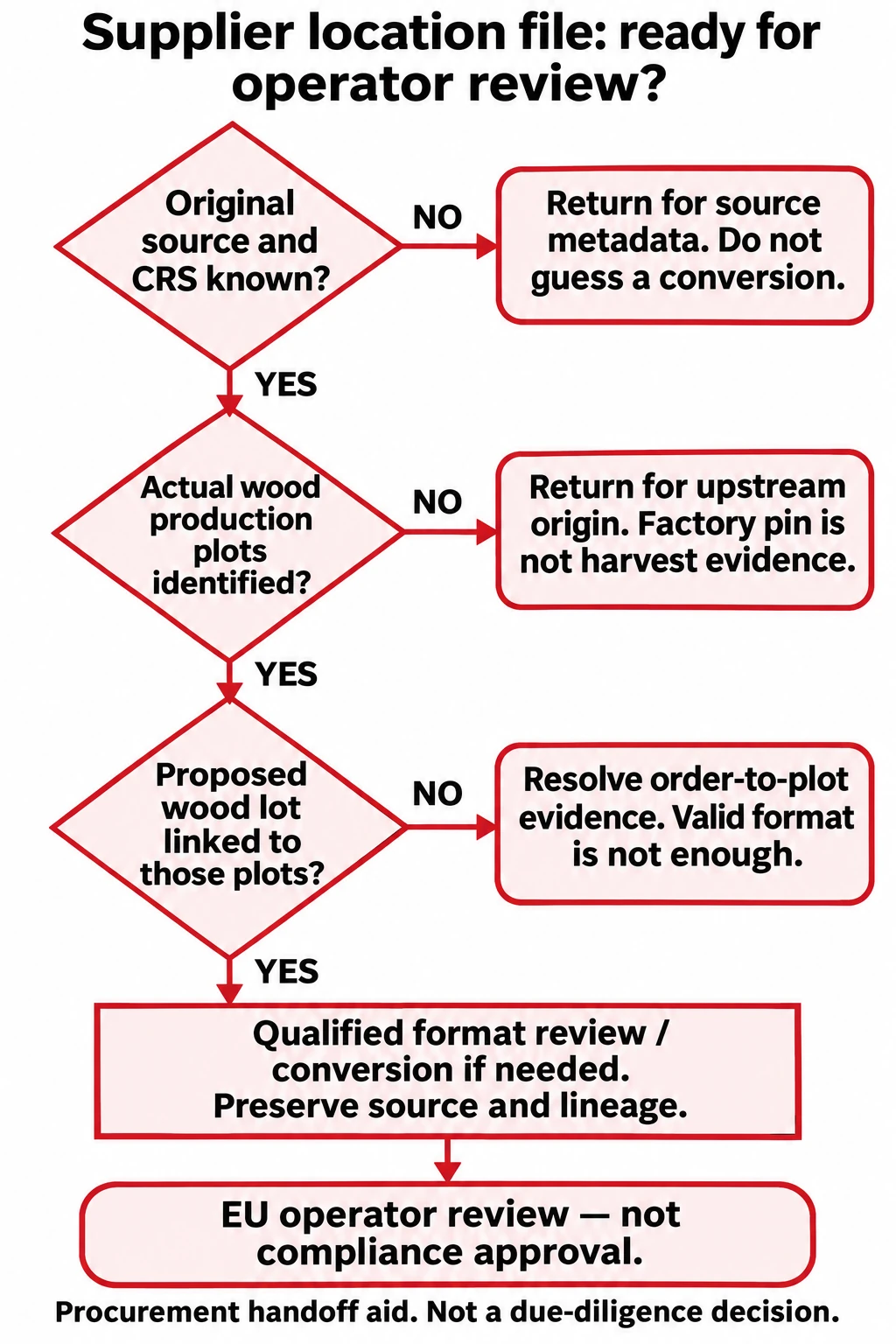
- Original source and CRS known? If no, return for source metadata. Do not guess a conversion.
- Actual wood production plots identified? If no, return for upstream origin. Factory pin is not harvest evidence.
- Proposed wood lot linked to those plots? If no, resolve order-to-plot evidence. Valid format is not enough.
- Qualified format review / conversion if needed. Preserve source and lineage. The next destination is EU operator review — not compliance approval.
Send a source request that can be answered
Open this illustration at full size. Scroll horizontally on narrow screens.
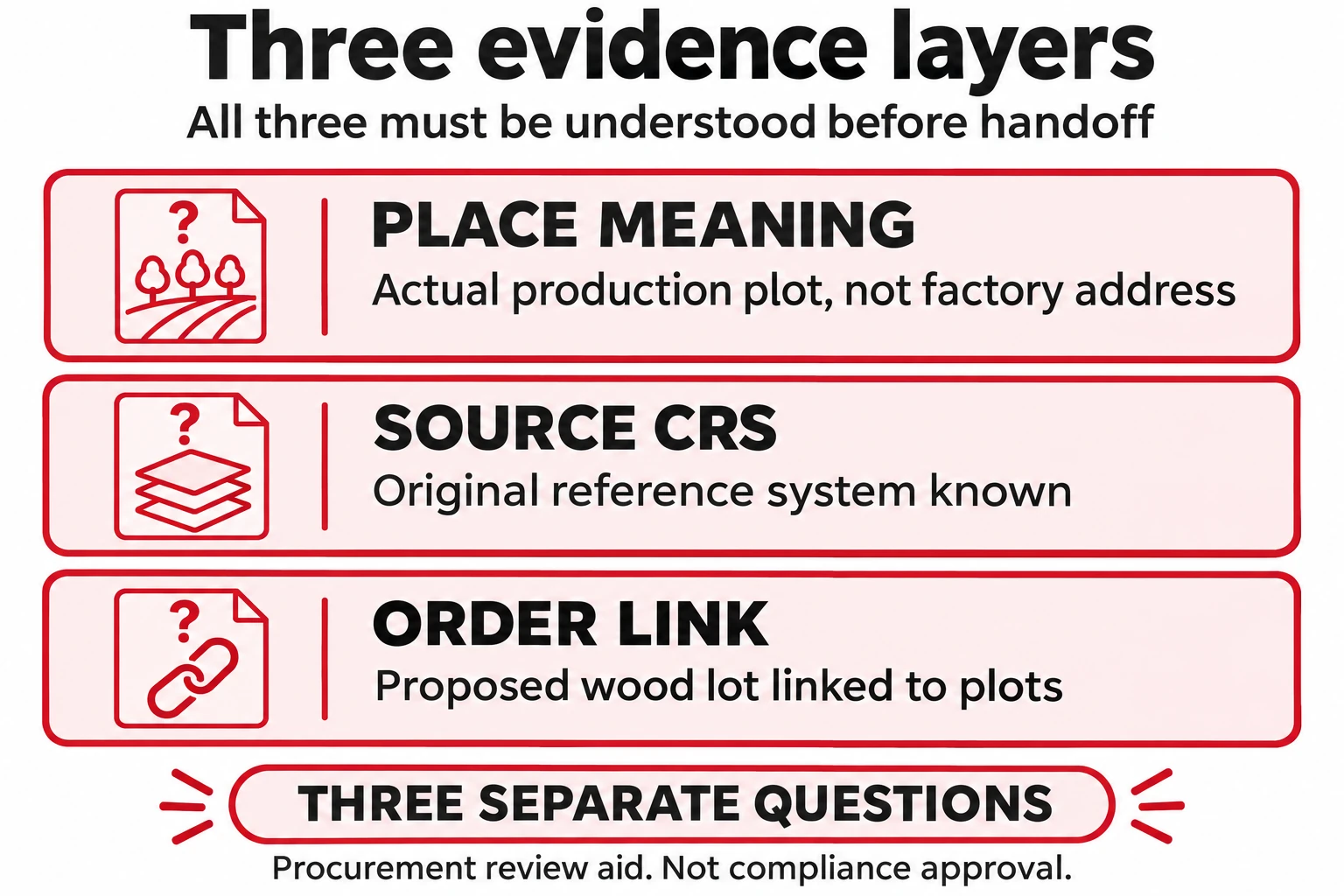
A request for EUDR coordinates can arrive at a factory sales desk with no indication of which purchase, wood input or upstream party it concerns. Asking for a different file extension may produce a neat export of the same unhelpful location. Give the supplier the proposed product and order reference first. Identify the particular wood input whose origin the EU-side party needs to assess, then ask the supplier to name the party that actually holds the location evidence. That might be upstream of the company selling the finished goods.
Ask for three separate explanations. First, what does each point or boundary represent? Second, how were the positions captured and exported, and what CRS was used? Third, which records connect the proposed goods to those production places? These questions should remain separate in the reply. A long narrative about the factory’s address does not answer the first question. A sentence saying the data is accurate does not identify the second. A list of plots without a connection to the relevant input leaves the third unresolved.
Preserve what the supplier sends, including the accompanying explanation and version date. A data specialist working only from a retyped spreadsheet cannot see whether a column was lost during copying or whether the supplier originally described a feature as a warehouse. Record any uncertainty beside the source rather than silently resolving it in the buyer’s own version. If the answer changes, retain the earlier explanation so the reviewer can understand why a previous assumption was withdrawn.
This is also the point to ask whether the data owner has constraints on collection, access or sharing. Do not assume that a public-facing map grants permission to redistribute its data, or that every China-origin geospatial file can be moved through a chosen online service. Where a genuine legal or access issue arises, have the responsible parties obtain appropriate advice. A procurement guide cannot determine those permissions from a screenshot.
| Supplier reply | Question still open | Useful next recipient |
|---|---|---|
| This is our factory’s position. | Where was the relevant wood produced? | Supplier’s upstream source contact |
| Here is the plot export; CRS unknown. | What capture/export record establishes its reference system? | Original data owner or qualified specialist |
| These are our normal sourcing plots. | Which of them supplied the proposed input lot? | Supplier’s material/traceability contact |
| This converted file opens successfully. | Does it preserve the right place and goods linkage? | Technical reviewer and EU-side responsible party |
The table is a buyer coordination aid, not a mandatory Commission form. Its purpose is to send an unresolved question to the party that can answer it. Repeatedly sending the whole bundle back to a sales representative without identifying the missing fact can turn a simple clarification into an apparently impossible compliance request.
Three completed handoff decisions
These are hypothetical evidence states, not real suppliers, surveyed plots, test results or compliance approvals. No conversion algorithm, invented coordinates or legal permission to export geospatial data is assumed.
Unknown map screenshot: return it for source clarification
The supplier sends a screenshot with a map pin and calls it the wood source. The order file identifies a factory but provides no plot identifiers, source CRS or capture/export record. A buyer proposes copying the displayed digits into a converter.
Decision: do not hand over the screenshot as a verified harvest-location file or commission an arbitrary conversion. Request the original geospatial data and source metadata; ask whether the pin marks the factory, a timber yard or an actual production plot. The supplier/data owner must resolve meaning and provenance. If it can only identify the factory, the next task is upstream origin collection, not file repair. Keep this order’s location handoff unresolved; do not label the supplier fraudulent merely because its initial answer is incomplete.
Known CRS and identified plots: prepare a traceable technical handoff
In a second hypothetical, the data owner supplies the original plot file, identifies its CRS and capture method, and links the production plots to the wood lots proposed for this order. A suitably qualified data specialist can now assess conversion to the Commission’s required WGS84 representation. The source data and applicable constraints still need review; the buyer should not assume any online converter is authorised or adequate.
Completed handoff: retain source and converted versions separately, record who transformed the file and which operation was used, preserve plot identifiers, and compare geometry and placement against the original evidence. Check the output’s longitude/latitude order and supported geometry against the current official specification. Hand both the source lineage and the order-to-plot references to the responsible EU operator for substantive assessment. This is readiness for review, not release to place goods on the EU market. The operator still assesses applicable scope, timing, legal production, deforestation and the required declaration process.
Valid GeoJSON of the wrong place: reject the evidence, not the syntax

The third supplier sends a syntactically valid WGS84 file, but its feature is the factory yard. The paperwork says only Made in China; it does not establish where the wood was harvested or connect the order to production plots.
Decision: reject that file as evidence of the harvest origin. A successful import into a tool does not change the location it describes. Ask the supplier to trace the relevant wood upstream and provide the actual production-place evidence, including origin outside China where relevant. If the required evidence cannot be obtained for an applicable order, the EU operator must decide the sourcing/market-placement consequences; a sourcing coordinator cannot issue a compliance release or replace missing plots with a company address.
Prepare a review package that preserves the distinction

Once the source meaning is understood, prepare the package so another person can reconstruct your decision without relying on your memory. Start with a short cover note naming the proposed product, order or consignment reference and the wood input concerned. State the current decision: source clarification required, technical transformation review possible, or wrong-origin evidence returned. Do not replace that specific state with an overall green approval flag.
Keep the source file unchanged in one part of the package. Place any transformed output in another part, with the source CRS, target representation and specialist’s transformation record. Preserve the feature identifiers or document how they correspond between versions. A reviewer should be able to tell whether a boundary has changed, whether only its representation changed, or whether an entirely different feature was substituted. If that connection is missing, a new filename and a clean preview do not explain what happened.
Keep the order linkage beside the spatial evidence. For example, a supplier’s record can identify the wood lot proposed for the product and the upstream production places attributed to that lot. The precise records depend on the actual supply chain; this article does not invent a universal traceability certificate. The important question is whether the responsible reviewer can follow the connection from the proposed goods to the locations actually supplied, and identify any unresolved link.
The handoff should also make limitations easy to find. List any unknown source metadata, disputed feature meaning, incomplete upstream response or change in proposed material. Name the party expected to resolve each one. If a supplier changes the wood input after the file was prepared, ask whether the existing location package still describes that input. Reusing a technically correct file for a different lot is an evidence question, even when no software reports an error.
For the EU-side party, receipt of this package is the beginning of its substantive review, not the end. Product classification, the entity’s role, the applicable date, legal production, deforestation-related assessment and the required declaration route remain outside a file-format handoff. Ask the responsible party to state what it has accepted for review and what remains open. Avoid language that turns its acknowledgement of receipt into a compliance release.
A sourcing coordinator can help organise a supplier’s response, keep document versions together and make the missing question visible. That is useful precisely because it leaves technical and regulated decisions with the people responsible for them. It does not require the coordinator to pretend to be a surveyor, geospatial analyst, EU operator or filing agent. Chineseyiwu’s sourcing service is a place to discuss practical supplier coordination, subject to confirmation of the actual task and charges.
| Record | Evidence held | Handoff result | Responsible next action |
|---|---|---|---|
| Unknown screenshot | Factory/order named; pin meaning and original CRS unconfirmed | Source clarification required; no guessed conversion | Data owner identifies what the pin represents and supplies source/export metadata |
| Known plot file | Original CRS and plot identity recorded; proposed wood lot linked | Technical review or conversion can be considered; no compliance release | Qualified specialist preserves source lineage; EU responsible party assesses substantive evidence |
| Factory-yard GeoJSON | Valid target format, but no actual harvest origin or lot-to-plot evidence | Wrong-origin evidence returned; software acceptance does not cure the gap | Supplier traces the relevant wood upstream and resolves the missing production-place connection |
Change one fact and rerun the result
Open this illustration at full size. Scroll horizontally on narrow screens.
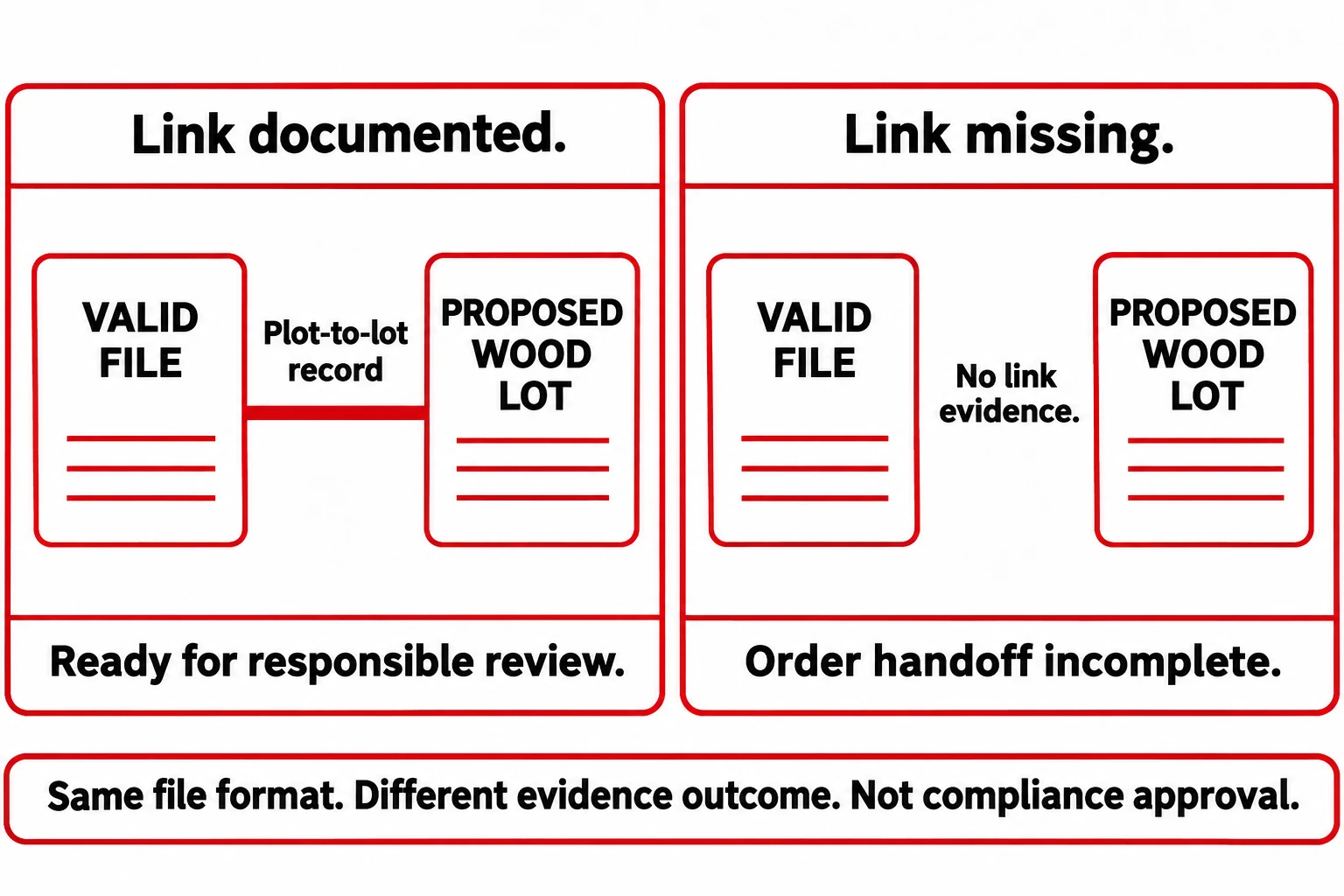
Keep the second case’s file format, CRS and coordinates unchanged, but remove the evidence linking the proposed wood lot to those plots. The technical format result remains the same; the order-level handoff becomes incomplete. That is the reason to maintain separate checks for representation, place identity and goods linkage. Conversely, correcting the coordinate order in a file can resolve a format defect while leaving the origin assessment exactly where it was.
Apply the correct timetable before treating a gap as a legal stop
The Commission’s current implementation material distinguishes 30 December 2026 application for large and medium operators and micro/small operators already covered by the EU Timber Regulation, from 30 June 2027 for other micro/small operators. Newly added product categories have separate scope/timing considerations. Confirm the specific CN product, role and date with the EU-side responsible party; do not apply a blanket deadline or treat every purchase today as prohibited. This article’s handoff checks are proposed procurement controls, not a complete EUDR due-diligence procedure or China geospatial-law advice.
Use the Commission’s current GeoJSON file specification y official EUDR implementation sources. A certificate, map pin or clean file does not alone determine compliance.
Discuss supplier document coordination with your product, proposed order, destination and the missing source-file or supplier-link information. Confirm scope and fees separately. No Chineseyiwu surveying, coordinate-conversion, EUDR filing, legal advice or compliance approval service is asserted.
Conclusión
Before handing over the package, check three questions: what the source describes, how its coordinates are represented, and why those production places belong with the proposed wood lot. Resolve an unknown source before requesting a conversion. Return a factory-yard point when the task requires harvest-origin evidence. When known-source plot data and order linkage are available, preserve them through qualified technical review and send the evidence to the EU-side responsible party with its limitations visible.
Frequently asked questions
Does a BeiDou receiver make Chinese coordinates incompatible?
The receiver or country does not establish the CRS of an exported file. Obtain the actual capture/export metadata and compare it with the Commission’s required representation.
Can we swap latitude and longitude until a point looks right?
Do not guess. The target GeoJSON order is longitude then latitude, but the source meaning and reference system must be established before a correction is justified.
Can a successful file upload replace missing order linkage?
No. Technical acceptance does not show that the proposed wood came from the plotted locations. Resolve the goods-to-plot connection separately.
Does this guide approve an EUDR declaration?
No. It supports a buyer’s source-file handoff decision. The responsible EU-side party must determine its applicable duties and assess the substantive evidence.