Justin
Search for the maximum loading weight of a 20ft container and you will be told it is 21,770 kg. You will also be told it is 28,000 kg, and 47,928 lb, and 55,100 lb. Those four figures come from four pages that all rank for the query, and the highest is nearly three times the lowest. They cannot all be right.
They are not contradicting each other by accident. They are answering different questions and labelling all of them “maximum weight” — some quote a gross rating, some quote a payload, some quote a figure from a container-sales catalogue that has no bearing on what a haulier will accept at the other end. A container loading plan built on the wrong one of those numbers passes every check you make in China and fails at the destination port, where the box is already on a chassis and the correction costs a re-stuff.
This article does something the load-planning tools on page one structurally cannot do. They optimise cargo into the cube. The constraint that actually decides whether your plan is legal sits outside the cube — on the road, at the destination, in a statute — and it is almost always the lower ceiling.
Key Takeaways
- The ISO 668:2020 gross rating is identical for 20ft and 40ft containers — 30 480 kg (67 200 lb) for 1AA, 1AAA, 1CC and 1C alike. What differs between a 20ft and a 40ft is tare, which is why payload differs.
- Four separate ceilings govern one loaded box: the ISO rating, the CSC plate on the unit you were actually allocated, the destination road limit, and the gross mass you declare under SOLAS. The lowest one binds.
- The road limit usually binds first. US Interstates cap the whole tractor-chassis-container combination at 80,000 lb under 23 U.S.C. 127 — the tractor and chassis come out of that before your cargo does.
- No honest source can publish your payload figure. Payload is the maximum operating gross mass on that unit’s CSC plate minus that unit’s actual tare. Any universal payload number in a blog table is a guess dressed as a specification.
- Pallets, dunnage and lashing count as cargo in the declared gross mass. Planning to the weight of the goods alone under-declares the box.
On this page
- Why your loading plan has four weight ceilings, not one
- What ISO 668 actually specifies for 20ft and 40ft
- Read the CSC plate before you plan a single carton
- The road limit that decides whether your box can leave the port
- Worked example: back-calculating from the road limit
- Declaring VGM: who signs, which method, what counts
- Building the loading plan in the right order
Why Your Container Loading Plan Has Four Weight Ceilings, Not One
A loaded container has to pass through four separate authorities, and each one applies its own limit. Most planning failures come from treating the highest of the four as “the” maximum.
| Ceiling | Set by | What it governs | Where it bites |
|---|---|---|---|
| Design rating | ISO 668:2020, Table 2 | Maximum gross mass R of the container type — 30 480 kg (67 200 lb) | Rarely. It is the highest of the four. |
| Unit certification | The CSC safety approval plate on that box | Maximum operating gross mass for that individual unit | When you are allocated an older or non-standard unit. |
| Road law | 23 U.S.C. 127 (US), Directive 96/53/EC (EU) | Gross weight of tractor + chassis + container + cargo | Almost always. This is the ceiling that ruins plans. |
| Declaration | SOLAS chapter VI regulation 2 (VGM) | The verified figure you are legally responsible for stating | At the terminal gate, before vessel loading. |
Read the fourth row carefully, because it is different in kind from the other three. The ISO rating, the plate and the road limit are ceilings you must stay under. VGM is not a ceiling at all — it is a declaration you are legally on the hook for. You can be perfectly within every weight limit and still have the box refused because nobody filed the number.
The practical consequence is an ordering rule. Plan against the lowest ceiling first, then work upward, and treat the ISO rating as what it is: a design specification for the container type, not a target to load toward.
It is worth being precise about why the four disagree, because the disagreement is structural rather than sloppy. Each ceiling was written by a different body solving a different problem. ISO was specifying a container that could be stacked, lifted and handled interchangeably worldwide. The CSC plate exists to certify that one physical box has been tested and remains fit for service. Road limits protect pavement and bridges in a specific jurisdiction. SOLAS was responding to ships being loaded on weights nobody had checked. None of the four was drafted with the other three in view, so nothing reconciles them for you — and the reconciliation is your job as the party planning the load.
Which of them bites depends on what you are shipping. Light, bulky goods — plastics, textiles, packaging — fill the cube long before any weight limit matters, and for those cargoes this entire article is a formality. Dense goods behave in the opposite way: hardware, hand tools, ceramics, tiles, glassware, liquids, batteries and anything with a steel or stone component reach a weight ceiling with the container visibly part-empty. If your order is a mixed consolidation, you get both problems in one box, and the weight ceiling is the one that arrives without warning.
What ISO 668 Actually Specifies for 20ft and 40ft Containers
ISO 668:2020 is the standard that classifies Series 1 freight containers by dimension and rating. Its Table 2 sets the rating R — the maximum gross mass — for each designation. Here is the part that resolves the contradiction in the search results.
| Designation | Nominal length | External height | Rating R (gross mass) |
|---|---|---|---|
| 1AAA | 12 192 mm (40 ft) | 2 896 mm (9 ft 6 in) | 30 480 kg / 67 200 lb |
| 1AA | 12 192 mm (40 ft) | 2 591 mm (8 ft 6 in) | 30 480 kg / 67 200 lb |
| 1CC | 6 058 mm (20 ft) | 2 591 mm (8 ft 6 in) | 30 480 kg / 67 200 lb |
| 1C | 6 058 mm (20 ft) | 2 438 mm (8 ft) | 30 480 kg / 67 200 lb |
The rating is the same number down the column. A 20ft box and a 40ft box are certified to carry the same maximum gross mass, and every Series 1 container is 2 438 mm (8 ft) wide regardless of length.
This is the single fact that explains the mess on page one. Because the gross ratings are identical, the only thing that separates a 20ft payload from a 40ft payload is the empty weight of the steel — and a 40ft box is heavier empty than a 20ft box. That is why a 20ft container has the higher payload of the two, which sounds wrong until you see where the number comes from. Writers who half-remember this produce exactly the range of contradictory figures the search results are full of.

There is one legitimate exception, and it is written into the standard. Clause 5.2.2 permits higher ratings for particular traffic: such containers are still considered ISO containers “provided that their maximum gross mass, R, does not exceed 36 000 kg and that they are tested and marked to their actual rating.” So a box rated above 30 480 kg can exist legitimately — but it has to be marked to its real rating, which sends you back to the plate.
The same clause carries a warning worth quoting, because it is the reason no table can be trusted over a physical inspection. ISO 668:2020 notes that containers exist “which have length and width dimensions similar to those of ISO series 1 containers but have ratings and/or heights in excess of those defined by this document.” A box can look exactly like a standard 40ft unit and be rated differently.
Read the CSC Plate Before You Plan a Single Carton
Every container in international service carries a CSC safety approval plate, issued under the International Convention for Safe Containers. It carries the maximum operating gross mass for that individual unit — not for the type, not for the class, for that box.
The plate exists precisely because published figures were being misused. The IMO adopted amendments to CSC Annex I in 1991 specifically “to prevent containers being marked with misleading maximum gross weight information,” to require removal of the plate when it is void, and to provide for the approval of modified containers. A convention amended to stop misleading weight markings is telling you something about how much weight to put on any unverified figure.
From the plate you derive the only payload figure that means anything for your shipment:
Payload = maximum operating gross mass (CSC plate) − tare mass of that unit
Tare mass has a precise definition under the IMO’s VGM guidelines: “the mass of an empty container that does not contain any packages, cargo items, pallets, dunnage, or any other packing material or securing material.” It is stamped on the container door alongside the plate, and it varies between units of the same nominal size — different builders, different build years, different floor and wall construction, repairs and reinforcement all move it.
This is why you will not find a payload number in this article. Publishing a universal tare would make the arithmetic look tidy and would make it wrong for whichever box you were actually allocated. What follows instead is what to ask for.
- Before booking: ask the forwarder what maximum operating gross mass the units on that service typically plate at, and whether any are rated above 30 480 kg.
- At allocation: ask for the container number, the plated maximum operating gross mass and the stamped tare, in writing, before the box is stuffed.
- At loading: have the plate and the door markings photographed. It costs nothing and it is the evidence behind your declared figure.
- If the plate is missing, illegible or void: the unit should not be loaded. A plate is removed when it is no longer valid, and an absent plate is a fact about the box, not a paperwork inconvenience.
The Road Limit That Decides Whether Your Box Can Leave the Port
Here is the constraint the load-planning calculators do not model, and the reason a plan can be perfect and still fail. Your container does not travel alone. It travels on a chassis, behind a tractor, over public roads that are governed by weight law — and that law caps the combination, not the container.
In the United States, federal law limits gross vehicle weight on the Interstate System to 80,000 pounds under 23 U.S.C. 127. Single axles are limited to 20,000 pounds, and tandem axles — axles spaced more than 40 inches and not more than 96 inches apart — are limited to 34,000 pounds. Those axle limits matter independently: a combination can be under 80,000 lb in total and still be illegal because the weight sits wrong across the axles.
On top of the flat limits sits the Federal Bridge Formula, which caps the weight on any group of two or more consecutive axles according to their spacing:
W = 500 ( (LN / (N−1)) + 12N + 36 )
where L is the distance in feet between the outer axles of the group and N is the number of axles in that group.
The formula has one exception that every container haulier relies on: two consecutive sets of tandem axles may carry 34,000 pounds each provided the overall distance between the first and last axles of those tandems is 36 feet or more. Without that exception, the formula would allow only 66,000 to 67,500 pounds on tandems spaced 36 to 38 feet apart. It is worth noting that the FHWA’s own guidance states it “paraphrases provisions of 23 U.S.C. 127 and 23 C.F.R. 658 for purposes of illustration only,” and that in a dispute the statute and regulation take precedence — so treat these as the planning baseline and let your haulier confirm the route.

The European regime is structured differently and lands in a similar place. Directive 96/53/EC sets the maximum authorised gross weight for road trains and articulated vehicles at 40 tonnes, raised to 44 tonnes for a three-axle motor vehicle with a two- or three-axle semi-trailer carrying a 40ft or 45ft ISO container in an intermodal transport operation. The driving axle is limited to 11.5 tonnes.
| Regime | Combination limit | Axle constraints | Source |
|---|---|---|---|
| US Interstate | 80,000 lb (approx. 36.3 t) | 20,000 lb single; 34,000 lb tandem; Bridge Formula on every axle group | 23 U.S.C. 127 |
| EU intermodal (40ft/45ft container) | 44 t | 11.5 t driving axle | Directive 96/53/EC, Annex I |
| EU standard road train | 40 t | 11.5 t driving axle | Directive 96/53/EC, Annex I |
Two warnings on using this table. Member states apply national derogations and route-specific restrictions on top of the directive, and outside these two regimes the numbers are simply different — this article does not guess at limits it has not verified. For any other destination, get the figure from the haulier who will actually pull the box, and get it before you finalise the cargo weight rather than after.
Worked Example: Back-Calculating Cargo Weight From the Destination Road Limit
Most loading plans are built forwards: fill the container, weigh the result, hope it clears. Build it backwards instead. Start at the lowest ceiling and subtract your way down to a cargo allowance, and the plan cannot fail at the destination because the destination was the starting point.
The worked figures below use a US Interstate delivery. The statutory constants are grounded; the equipment weights are illustrative placeholders — your haulier’s actual tractor and chassis weights and your allocated unit’s stamped tare go in their place, and they will differ.
| Step | Artículo | Peso | Where it comes from |
|---|---|---|---|
| 1 | Legal gross combination limit | 80,000 lb | Grounded — 23 U.S.C. 127 |
| 2 | − Tractor | 17,000 lb | Illustrative — ask your haulier |
| 3 | − Chassis | 7,000 lb | Illustrative — ask your haulier |
| 4 | − Container tare | 8,400 lb | Illustrative — read the door stamp |
| 5 | = Cargo allowance on the road | 47,600 lb (21 591 kg) | The number your plan must respect |
| 6 | Compare: ISO gross rating less the same tare | 58,800 lb (26 671 kg) | 30 480 kg rating − illustrative tare |
Look at the gap between rows 5 and 6. On these inputs the container is certified to carry roughly 11,200 lb more than the road will legally accept — around five tonnes of cargo that exists on the specification sheet and nowhere else. Load to the container’s capability and you have built a box that cannot complete its journey.
Then subtract once more, because the declared gross mass includes more than your goods. Under the IMO definitions, a packed container includes pallets, dunnage and other packing and securing material, and securing material covers “all dunnage, lashing and other equipment used to block, brace, and secure packed cargo items.” Every pallet and every length of lashing comes out of row 5 before your cartons do.

This calculation also settles the 20ft-versus-40ft question for dense cargo, and it settles it against intuition. If your goods hit the weight ceiling before they fill the cube, the extra volume of a 40ft box buys you nothing — you will ship it part-empty and pay for air. The 20ft unit has less tare working against the same gross ceiling, so more of the allowance is available to cargo.
The decision that follows is a real one with money attached: one dense 20ft, one part-filled 40ft, or a split across two boxes that balances a heavy line against a light one. If your order is a mixed consolidation from several Yiwu suppliers, that decision is easier to make before the cargo is collected than after, because the alternative is discovering the problem when a stuffed container is already over. The trade-offs between full-container and shared-container options are set out in our guide to LCL consolidation versus FCL and air freight, and the Yiwu consolidation and shipping service covers the case where cargo from multiple suppliers has to be balanced into one booking.
For importers consolidating cartons from several Yiwu suppliers into a single FCL or LCL booking — not for single-supplier orders where the factory already loads and seals the box. Cartons stage in our 3,000 sqm Yiwu warehouse with 30 days of free storage, which is the window you actually have to re-plan a load that fails its weight check, and we strip bulky supplier packaging to cut CBM before the box is stuffed.
Declaring VGM: Who Signs, Which Method, and What Counts as Cargo
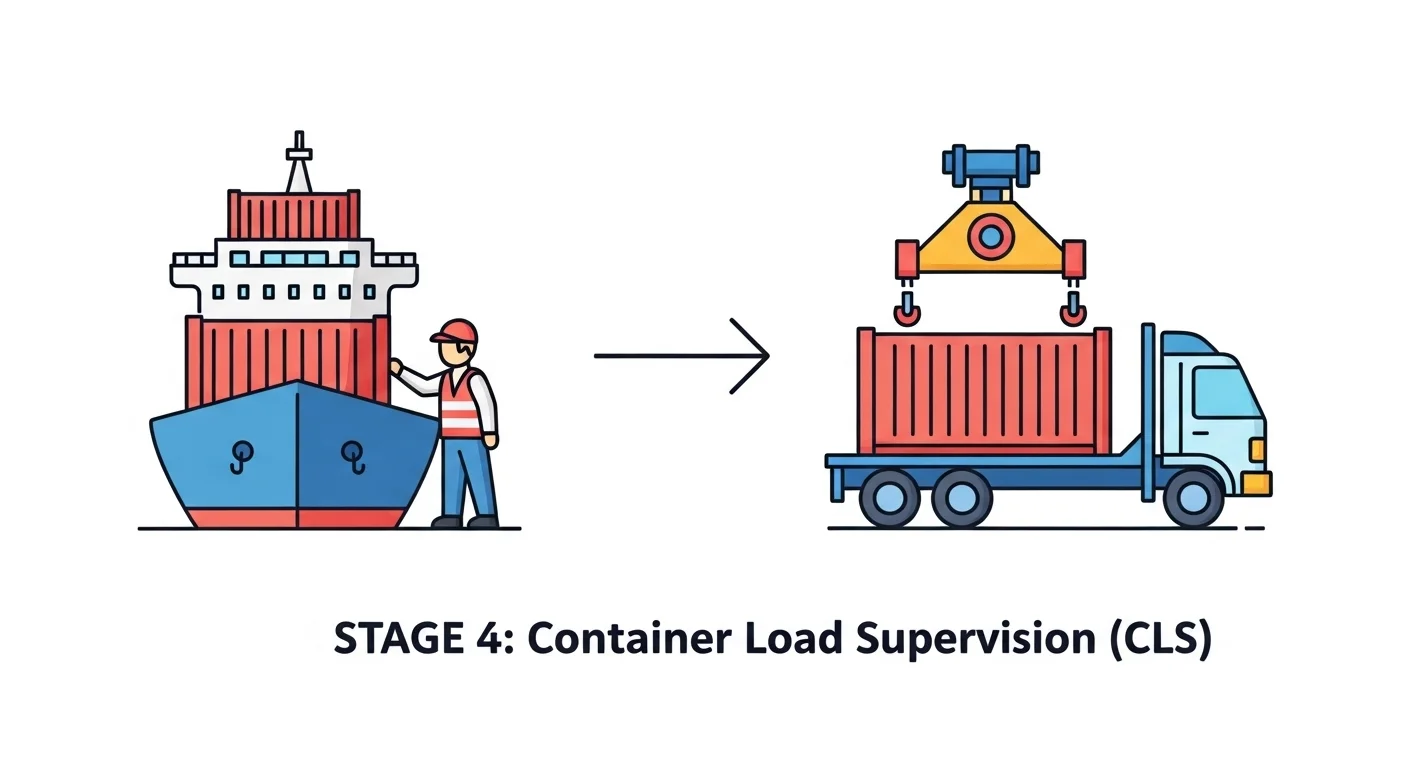
The weight you calculate has to be declared, and the declaration has a named legal owner. Since 1 July 2016, SOLAS chapter VI regulation 2 has required the gross mass of a packed container to be verified before stowage aboard ship.
The IMO guidelines are blunt about who carries it: “The responsibility for obtaining and documenting the verified gross mass of a packed container lies with the shipper.” And on the consequence: a packed container “should not be loaded onto a ship to which the SOLAS regulations apply unless the master or his representative and the terminal representative have obtained, in advance of vessel loading, the verified actual gross mass of the container.”
Note who the shipper is. Under the guidelines it is the legal entity named on the bill of lading — which on an FOB purchase is frequently the buyer’s own nominated party rather than the Chinese factory that packed the box. If you buy FOB and your name is on that document, the obligation is yours even though you were nowhere near the loading.
▶ Play
Neutral explainer of the SOLAS VGM requirement (Scarbrough Global). We have no commercial relationship with the publisher.
SOLAS prescribes two methods, and the choice between them is a practical one for consolidated cargo.
| Method No.1 | Method No.2 | |
|---|---|---|
| What you do | Weigh the packed, sealed container as one unit | Weigh all packages, cargo items, pallets, dunnage and securing material, then add the container tare |
| Certification | Calibrated and certified weighing equipment | The method itself must be certified and approved by the competent authority of the state where packing and sealing was completed |
| Suits | Any cargo; the only option for bulk | Cartonised, palletised and consolidated cargo with known package weights |
| Not suitable for | — | Scrap metal, unbagged grain and other bulk cargo, where the IMO states Method No.2 is “inappropriate and impractical” |
One provision inside Method No.2 is worth knowing if you buy consolidated cargo from many suppliers. Individual original sealed packages that carry their accurate mass “clearly and permanently marked on their surfaces” do not need to be weighed again when they are packed into the container. Accurate, permanent carton weight markings are therefore not decoration — they are usable evidence, and they turn a re-weighing exercise into an addition.
Two cautions. The marked weight has to be accurate, so a supplier who prints a nominal figure on every carton regardless of contents has handed you a liability rather than a shortcut, and verifying that on inbound cartons is exactly the kind of check that belongs in a pre-shipment inspection. And the Method No.2 calculation route requires certification by the competent authority where the packing happened — which for a Yiwu consolidation means China, not your own country.
Building the Loading Plan: A Sequence That Survives Both Ceilings
The order of operations is the whole method. Every step below is ordered by which constraint binds hardest, not by which is most convenient to check, so that nothing discovered late invalidates work done early.
- Get the destination road limit first. Ask the delivering haulier for the legal gross combination weight on the delivery route, plus the tractor and chassis weights they will actually use. This is step one because it is usually the lowest ceiling and everything downstream depends on it.
- Subtract equipment and tare to get a cargo allowance. Use the worked example above. Until you have this number you do not have a plan, you have a hope.
- Deduct packing and securing material. Pallets, dunnage and lashing sit inside the declared gross mass, so take them off the cargo allowance before you allocate a single carton.
- Collect real per-SKU carton weights and dimensions. Gross weight per carton, not net. Verify against a sample rather than trusting a specification sheet, because this is where under-declaration originates.
- Decide container size against the binding constraint. Weight-limited before volume-limited means a 20ft or a split. Volume-limited first means the 40ft or high-cube.
- Confirm the allocated unit at booking. Container number, plated maximum operating gross mass, stamped tare — in writing, before stuffing.
- Choose the VGM method before the box is sealed. Method No.1 needs a weighbridge slot booked; Method No.2 needs the certified calculation route and accurate carton markings in place. Deciding after sealing removes the choice.
- File the VGM in time for the stowage plan. The figure must reach the master and the terminal “sufficiently in advance” to be used in preparing the ship stowage plan — this is a cut-off, not a formality, and it moves by terminal.
Expect step 5 to force a revision. It is normal for a first pass to be volume-planned and then to fail the weight check, and the revision is cheap while the cargo is still at the suppliers and expensive once it is in a warehouse aisle.
What to check on the plan you get back
Whoever builds the plan — a forwarder, a consolidator, a stuffing calculator — these are the four things worth checking before you approve it. Each one is a question the plan should already answer in writing.
- Does it state a destination road limit at all? A plan that only shows the container filling up has optimised the cube and ignored the binding constraint. This is the most common omission.
- Are the weights gross or net? If the figures match your supplier’s product specifications exactly, they are probably net and the packaging is missing.
- Are pallets and dunnage in the total? They belong inside the declared gross mass. A plan that lists them separately from the cargo weight has understated the box.
- Does the container number match the plate figures used? A plan built on a generic tare for the container type is a plan built on an assumption.
If you are handing this to a consolidator, the quality of what comes back is set by what you send. A usable request carries the destination postcode or city and the delivering haulier if known, a per-SKU list with carton dimensions and gross weight per carton, the total carton count per SKU, whether goods will be palletised, and any hard delivery date. Send net weights or “about 15 kg a carton” and the plan you receive will be a guess with a professional layout.
Where our own service touches this arithmetic, here are the numbers we publish and the ones we do not, because a buyer planning a booking needs to know which figures exist before asking for them.
- The re-planning window is 30 days, and it is free. Goods collected from several suppliers sit in our 3,000 sqm Yiwu warehouse with 30 days of free storage. That window matters to a weight plan specifically: when step 5 fails the weight check — and it routinely does — the cartons are already under one roof and can be re-weighed, re-split across two boxes, or held while a heavy line is re-cut, without a storage clock running against the decision. A load that fails its check at the supplier’s own dock does not get that.
- De-packaging changes the plan, so do it before the plan is built. We remove bulky supplier packaging to reduce CBM. That is a volume service, but it moves the weight arithmetic too — stripping a carton alters gross weight per carton, which is the input every figure in this article is built on. Ask for it before the loading plan is fixed, not after, or the plan is describing cartons that will no longer exist when they are stuffed.
- Cargo insurance is 0.3% of value — that number is published. It is worth pricing against the specific risk here: an overweight box that is turned away at the destination gate incurs re-stuffing and re-haulage, and that is a cost of a bad plan rather than an insured peril. Insurance covers damage, loss and theft; it does not cover a load that was never road-legal.
- On DDP we are the Importer of Record, on our own import bond. That is why the destination road limit is not an academic section on this page — the party carrying the customs entry is the party exposed when the drayman refuses the box, so the road limit is checked before the container is sealed rather than discovered at the port.
- What we do not publish: a consolidation MOQ, a lead time, or a freight rate. We have no honest generic number for any of the three. The MOQ moves with how many suppliers feed one load, the lead time sits behind supplier collection and ahead of a sailing schedule whose VGM cut-off is set by the terminal, and sea freight rates move with the market. Anyone quoting you a fixed figure for these without seeing your supplier list is guessing at it. The levers that actually move the freight number are in our breakdown of container shipping rate strategies.
Specification range: the planning envelope is bounded and worth restating in one place: Series 1 general-purpose containers run 20ft (1CC, 1C) and 40ft (1AA, 1AAA), all 2 438 mm wide, at external heights of 2 438 mm, 2 591 mm or 2 896 mm for the high cube, every one of them rated to a maximum gross mass of 30 480 kg unless the unit is marked otherwise up to the 36 000 kg ceiling. Your working payload sits below that, and the road limit sits below that again.

Before You Send the Loading Instruction
The four ceilings are not equally likely to catch you. The ISO rating almost never binds, the CSC plate binds occasionally, the VGM declaration is a filing obligation rather than a limit — and the road limit at the destination binds most of the time, which is exactly the one the container-loading tools do not model.
So the discipline is simple to state and easy to skip: get the destination road number before you decide the container size, and treat every payload figure you did not derive from a specific unit’s plate and tare as an estimate. Run this checklist before you send the loading instruction. If you can tick all six, you can produce a loading plan yourself and audit anyone else’s.
- Destination road limit confirmed — the legal gross combination weight on the actual delivery route, from the haulier who will pull the box. Miss this one and you are not ready to book, whatever else you have.
- Equipment weights in hand — the tractor and chassis that will carry it, not a figure from an article.
- Plated maximum operating gross mass recorded — from the CSC plate on the allocated unit, in writing, before stuffing.
- Stamped tare recorded — from the door of that same unit. Plate minus tare is your only real payload figure.
- Per-carton gross weights verified — gross, not net, checked against a sample rather than a specification sheet, with pallets and dunnage counted in.
- VGM method chosen and the cut-off known — weighbridge booked for Method No.1, or accurate permanent carton markings and a certified calculation route for Method No.2.
The order matters as much as the list. Every item below the first is worth re-doing if the first one changes, which is why the destination road limit is the number to chase before anything else moves.
Preguntas frecuentes
What is the maximum loading weight of a 20ft container?
ISO 668:2020 rates a 20ft 1CC or 1C at a maximum gross mass of 30 480 kg (67 200 lb) — the same rating as a 40ft. Your usable payload is that unit’s plated gross mass minus its stamped tare, and the destination road limit is often lower still.
Why do published 20ft payload figures disagree so much?
Because they mix gross ratings with payloads, and because payload depends on a tare that varies unit by unit. Any single published payload figure is an average presented as a specification.
Can a container be legal at sea but illegal on the road?
Yes, and it is the most common failure. A box within its ISO rating and correctly declared can still exceed the 80,000 lb US gross combination limit under 23 U.S.C. 127 once the tractor and chassis are counted.
Who is legally responsible for the VGM, the factory or the buyer?
The shipper named on the bill of lading. On FOB terms that is often the buyer’s nominated party rather than the factory that packed the container, so check whose name appears before assuming the obligation sits in China.
Do pallets and dunnage count toward the container weight limit?
Yes. The IMO definition of a packed container includes pallets, dunnage, packing and securing material, so all of it sits inside the declared gross mass and comes out of your cargo allowance.
Should I ship dense cargo in a 20ft or a 40ft container?
If the cargo hits the weight ceiling before it fills the cube, a 20ft usually wins: the gross rating is identical and the lower tare leaves more of it for cargo. The 40ft only pays when volume binds first.
What happens if no VGM is filed before vessel loading?
The IMO guidelines state the container should not be loaded unless the master and terminal representative have obtained the verified gross mass by other means. In practice the box misses its sailing.
Sources: ISO 668:2020, Series 1 freight containers — Classification, dimensions and ratings, Table 2 and clause 5.2.2 · IMO MSC.1/Circ.1475, Guidelines regarding the verified gross mass of a container carrying cargo (9 June 2014), paragraphs 2.1.8–2.1.17, 4.1–4.2 and 5.1.1–5.1.2.3 · IMO, Verification of the gross mass of a packed container and the International Convention for Safe Containers (CSC), 1972 · FHWA-HOP-19-028, Federal Bridge Formula Weights (August 2019), 23 U.S.C. 127 · Council Directive 96/53/EC, consolidated text, Annex I.